Showing posts with label Large Round Postmark. Show all posts

Wednesday, 8 January 2020

Porcelain Warehouse in Medemblik

Postcard sent from Medemblik to Amsterdam on the 27th of July 1900. The 2½c Vürtheim stamp has been tied by an unclear 'Large Round' cds. The card left Medemblik in early morning (12-6V) and arrived in Amsterdam between 20:00 and 21:00.  


Porcelain Store
'Warehouse of Porcelain, glass and pottery A. Langereis in Medemblik'.

Sunday, 6 January 2019

Happy New Year - 1914

Gelukkig Nieuw jaar
Happy New Year!
While browsing through my collection, I stumbled upon the embossed Happy New Year postcard above. A proper reminder for me to convey you all my - now belated - best wishes for 2019!

Although the picture postcard itself seems philately wise quite irrelevant, it suits my West Frisia collection nicely since it bears the postmark of the town of Hoogkarspel:

Postmark
Large round postmark of Hoogkarspel, reading 31 DEC 13 on 1c Vürtheim
Since the sender chose to apply a 1c stamp (printed matter rate) she wasn't allowed to write anything on the card apart from the address. She did cheat however by discretely placing her name under 'Bovenkarspel': T. Broers. After some research online a very respected genealogist found a certain Catharina Broers who lived in Hoogkarspel in these years. In the West Frisian dialect the catholic name of Catharina is often abbreviated to Trien or Trijntje, hence the 'T'. She was the daughter of Cornelis Broers and Aaltje Neefjes and married with Nicolaas Koopman in 1917 at age 23.


Postmark
Reverse of the postcard
New Year 1914 was quite chilly, temperatures did hover around freezing. Frederik van Eeden, a famous Dutch author added to his diary on the 1st of January: "Stil, matig vriezend weer." Tranquil weather, moderate frost. January 1914 turned into a below average cold month in the Netherlands: from the 10th until the 25th people had to cope with a period of frost with an average temperature of -3°C. Compared to today's Dutch standards: extremely cold. Alas, the period fell only one day short for a 3rd Elfstedentocht to be organized. 

A tumultuous year

We all know now that 1914 didn't turn in a happy year at all, although the Netherlands did escape the bloody consequences of the assassination of Archduke Franz Ferdinand. The town of Bovenkarspel and its hamlet Broerkerhaven, situated in West Frisia (Holland) probably didn't witness even one of the approx. 1 million Belgian refugees who fled their country after Germany had successfully occupied it. It really was (and still is) on the edge of the country, far from every border.

1914
Map of the upper part of the province of Noord-Holland, the protruding part (the 'Nose') is the eastern part of West Frisia. Bovenkarspel below the red arrow. 


Hoogkarspel-Broekerhaven

The actual route the postcard travelled was not very exiting: from the town of Hoogkarspel the postcard could either have made the journey by rail or by tram taking the old route through the various villages of the 'Streek'. In Dutch 'streek' means a region, or part of a country. The Streek is the long road (already paved in 1671) between the VOC cities of Hoorn and Enkhuizen. Since the villages between these cities were of vital importance for the people living and working there, a good quality road was deemed essential. Many people who lived alongside the paved road benefited from this fast connection to Hoorn and Enkhuizen and therefore local trade flourished. In 1889 a horse drawn tram was introduced, but the dawn of motorized traffic turned the tram into an old-fashioned and eventually superfluous means of transport. Services ceased in 1918.

The route between Hoogkarspel and Broekerhaven over the Streekweg in red. To the left we see the once proud city of Enkhuizen, large parts of it were demolished after 1800 because of Napoleon and consequently decreased trade flows.  
The card was addressed to Catharina Botman, probably a daughter (or wife) of Willem Botman. It's a rather strange since mej. (mejuffrouw) is the form of address used for unmarried girls in Dutch and therefore the equivalent of the English miss. But in 1913 Catharina Botman was already married to Willem for a long time, so maybe this card was addressed to her daughter with the same name. By sheer chance Catharina's own family name was also Botman, so she was called Catharina Botman-Botman.  


Transport over water

Willem Botman was trained into a special trade, that of schuitenpik. Schuitenpikkers build so-called schuiten (Dutch barge or schuyt), which are the type of flat-bottom ships farmers and agrarians used in West Frisia and other parts of Noord-Holland to bring e.g. cattle to and fro their lands in the wet polder area's. You only have to look at the map above to see that most of the fertile lands were inaccessible by foot, everything had to be transported over water. You'll find more about Westfrisian agriculture here

Schuitenhelling (barge ramp) of the Botman family in Broekerhaven. The third person from the right is Willem Botman (1865-1929),  the fourth person from the right is his wife Catharina Botman (1870-1954) to whom the postcard could have been addressed. Copyright and courtesy of Historische Vereniging Stede Broec. 

Two schuyts entering the city of Enkhuizen with one of them carrying a tractor. © Collectie Rijksdienst voor het Cultureel Erfgoed, F002889 

This all changed as late as the 1960s when the polders were 'verkaveld', which means that the land and numerous ditches were straightened, raised and filled. At the same time new roads were introduced to make this vast area accessible for motorized vehicles. I do not have to stress how this process literally wrecked the unrivalled beauty of West Frisia, particularly ruining the Streek region.
       
PS I've added three - I think - relatively contemporary photo's which were taken along the route the postcard travelled. Could you guess where exactly the pictures were taken?

Hoogkarspel autochrome
Hoogkarspel approx. 1907-1915. Autochrome photograph of a freshly painted West Frisian farm (Stolp) in the early 1900s, before the introduction of electricity. The tram rails laid claim on the southern part of the Streekweg, so the photographer looked to the west.   
Catholic Church Netherlands
Spire of the Catholic Church of Bovenkarspel (now demolished) and the tram rails (removed in 1924). © Collectie Rijksdienst voor het Cultureel Erfgoed, BR00885-81357 

Railway crossing Netherlands
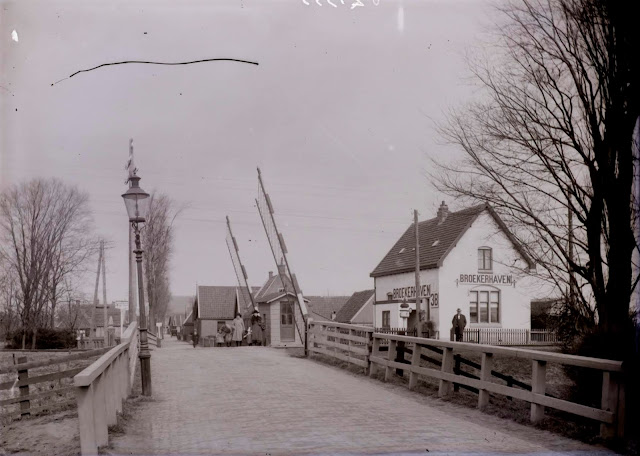
Railway crossing Broekerhaven. © Collectie Rijksdienst voor het Cultureel Erfgoed, BR00883-81355

Wednesday, 13 June 2018

Rustenburg-Berkhout 1908

Recently I acquired the following postcard which shows the Oostpoort in Delft:

Oostpoort Delft
By some curious coincidence postcards with this Delft city gate on them seem to have been regularly sent at strange times or from strange places. I possess, for example, some quite rare postmarks with 'night hour intervals' on several Delft gate cards. When sorting through a new collection of Delft postcards, the back of this particular one caught my attention:

Rustenburg to Berkhout, 1908

The postcard was sent from the hamlet of Rustenburg ( Resting Town = Quiet place), near Ursem ( House of Uri), to the town of Berkhout (Birch Forest) which is situated about 10 kilometers to the east. The Rustenburg cancel belongs to the Small Round Postmark type which was effectively the predecessor of the Berkhout type cancel (Large Round Postmark). The Rustenburg post office stayed in use until the 31st of December 1909, since the hamlet's proximity to Ursem made it probably not longer viable. The following contemporary maps give an impression of the distance between Rustenburg and Berkhout, as well as an indication of the vicinity of Ursem. 

Rustenburg to Berkhout

Rustenburg to Berkhout Small scale

Ursem (bottom) and Rustenburg to its northwest
The 18th of March 1908 was a Wednesday and the Rustenburg postmark reads 4-8N which means that the card was cancelled between 4 and 8 p.m. The Berkhout arrival postmark of the following day reads 12-4N (between 12-4 p.m.). Why did it take almost a day to travel between these almost neighboring places? Compared to other postcards I have this is remarkably slow...

Rustenburg Small Round Postmark on a Vürtheim 1 cent stamp which meets the printed matter rate of 1908. 

The sender of the card lived on the Noorddijk, east of Rustenburg. She misspelled her place as 'Noordijk' on the card, probably due to the way West Frisians pronounce Noorddijk. Not Nóórddijk with accent on the first syllable, but Noorddíjk with accent on the second syllable, making the first 'd' quite irrelevant. The same occurs with Ursem which should be pronunciation as Ursém not Úrsem as all the ignorant Hollanders do... 

The addressee was called Bavonia Bakker, a typical late 19th century West Frisian name, latinized of course, as the name is derived from Baaf(je). 


Oily forwarding mystery - Delft to Port Swettenham via Babo

Newspaper wrapper sent from Delft 17-1-1938 via Pladjoe and Babo to Port Swettenham via Singapore (4-6-1938) The newspaper wrapper shown abo...