Showing posts with label France. Show all posts

Sunday, 4 July 2021

Iron Rhine: from sand track to mud fight

Vlodrop Station
Signal House at Vlodrop along the Iron Rhine railway near the German border in the 1930s. The area surrounding Vlodrop has been declared a national park in 1990 which resulted in the closure of the railway.

To this day, needless disputes between nation states stand in the way of closer European cooperation. At a time when Europe should have a democratic response ready to destructive dictatorships and pandemics, stupid trifles such as border disputes ensure that the EU remains ineffective and, more importantly, indecisive when it comes to foreign policy and rapid action. Even closely cooperating states such as Belgium and the Netherlands deal with disputes which date back centuries. One example is the Iron Rhine, a railway which has fallen into disuse since the late 1980s and which once formed an important trade artery between Antwerp and the Ruhr area.

In the treaty of London of 1839, in which the actual division between the Netherlands and Belgium is recorded, both parties agreed that Belgium should reserve the right to establish a direct connection between Antwerp and Prussia through Dutch Limburg. During the ten years that Dutch Limburg fell under Belgian rule, the economy of Belgium had increasingly focused on the strong Prussian economy of the Ruhr area. The stipulation that eastern Limburg would become part of the Netherlands could mean a death blow for the port of Antwerp. A solution was therefore found in a connection in the form of either a new canal to be dug or a railway line to be built. Just as the right of way will continue to generate court cases for landowners, the international variant of it will also cause friction between two states.

IJzeren Rijn
Route of the Iron Rhine between Antwerp and Mönchengladbach and thereby crossing the Netherlands

The route of the to be established connection between Antwerp and Prussia already became a point of contention in the 1860s. Belgium saw the benefit of building a railway at the point where Dutch Limburg is narrowest: at Echt. The Netherlands tried to change the route to Northern Limburg. I believe that the interests of the regional economy played a major role in this. Although a railway line had already been built between Maastricht and Venlo in 1865, an East-West connection was still missing in North Limburg. Weert could thus be added to the Dutch rail network by means of a rail project – an this would partly be financed by Belgium. In the end it was decided to build a route from Hamont in Belgium via Budel, Weert and Roermond to Mönchengladbach. Instead of 15 km of track over Dutch territory, the final length of the route was almost 30 km! The Dutch concession was granted in 1873 to the Belgian Compagnie des Chemins de Fer du Nord de la Belgique. This concession would expire after 99 years in 1973. In 1879 the route was ready.

IJzeren Rijn
Route of the Iron Rhine in the Netherlands with Roermond right of the centre.

In terms of postal history the Iron Rhine railway has not overtly been spoiled with postal markings. Nevertheless there existed TPO (travelling post offices) on board trains which ran Roermond/Vlodrop v.v. and Budel/Roermond v.v. which used their own postmarks. Several stations along the route will also have had their own baggage office markers. It should be pointed out though that the share of domestic passengers on the route sections Budel-Weert and Roermond-Vlodrop was small. The Iron Rhine was mainly used for freight transport and international passenger trains. 

The border crossing between Belgium and the Netherlands near the town of Hamont is really curious from a postal history point of view. As early as 1810, in the middle of the wild Brabant moorland, there was already a border office where mail travelling to France was marked with the three-line Hollande/Par/Hammont marker. The choice of the Iron Rhine route therefore does not seem entirely coincidental. But why was this medieval town surrounded by peat and bracken a border office in the first place?

Hollande Par Hammont
Entire letter from Haarlem to Francomont near Vervier in French occupied Belgium (13-2-1810). The Marque d'entrée which reads Hollande/Par/Hammont was applied in Hamont close to Budel.

Since the Peace of Münster in 1648, the medieval town of Hamont had grown into an international hub for postal traffic. Mail from the Republic found the quickest way to the garrison of Maastricht and cities such as Liège, Aachen and beyond by crossing the border at Hamont. The central exchange point in the Netherlands being Alphen aan de Rijn where mail from several cities was collected before being forwarded to the south. Private initiatives were the basis of postal traffic in those days, but the strong economy of the Republic ensured a steady influx of correspondence. From 1667, postilions even carried out night trips to Maastricht. From about 1750 these private enterprises were gradually transferred to the States (State Post). The ride Alphen-Hamont and beyond was also maintained. 

In the Napoleonic period a postal treaty was concluded between the puppet Kingdom of Holland and the French Empire in 1808. Hamont and nearby Achel remained two important customs points en route to France. The Décret Impérial came into effect on 1 August 1809 and would eventually remain in effect until 1 April 1811. This in spite of the incorporation of the Kingdom of Holland into the French Empire in 1810 and the subsequent applicable declaration of all French laws and regulations. For the territory of the former kingdom, therefore, nothing changed until April 1 1811. The 1809 Décret Impérial stipulated that the Kingdom of Holland would be divided into 3 rayons or districts for the sake of a more unified rate calculation. This division surely had some benefits, but rate calculation remained a somewhat cumbersome practice. Four official border crossing points were created. One at Hamont and the Hollande/Par/Hammont border marker was created for outgoing mail. There was no Dutch equivalent for this marker. Incoming mail would incidentally be marked with a red crayon capital M (for Middelburg), B (for Breda) etc.  Because the Hollande/Par/Hammont marker was only in use until the expiration of the postal treaty on the 1st of April 1811, strikes are quite rare.

Hamont kaart
Hamont and surroundings during the time of the reunited Netherlands (1815-1830)

In contrast to the route of the Iron Rhine, which is oriented east-west, the previous postal route was north-south. A substantial difference. In this light, the two routes have only one common denominator: that both traverse Hamont. In recent years there has been much talk about a possible reactivation of the Iron Rhine with a view to international commuter transport and the active promotion of public transport in the context of climate laws. A first step has already been taken: the electrification of the still existing passenger line Mol-Hamont in Belgium. The Netherlands had stipulated this condition in order to realise the reopening of the Iron Rhine. One of the arguments with which the line was closed in the 1980s was the endangered fauna in the Mijnweg national park near Vlodrop, which was threatened by the diesel fumes of the freight trains. 

Vlodrop station
The disused stretch of railway at Vlodrop in 2007

Reopening can only take place if the route is fully electrified. But even now an important condition (the electrification of the Belgium stretch of railway) has been met, the reopening of the relatively short Hamont-Budel-Weert section of track is currently being derailed by the Dutch government. Prorail (the Dutch rail manager) estimates that the cost to reactivate and electrify the stretch would amount to a staggering 50 million euro's - which equals €5000 for every meter of track! The Flemish press now suspects that other interests are at play: if the section up to Weert is reopened, the reopening of the entire Iron Rhine will only be a matter of time. The port of Rotterdam has a lot to lose from this, as do Dutch rail carriers and therefore -  to continue this (railway) line of thought - Prorail as well. If (largely) green freight transport becomes faster and easier from the Ruhr area via Hamont to Antwerp, the Dutch state will suffer a loss of income. So the neoliberal spirit that (still) controls The Hague makes up enough arguments not to reopen the Iron Rhine for the time being e.g. the outrageous cost estimate. The result: an old-fashioned, vulgar border dispute  which is silently being fight out. The students and commuters living in East Flanders and for whom a direct rail link to Weert and from there to Eindhoven and beyond would be a great win, lose out on this political game. 

Let's hope that the old international post route through Hamont may inspire the Dutch state to put aside their nonsense arguments and old objections to solve this unhelpful obstacle for further EU cooperation.

A great Podcast on the recent mud fight over the Iron Rhine railway can be listened to here. Two journalist (Kato Poelmans and Timmie van Diepen) of the Flemish newspaper Het Belang van Limburg discuss the history and uncertain future of the line.  

Tuesday, 15 December 2020

Into the heart of New Guinea - The Central New Guinea Expedition of 1920

New Guinea
Postcard sent from Pionierbivak in December 1920 via Manokwari (early January 1921) to France, before being redirected to Rome in March 1921.

When interest in the western part of New Guinea grew at the end of the 19th century, Batavia - modern Jakarta - was faced with an extensive topographical job to map this huge island. Traditionally, the sultan of the small island of Tidore controlled this area after the Sultanate had reached a 'thin' agreement with the VOC in 1660. This agreement stated that "The Papuan areas, or similar islands, all belong to the King of Tidore." The VOC  closed this deal with the Sultan of Tidore without having any basic knowledge of the enormous archipelago (approx. 19x times the size current area of ​​the Netherlands, more than 2x the size of Germany). Only a few journeys were endeavored by the VOC to ensure that no illegal clove growers were active in this vast area. When it turned out that this was not the case, indifference to New Guinea rose to a degree which bordered on contempt, and this remained to be the case in the centuries that followed.

At times, Batavia feared that other colonial powers might be interested in this unexplored country. That this was a well-founded fear is evident from the efforts of the British Captain John Hayes, who claimed New Guinea for Great Britain in 1793 and founded a small stockade fortress which he called Fort Coronation. It took its occupiers three years - until 1795 - to abandon. Later Manokwari was built on this spot.

1920
Manokwari in 1920

Rather startled by this "surprise attack" by a British merchant and later in the 19th century by the Scramble for Africa, Batavia resolved to gradually colonize the area. It took until 1897 however before the colonial government decided to do so. In this year, two districts were formed: Northern New Guinea with Manokwari as capital and West and South New Guinea with Fakfak as capital. It was believed that the need for (limited) Dutch rule would also limit the unbridled power of the Tidorese sultan. Until the beginning of the 20th century, the monarch regularly held (illegal) slave raids in the Geelvinkbaai to obtain cheap manpower for his plantations.

In order to thoroughly explore the area, Batavia sent various military expeditions to the yet unknown heartland of New Guinea to colourize this white spot on the map. From 1903 scientific expeditions were also ventured. One of these scientific expeditions is known as the Central New Guinea Expedition of 1920, which aimed to reach the Wilhelmina Summit (now Puncak Trikora) in the central mountain range. In general, the scientific team also wanted to know which (unknown) peoples lived in the area between the so-called Meervlakte and the central ridge. In addition, five scientists focused on issues such as native flora, fauna, geology, etc.

Pionierbivak on the Mamberamo river is located in the most northwards pointing tip of the main body of West New Guinea (excluding the large Bird's Head Peninsula to the west). 

The Central New Guinea Expedition started in late January 1920 after the entire crew had gathered in Manokwari. From there they sailed about 400 km east before they entered the mouth of the mighty Mamberamo river on the  2nd of February. A military expedition had already explored this river and its headwaters in 1914 and had established some camp sites. A fascinating account (in Dutch) of this military expedition is available online: https://www.gutenberg.org/files/20167/20167-h/20167-h.htm.

New Guinea, Pionierbivak
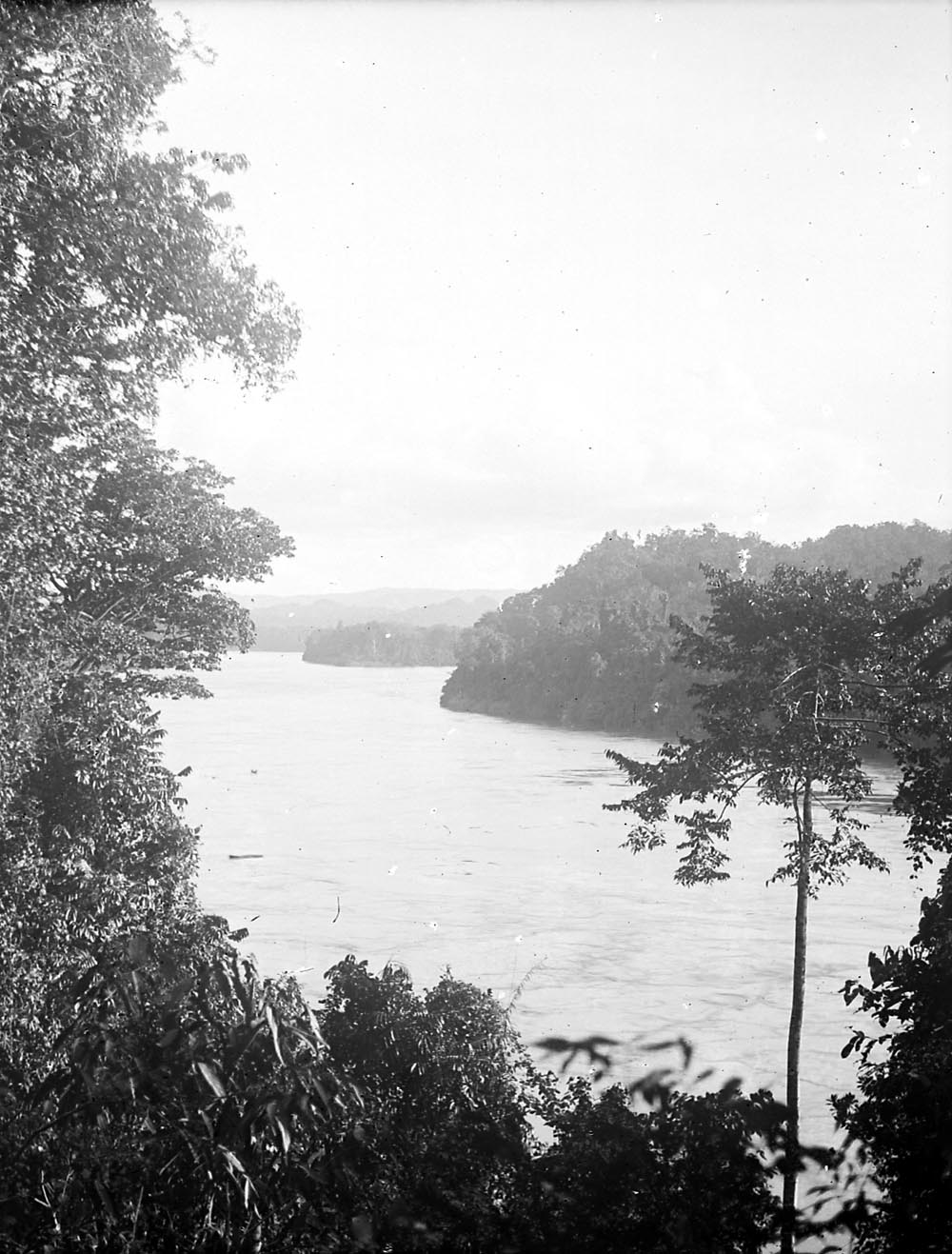
The bend in Mamberamo river near Pionierbivak

The main bivouac - called Pionierbivak (Pioneer Bivouac) - was situated along a strategic bend in the river. From the mouth of the Mamberamo it took several days to reach this place. From this "base camp" the Central New Guinea Expedition explored the dense flora and fauna of central  New Guinea. Besides, they encountered very friendly peoples near the central ridge. Not to be compared with the relentless headhunters around Merauke on the south coast!

1920
Pionierbivak in 1920 

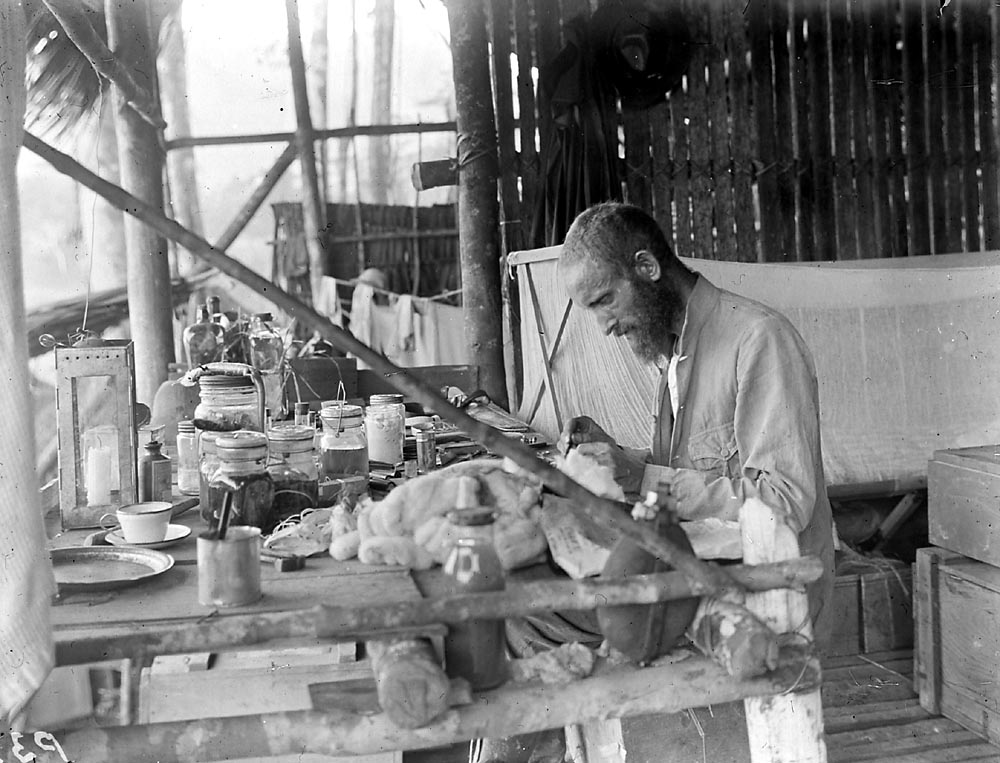
The journey of this postcard also starts in Pionierbivak. Although philatelic in nature, I am not aware of any other postal (value) item sent from Pionierbivak, let alone an item sent from another bivouac. The expedition maintained a regular freight link across the river and sea with Manokwari. The card was sent by the expedition's zoologist, Dr. W.C. van Heurn. W.C. van Heurn (1887-1972) was of noble descent and carried the title of Jonkheer (comparable with squire in English). His younger brother had studied zoology as well and was active in the Sultanate of Deli on Sumatra. W.C. van Heurn has been described by the famous biologist and author Stephen Gould as a "taxonomist's taxonomist". Van Heurn was a keen collector (and hoarder) of 'ordinary' (i.e. not rare) species such as the European Mole and Grove Snail. The Dutch Museum of Natural Science - Naturalis - still houses Van Heurn's collection in a wide variety of jars. Specialists often discovered new species in Van Heurn's diverse collection and no less than 38 species has been named after our author. 

Some members of the Central New Guinea Expedition in front of a shelter (possibly in Pionierbivak): Standing from left to right: zoologist W.C. van Heurn, Lieutenant J. Kooy, Lieutenant Drost, Botanist H.J. Lam; Sitting: Medical Officer H.J.T. Bijlmer and Controleur J. Jongejans.

The addressee was a Frenchman who often asked Van Heurn to send him cards. The postcard was probably written in early December 1920 but was not postmarked in Manokwari until  (1) 4 (?) January 1921. Upon arrival in France in March (?) 1921, the postcard was forwarded to Rome. 

Nieuw-Guinea
The zoologist and writer of the postcard - W.C. van Heurn. This photograph was taken inside his hut in Pionierbivak. He probably wrote this very postcard at this desk.


Postcard
The reverse side of the postcard with written 'Pionier-bivak' and Dec. 1920. The rather formal message was written in French. 

1st update: 7th of April 2021 - new photo, text additions Van Heurn

Sunday, 30 December 2018

Biak to Nice - Netherlands New Guinea

Netherlands New Guinea cover
Netherlands New Guinea cover, sent from Biak to Nice, France on the 17th of September 1962
The cover shown above was sent by Lieutenant Colonel G.J.B. Veenhuys to a real-estate agency in Nice, France. Veenhuys was stationed at the marine corps barracks on Biak, an island which is situated in the so-called Geelvink Bay in what is now Indonesia. Besides its strategic location, the city of Biak is equipped with an airport: ideal for defense operations. 

Situation of Biak (green) in the current province of West Papua
On the 1st of October 1962 the Dutch government would transfer the colony to the United Nations Temporary Executive Authority and on that same day most of the Dutch troops were repatriated to the Netherlands. Dutch citizens were repatriated as well, an estimate of 12.000 citizens still lived in the colony by mid 1962 and all were eager to return to the Netherlands, especially after it became clear the colony was to be transferred to Indonesian rule. In order to cope with this evacuation the Dutch government opened an airbridge between Biak and Schiphol. This operation was called Spectrum and was ready in August 1962. Because of the threat of war many people made use of this service, but civil servants had to remain in the colony until the 1st of October. When this date had finally past, 2540 servants which were still on duty could return to the Netherlands. Only 800 of them stayed behind to take care of an orderly transfer to UNTEA rule. The last Dutch soldiers departed Guinea in late November 1962 (1).   


copyright Rinus Peperkamp
Dutch Submarine Dolfijn departs Biak on the 1st of October 1962, © Rinus Peperkamp
The rate of a letter with destination Europe was 65c in 1962 and Colonel Veenhuys stamped his envelope accordingly. I'm not so sure how the airmail fee is included in this rate, but the cover clearly states 'by airmail' and the postmark reads Biak Luchthaven (airport). So, the cover obviously went by plane to  France, and therefore it seems to me that the airmail fee was already incorporated in the 65c.

Nederlands Nieuw Guinea postzegels
20c bird of paradise and 45c Juliana en profil
In my previous post I mentioned that NNG covers sent to other countries than the Netherlands are quite scarce, especially if they are not philatelic. I do wonder how many (non-official) NNG covers  were ever sent to Nice or even France as a whole! Couldn't be more than a couple of thousands, since at its peak by mid 1960 there only lived a mere 18.000 Dutch citizens in Netherlands New Guinea. (1).

Hollandia together with Biak were the only two places in the whole of NNG were considerable amounts of mail were processed. Several NNG postmarks was used quite often apparently, so that the post deemed it useful to insert a time indicator as well. So we even know that this piece was posted at 11 a.m. This additional time stamp might have been helpful for NNG domestic mail - though even domestic mail took more than one day travelling - but for locations abroad it seems quite ridicule. Bureaucracy at its finest. 

(1) Meijer, H. (2007),  'Daar heb je ze weer': de overkomst van overzeese rijksgenoten uit Nieuw-Guinea bezien in het perspectief van de algemene repatriëring uit de Oost in Transparant, 18.2:18-25

Wednesday, 19 December 2018

Netherlands New Guinea - a short history

Steamboat connections 1915
Map of New Guinea with an overview of steamboat connections in 1915, published in Batavia
After the Dutch East Indies became independent Indonesia in 1949, there remained several disputes unresolved between the new republic and the Netherlands. One of them was the gigantic province of New Guinea which equals Poland in size and which landmass is about 8 times larger than the Netherlands. Nevertheless, in 1949 there existed little to non Dutch colonial activity as it was never deemed profitable for proper cultivation. Besides, the Netherlands only barely started exploiting the enormous amount of natural resources on Sumatra and Borneo in the 1930s. In short: there was no real interest in New Guinea, apart from some colonial internment/concentration camps for Indonesian / Communist independence activists from 1926 onward. The local tribes which inhabited this large island mainly covered by tropical forest remained undisturbed.

Photograph of a bay on the north coast of New Guinea. This photo was taken by Gijsbert van der Sande on the 1903 North New Guinea expedition. One of the first Dutch scientific expeditions on this vast island. Tropenmuseum Collection.
This all changed in 1949 when Indonesia became independent. To ratify its independence the Netherlands had to agree politically on the the issue. This turned out to be quite a difficult matter. After two years of war against the independence movement the Netherlands was forced by the U.S.A. to settle the dispute. So shortly after WOII, the Netherlands was heavily depended upon the states for financial aid and supplies. More than 50% of the Dutch population held a negative opinion about an independent 'Indië'. This attitude created a major dilemma: it proved to be struggle to find a majority in the 2nd Chamber (Dutch lower house) to ratify the independence treaty. Moreover, Sukarno's highly dubious position regarding his collaboration with the Japanese during WOII created many additional problems for the then ruling PvdA to 'sell' this deal to the Dutch people. To cope with this political problem the PvdA proposed an unilateral addendum to the treaty: that the Dutch could retain control over New Guinea for the time being. This made it possible for the PvdA to get a majority in the 2nd and 1st Chambers and it softened the loss of the 'emerald girdle', a cognomen Multatuli once devised to describe the 'Oost'.

1949
Sukarno in 1949
Of course this 'addendum' was a major blow for Sukarno, but he grudgingly accepted: he probably reasoned that it was now or never for his independent Indonesia. As stated above already, New Guinea was deemed uncultivated, inhospitable and wild in Dutch eyes. Sukarno likely reasoned the same: the vast country was of no necessity for the young republic at the moment and more importantly, there lived little to none Indonesians.

The old colonizer happily proclaimed 'Netherlands New Guinea' as their new colony and transported a small army of dignitaries, officials and soldiers to its new capital which was known as Hollandia and was situated close to the border of Australian territory of Papua and New Guinea. During the early 1950s Australian became a friend of the Dutch regime since it feared a communist led Indonesia bordering its province. Strengthened by this newly gained trust from Western allies, the Dutch government put the idea of handing New Guinea over to Indonesia in the 'refrigerator' as we say in Holland. We shelved the plan.

Sukarno felt obviously belittled over the matter and raised the stakes: he expelled Dutch Indonesians, attacked the Moluccans in 1950 and threatened to stop trade with its former colonizer. From 1957 onward relations between the two countries grew even worse: strikes in Dutch factories in Indonesia, trade bans on products imported from the Netherlands etc. Sukarno did everything to drive the Dutch government to the limit. Together with the under performing New Guinean economy and local resistance made it clear that Netherlands New Guinea wasn't meant to be for the long term.

Tensions reached boiling point in 1959 when a nationalistic government was created in the Hague. Cabinet De Quay was in favour of keeping New Guinea and it made it possible for Dutch conscripts to fight in colonies overseas. This policy made it easier to send troops to New Guinea, which lacked an army of its own. Meanwhile, Indonesia had developed an army which could easily take possession of the last bit of Dutch-possessed land if Sukarno wished. Still, he didn't know for sure how the U.S.A. would react if he dared to make such a bold move. Communis opinio had it that the U.S.A. supported the Dutch cause in this matter....

De Quay Cabinet bordes scene after Queen Juliana appointed all members by royal decision in Huis ten Bosch Palace - 1959
This all changed in late 1960 and 1961 when the Netherlands sent its troops to New Guinea: it turned into a diplomatic fiasco and was an absolute failure. The sabre rattling probably caused the U.S.A. to shift its position about the issue. Kennedy wanted to avoid a second conflict in Asia at all costs. He thought that the Netherlands provoked Indonesia which lured Sukarno into communism. He could buy plenty of weapons in Russia...

In the end Netherlands New Guinea fortunately saw little fighting between Dutch and Indonesian troops and in early 1962 De Quay made it clear he would like to negotiate with Indonesia about the transfer of power. In the meantime  a temporary executive authority led by the United Nations (UNTEA) would be in charge over the former colony. The Dutch left the colony on the 1st of October 1962, Indonesia took possession of it on the 1st of May 1963.

During the short existence of Netherlands New Guinea, it issued its own stamps- some of them were overprinted with UNTEA in 1962. Since not many Dutch officials lived in the colony and many of its native people were illiterate, its postal history is fairly unknown and real (non-philatelic) items are quite scarce. Especially covers from smaller towns and villages are sought after, as well as interesting locations to which covers were addressed. Most of them were sent from its capital, Hollandia, or Biak (airfield) to the Netherlands. Other destinations are quite rare. In my next post I will tell you something about the cover below, which was sent to France!

Wednesday, 26 September 2018

A wrecked French Brig


Cover Vlieland to Amsterdam 1871, Naamstempel Vlieland, Tweeletterstempel Den Helder
Cover which travelled from the island of Vlieland to Amsterdam in November 1871
Sometimes you just stumble upon an interesting piece of postal history by chance. A few weeks ago I enjoyed such a moment when I discovered the envelope depicted above. At first sight a very ordinary cover and - to be honest - even a bit ugly because of  the discolouring of the lower half. Still, I found myself struggling to put it aside and continue my search for covers which would suit my collections better. Several reasons tempted me though not to put the cover aside:

  • The unusual location from which the cover was sent: the isle of Vlieland. 
  • The unusual addressee of the cover: the French ambassador/consul to the Netherlands.
  • The mysterious and quite attractive red wax seal on the reverse (see below).

In the end I bought the cover...

Vlieland
In November 1871 Vlieland could consider itself as the least populated island of the Dutch Frisian Islands (Dutch: Waddeneilanden). Only about 650 souls inhabited the elongated sandy stretch of land and most of them earned their living from fishing and occasionally they plundered wrecked ships...

Locations of the isle of Vlieland (upper arrow) and Amsterdam (lower arrow)

It needs no explanation that most of the Dutch were unaware of the nature of the island, since back in the 1870s tourism wasn't as thriving as in 2018. Nowadays a large ferry shuttles between the island and Harlingen in Frisia which brings thousands of tourists to Vlieland every summer. The island's actual population though remains still quite small: about 1.100 people. The island today belongs to the province of Frisia, although the dialect and more cultural aspects share more resemblances with Texel and North-Holland.

The isle of Vlieland with its sole village Oost-Vlieland on the southeastern side.
Postal pieces travelling to and from the island went by ship via the neighbouring island of Texel to Den Helder in North-Holland. Our piece travelled this route too.

Postmarks
The "Vlieland" town name marker (see below) was placed in blue ink on the cover before reaching the first proper (main) post office in Den Helder. Only main post offices were allowed to cancel the stamp when a postal item travelled beyond the border of a postal district (rayon). In 1871 this happened by the combination of a so-called "hour postmark with letter" (departure) postmark reading Den Helder 4A-8A and its corresponding numeral postmark 53 which was used for the actual cancellation of the stamp. 

3e Emissie NVPH 7 Willem III 5 cent nummerstempel Den Helder
Numeral Cancel of Den Helder '53' on a King William III 5c blue (1867-68): Scott 7/NVPH 7 
Tweeletterstempel Den Helder 1871 4A-8A
Den Helder's Hour Postmark with Letter reading "24 NOV 71 / 4A-8A" 'A' stands for the Dutch Avond (evening), so this interval means between 16:00-20:00. A bit inconvenient and therefore replaced by a more logical postmark from 1877 onwards.

Naamstempel / Langstempel Vlieland 1871 blauw
Vlieland Town Name Marker in blue
Although both the Den Helder numeral as hour postmark are quite common to find (even on complete postal pieces), the Vlieland Name Marker is scarcer on piece. This is of course due to the relative isolation and the low population number of the island. There was no real need of an advanced and speedy postal service so Vlieland always remained a sub-post office.

Mysterious sender
How odd it is then that the cover above was addressed to French ambassador to the Netherlands (Le Consul Général) in Amsterdam? My first guess was that the cover carried a request made by an inhabitant of Vlieland because he/she wanted to settle in France. Odd indeed, but I couldn't think of anything else until I closely looked at the wax seal on the reverse.

Lakzegel / Red wax seal
Wax Seal of ?  
Initially I was inclined to see the ornament above the proper shield as the French Fleur-de-Lis. Now I am not so sure anymore, but this initial thought gave me the impetus to look beyond Vlieland's horizon for other reasons why this letter could have been posted. Could this cover has been sent by a French delegate or attaché for instance? An attaché reporting on French trade with Vlieland? Very unlikely, but I continued my search on the great online resource of Dutch newspapers delpher.nl and curbed my search results "Vlieland", "Frankrijk" and "1871" to the months of October, November and December. After 10 minutes or so the following entry caught my attention (Leeuwarder Courant, 05-12-1871):


~
Public Sale
 Vlieland
On Monday the 11th of December 1871, half past ten in the morning Mr L. Zunderdorp will sell by court order of the right honourable Consul-General of France to the Netherlands and in presence of bailiff P. Hoedemaker on Vlieland 
The Body or Vessel  
of the French Brig Adèle, Capt. Frouillon, which headed for St. Malo (Frankrijk) from Sundsvall, but now lays wrecked on the northern shore of Vlieland, approximately a half hour walk from the village of Vlieland, as well as the rigging of the ship, consisting of: Anchors, Chains, Cables, Hawsers, Ropes, Ironwork, Blocks, Sails, Spars, Water casks etc. etc.

- Then a piece about the cargo of the ship: pine and fir wood sheets/plates -          

For more information you could apply in writing to the French Consulate near the Weteringbarrière, B B 153 in Amsterdam, as well to Mr L. Zunderdorp on Vlieland.
~
So there we are! Our cover very likely contained a message about this stranded French vessel. I continued my research and soon afterwards I found two very short articles in which the shipwreck was being reported. The first is from the Algemeen Handelsblad of 19-11-1871:

  
~
Shipping Reports
Amsterdam, 17 Nov. The French Brig Adèle, capt. Trouillon, headed for St. Malo from Sundsvall has run ashore on Vlieland last night according to a telegram from the island today. One man perished in the event ; the cargo is being salvaged.  
~
The second article is from the Helderse en Nieuwedieper Courant of the same date:


~
-- Last night the French brig Adèle, capt. Troullon, run ashore on Vlieland, carrying timber from Sundsvall to St. Malo. One of the rig men drowned, all others have been rescued.  
~

Apparently this ship, Adèle, ran aground on the 17th or 18th of November: the two reports differ on the exact night. That makes 6-8 days for its captain (or a French attaché) to have sent our cover to Amsterdam. Bearing in mind that Vlieland certainly wasn't an easy place to reach in these days, I think it was the captain himself who sent the letter. Maybe he had already sent another one earlier on, or - because of the unknown territory he set foot on - he waited a few days in order to sort everything out before he updated the Consul on the dire situation. 

Alas, I haven't found any information on this particular ship and on its captain Trouillon. I will update this post whenever I have found some additional (and eagerly wished for!) details. Obviously no waste of money this cover!    

Lakzegel en tweeletterstempel Amsterdam + bestellersstempel
Reverse of the cover with wax seal, Amsterdam Arrival Postmark (12M-8M: between 12 p.m. and 8 a.m.) and Post Man Mark indicating this cover  has been delivered during his first round of the day (on the 25th of November).

Oily forwarding mystery - Delft to Port Swettenham via Babo

Newspaper wrapper sent from Delft 17-1-1938 via Pladjoe and Babo to Port Swettenham via Singapore (4-6-1938) The newspaper wrapper shown abo...