Showing posts with label railway stamp. Show all posts

Saturday, 30 May 2020

Catching the 19:58 train from Hoogkarspel


Hoogkarspel
1940 express delivery cover which was sent from Hoogkarspel to The Hague by semi-private
 train mail. Rate: 10c (letter over 20 g) + 10c express delivery fee + 10c railway fee.  

In 1924 the Dutch postal service (P.T.T.) came to an agreement with the railways which allowed any railway company who signed up to this agreement to run their own station to station express delivery service. This new semi-private postal service had speed and its regular time-table as a big advantage over the ordinary mail system. Especially small railway towns and villages which used to see a once-a-day collection profited from this service. Initially the agreement between the P.T.T. and the railways was limited to express delivery only. From 15 May 1927 onwards however ordinary postcards and letters were allowed as well.
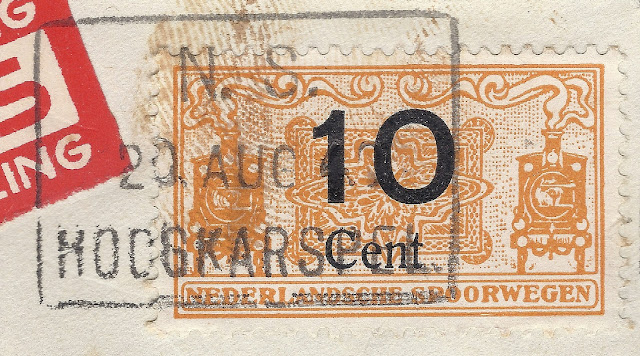
Hoogkarspel stempel
10c railway stamp cancelled by a boxed N.S. Hoogkarspel railway postmark. To this day (May 2020) there doesn't exist a compendium or even a list of these boxed railway hand stamps (bagagebureaustempel).   

Of course the railways charged a fee to finance their new service. Customers had to buy a 10c railway stamp at the station on top of the ordinary (express) letter rate. The cover would be handed over to a railway clerk at the luggage office who would take care of the right train and who would give instructions to the conductor: where the piece should change trains etc. At the station closest to the destination the item would be handed over to the P.T.T. for the final leg. 
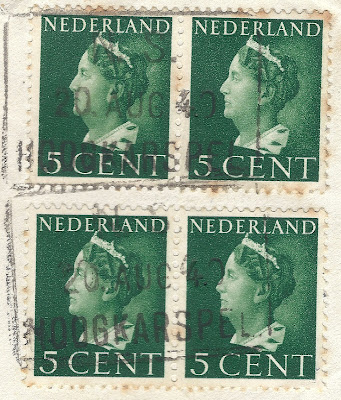
Hoogkarspel postzegel
4x 5c green Wilhelmina Van Konijnenburg 

The cover which serves as illustration to this blog was picked up by the N.S. at Hoogkarspel and travelled with train 374 (blue pencil mark) which departed at 19:58 that evening (20-8-1940). Although the Dutch queen and cabinet sought refuge in the U.K. after the Germans invaded the Netherlands in May of that year, people still used stamps with her portrait. Reichskommisar Seyss-Inquart declared them invalid however on 10-10-1940. The P.T.T. stamps and the additional 10c railway stamp were cancelled by a boxed N.S. Hoogkarspel railway hand stamp. The express delivery was highlighted by the red Exprès label (type 37 L). Unfortunately the cover didn't make it to The Hague the same day. The arrival date stamp on the reverse makes clear that the item reached the capital on Wednesday 21-8-1940 between 9 and 10 AM.

Hoogkarspel station
The old railway station of Hoogkarspel. Sadly this station was replaced in 1965.

Thursday, 12 July 2018

Netherlands 1939: Dutch express letter by train

Apart from my interest in retrieving information about senders and addressees, contents and messages, I occasionally include covers / postcards in my collection because the postal rate or postal markings intrigue me. The cover below is such an example:


This letter was sent to the 'Dutch agricultural head office' by making use of the Dutch express service. Voermans & Backx had to pay 10c extra to make this a valid express letter. The label 'Spoedbestelling / Exprès / Spoedbestelling' was hence applied which made the PTT aware that this was a special delivery. In these days - and today still - the service was provided for by a separate agency of the postal service, which meant that 'ordinary' postmen weren't allowed to process the item.  

If you carefully read the address of the sender (Voermans & Backx) you might notice that this company which traded in agricultural products was situated alongside the 'Stationsstraat', Dutch for Station Road in Roosendaal. The combination of this address and the unorthodox cancel made me flip the cover: 


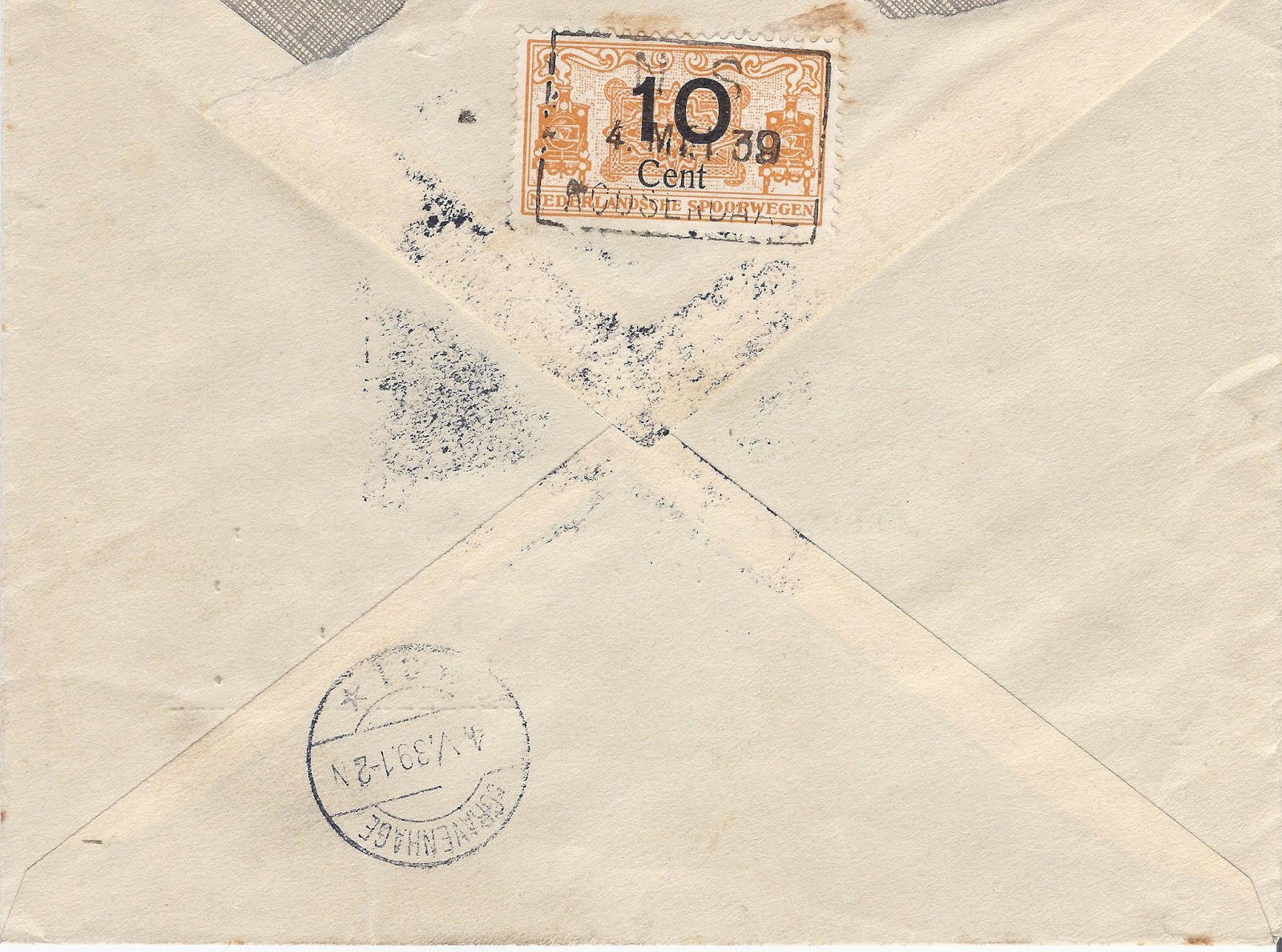
A third stamp is glued to the back flap of the cover! And it is no ordinary one:  


It turns out to be a so-called 'Railway stamp', a type of stamp which was used by various countries in the world to pay the cost of the conveyance of a postal item by train. A steam locomotive adorns the stamp and the text reads: Nederlandse Spoorwegen: the Dutch Railways (NS). 

The marvelous book about Dutch express delivery by Arie Zonjee and Ot Louw (2013) devotes a chapter to the Dutch Rail Express Service:

From 1924 onwards the Dutch Railways (NS) made it possible to send express items by train. In order to do so, the sender had to pay the standard PTT Express fee of 10c + and an extra Train Express fee of 10c. The Dutch Railways produced their own stamps in order to comply with this service. The guard on the train took care for the items during the ride. The (Railway) stamps were to be cancelled with a NS cancel of the local luggage center from which the items were being sent. 

The example above was cancelled at Roosendaal Station on the 4th of May 1939 and arrived in The Hague the same day between 1 and 2 p.m. 

Why did the sender chose to sent this particular cover by train instead of the ordinary service? Maybe this was the fastest way to get the letter from a to b. I doubt this, as the ordinary express service would be almost as fast. Maybe the station was easier to reach than the main post office of Roosendaal. Quite possible, but - then again - most railway stations had a PTT office as well... Oh well, it makes a fine example of a Dutch train cover after all!


Oily forwarding mystery - Delft to Port Swettenham via Babo

Newspaper wrapper sent from Delft 17-1-1938 via Pladjoe and Babo to Port Swettenham via Singapore (4-6-1938) The newspaper wrapper shown abo...