Showing posts with label tiara. Show all posts

Thursday, 8 November 2018

Sparkling tiara's on Curaçao stamps

Last but not least in this series of studying Wilhelmina's tiara's, we will cross the Atlantic to the Dutch Caribbean. Although all stamps during Wilhelmina's reign carry the name 'Curaçao', they were used on the other Dutch Antilles as well (Aruba and Bonaire and St. Maarten, St. Eustatius and Saba). We will see that most designs match the Dutch Indies stamps, starting with the Veth 1903 series. By 1916 the new series by Seegers and Harting was introduced:

postzegel, stamp, NVPH 64
NVPH 64 - 1915 - Queen Wilhelmina 22 1/2c
postzegel, stamp, NVPH 68
NVPH 68 - 1916 - Queen Wilhelmina 50c


I always felt these designs suited the Dutch possessions in the Caribbean much better than the Dutch Indies territories. This 'feeling' might result from the fact that the Seegers' design only displays an empty horizon and a lonely ship. When thinking of the Dutch Indies I always imagine mighty volcano's and inaccessible mountain ranges which are draped in dense tropical forests. The Dutch Antilles on the other hand remind me of small windswept islands exposed to hurricanes, the sea and whatever more. The Seegers' 'lonely ship' design nears this feeling the closest, but Harting's design with its plain palm trees does invoke this same 'barren' atmosphere. Only when you try very hard, you will uncover the mystic mountain ranges of the Indies:

Detail of NVPH 68 with focus on the mountain ranges
When we continue we will see Cheffer's Jubilee design of 1923 again, which I decided not to review here again - see this post for his design.. Unlike the Dutch Indies however, the colony of Curaçao decided to grant these stamps a second life as definitive series by slightly altering the frame. It appeared between 1928 and 1930:

postzegel, stamp, NVPH 89
NVPH 89 - 1930 - Queen Wilhelmina 6c
I don't know if this design does the trick: I find myself somewhat puzzled by the three ships. I think that Mr Seegers tried reworking the frame, but he pushed the design too far by engraving three seemingly random ships below the queen in my modest opinion. I think it would have better suited the stamp to have only one ship displayed or a combination between the outline of an island and a single ship -  or even better: no display of ships at all. 

postzegel, stamp, NVPH 126
NVPH 126 - 1936 - Queen Wilhelmina 6c
Next comes a stamp which was only used on the Dutch Antilles and in Suriname, since the Dutch Indies had their own iconic square Kreisler stamps. Of course I do not want to suggest that this stamp is inferior to Kreisler's design, but I have to admit it is a bit dull ... On the other hand the designer - Mr Mees -  chose to depict Wilhelmina with a veil. This really makes her a bit magical and quite exotic. A remarkable choice and therefore the design will get my stamp of approval nevertheless. Wilhelmina seems to wear three strands of pearls on a plain tiara. I seriously doubt if Wilhelmina ever possessed a jewel of this kind.

postzegel, stamp, NVPH 138
NVPH 138 - 1938 - Queen Wilhelmina 1 1/2c
We will end with the ruby jubilee stamps which were a shared issue between the Netherlands, Suriname, Curaçao and the Dutch Indies. Mr Koch made a fine drawing of Queen Wilhelmina with the massive Wedding Gift Tiara which was so quickly dismantled after Juliana became our queen in 1948. A very stylized stamp.

Wednesday, 7 November 2018

Sparkling tiara's on Dutch Indies stamps

In my previous post I wrote about the various tiara's worn by Queen Wilhelmina which appear on Dutch stamps. Now time has come to do the same for Dutch colonial stamps (Curaçao and the Dutch Indies). While some colonial series share resemblances with Dutch stamps and are based on the same photographs, various series belong solely to the colonies. They really give you a more exotic impression when compared to the quite frugal Dutch designs. We will commence with the Dutch Indies.

Veth 1903
The first Dutch Indian series of Wilhelmina was designed by Jan Veth and introduced in 1903. Veth was also responsible for the definitive 1924-1930 series which was used in the Netherlands. His 1903 Indies design was even more attractive than his Dutch series in my opinion. Have a look at this 10c overprint variety:

postzegel, stamp, 1908
NVPH 88 - 1908 - Queen Wilhelmina 10c 'Buiten Bezit' overprint

Even with the heavy postmark and obtrusive overprint the stamp still possesses a simple grace. The overprint 'Buiten Bezit' indicates that this stamp was meant for post offices in the Dutch Indies which were not located on the isle of Java. Since this island was the first real colonial property of the Netherlands, officials used the term 'Buiten Bezit' (~ outer possessions) for the numerous other islands, especially Sumatra, Celebes and Borneo.  

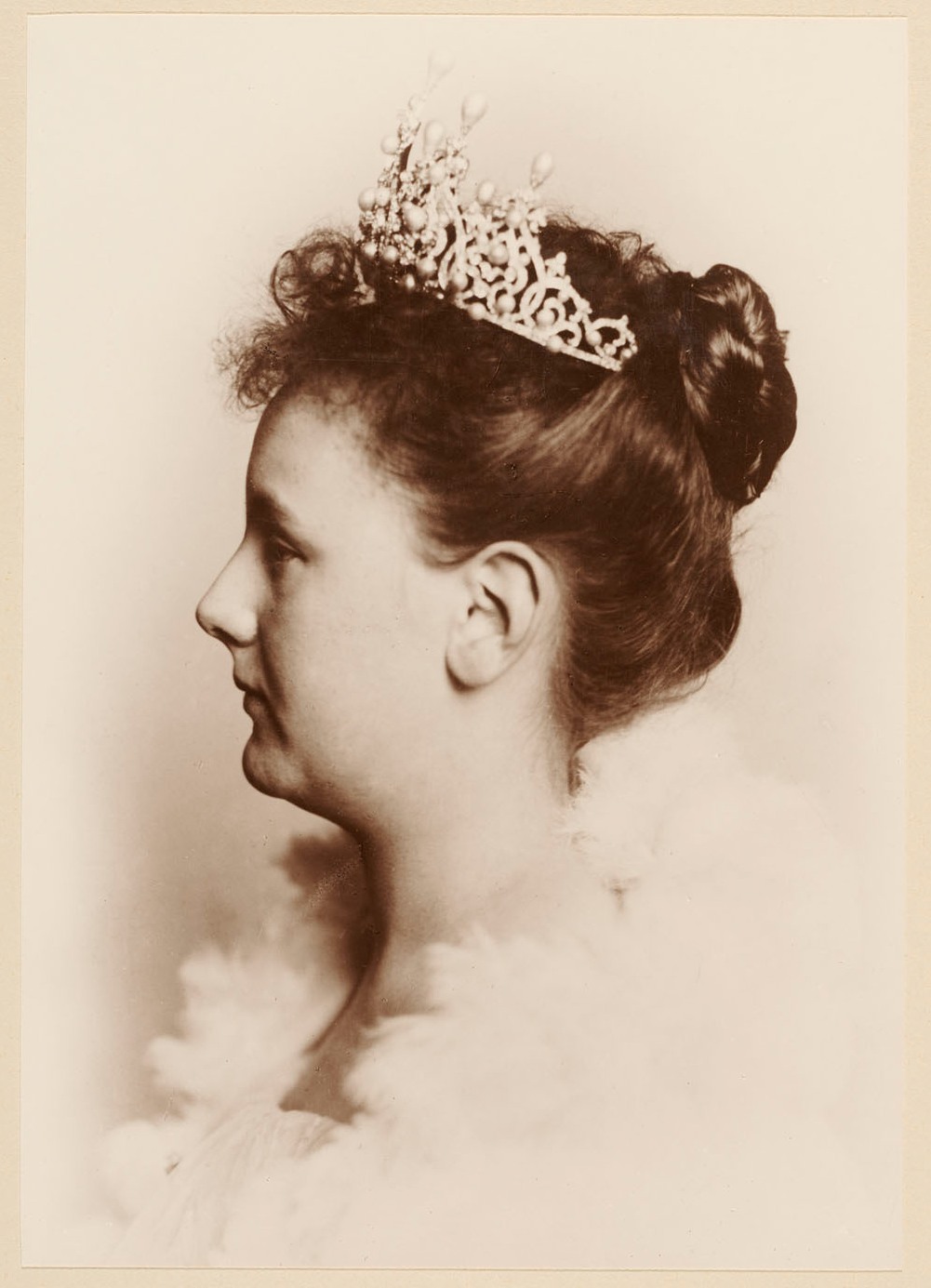
Queen Wilhelmina 1897 photograph
I'm convinced Mr Veth used the photograph above for his design, the same photograph which was used for the Dutch 1899 Mouchon 'Fur Collar' stamps. Wilhelmina wore her Württemberg Ornate Pearl Tiara on that occasion but I have to admit Veth didn't succeed in engraving this tiara. He has turned it into a rather clumsy diadem on his stamps. 

postzegel, stamp, dienst, 1911
NVPH D26 - 1911 - Queen Wilhelmina 1g 'Dienst.' overprint
The stamp above belongs to the same series, but is larger in size (together with the 2 1/2g) and is embellished with two Olympic gods (Hermes and Ceres) and two ships in its frame. A very handsome design, although this particular one is gravely ruined by the 'Dienst' overprint. 'Dienst' stamps are officials.

Seegers and Harting 1913

postzegel, stamp, 1914
NVPH 120 - 1914 - Wilhelmina 20c
In the early 1910s H. Seegers designed a new series of stamps, to be used in the Dutch Indies, Curacao and Suriname. A plain engraving showing Wilhelmina en profil and a lonely ship was used for the lower values up to 50c. From 50c onwards a more elaborate and a larger stamp was used, designed by D. Harting (see below). I daresay both designers used the 1897 photograph again (15 years after it was made...) and Harting obviously did a better job. Wilhelmina's ear on Mr Seegers' stamp is simply too grotesque.  

postzegel, stamp, 1913
NVPH 132 - 1913 - Queen Wilhelmina 1g
What I do like when looking at Harting's stamp is the very exotic though elegant framework. Much attention has been given to design the denomination and country designation, which makes me think of this stamp as a particularly charming one.     

Jubilee 1923

postzegel, stamp, 1923
NVPH 162 - 1923 - Queen Wilhelmina 20c
In 1923 Wilhelmina had reigned for 25 years: a jubilee which the P.T.T. did not miss. In the Netherlands and the colonies series of stamps were issued which commemorated her achievement. The colonial stamps differed a great deal from the Dutch series, which was designed in art deco style. The stamp above though can be described as very conservative and '19th centurish', but was apparently deemed perfectly apt for the Dutch colonies associated with all their opulence and richness. We see a heavily illuminated frame surrounding Wilhelmina who wears a grand diadem. You could almost imagine that this diadem should be called the 'pearl of the Indies' when taking its gigantic proportions into consideration. Not frugal at all and very un-Dutch. On top of this she wears an eye-catching necklace. 

1923 photograph by H. Deutmann
In the archives I found the photo on which the series was based. Cheffer made the excellent engraving, whilst Seegers resorted to the framework. He probably hadn't forgot his clumsy ear (nor had the P.T.T.), but he made it up by lovely adorning this series. Wilhelmina wears the so-called Wedding Gift Tiara. Because of its gigantic proportions her daughter - queen Juliana - had dismantled the parure when she became queen. Maybe she thought it a too opulent display for the Netherlands, especially after we lost the Indies in 1949.  

Kreisler 1934

postzegel, stamp, 1934
NVPH 196 - 1934 - Queen Wilhelmina 12 1/2c
To complete the Indies diadem tour, we cannot exclude Kreisler's magnificent 1934 Wilhelmina series. Why magnificent? Well, he dared to present the P.T.T. with a square stamp design. That was a first and a gamble. Moreover, his design consists out of a very humble but at the same time proud depiction of the queen within a neat though elegant framework. This and the combination of native art with two important Dutch elements (shipping & infrastructure) makes the stamp truly iconic. Where the 1923 jubilee series overwhelms you a bit too heavily, this stamp does not make any presumptions. That's quite an achievement, since Wilhelmina is depicted with her Wedding Gift Tiara again. Kreisler didn't make this diadem look preposterous though (a feeling which I got with the jubilee series), since the diadem softly sinks away in her hair. Very refined. 

Wednesday, 24 October 2018

Sparkling tiara's on Dutch stamps


Last night a grand state banquet was held in Buckingham Palace in honour of the state visit of King Willem-Alexander and Queen Maxima to the United Kingdom. A historic state visit, since Willem-Alexander is the third (!) monarch of the Netherlands to visit the U.K. during Queen Elizabeth’s reign. Whilst Brexit was certainly discussed, the king’s speeches to the U.K. parliament and Queen Elizabeth stayed both very diplomatic (as was expected) and amicable.  

In the months and weeks prior to the state visit, many royalty experts eagerly discussed the possibility of Queen Máxima wearing the so-called Stuart Tiara (and accompanying parure) which was last worn by Queen Juliana (reign: 1948-1980) in the 1970s. Her daughter queen Beatrix (reign 1980-2013) never seemed to have worn the set in public. She might have had her personal reasons not to wear it, but certainly its absolute stunning extravagance (see photo below) will not escape anybody's attention. 

Queen Juliana

The tiara itself is massive and was ordered by Queen Emma for her daughter Wilhelmina on the occasion of her inauguration in 1898. Its absolute piece de resistance is the fabulous Stuart Diamond which has been in possession of the Dutch royal family for centuries. Stadtholder-King William III of the Netherlands and England acquired this uncut diamond for his wife Mary in 1690 and in the same year an Amsterdam diamond cutter polished it into a heavy 39,75 carat gem.
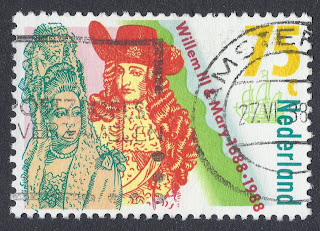
Willem III
NVPH 1407 - 1988 - 75c
Some people deem the tiara itself already over-the-top, let alone with the Stuart and the accompanying diamonds added! Queen Máxima however did not think it was too pompous and – to the absolute delight of many royalty fans and gemmaphiles – the Stuart sparkled on the queen’s head yesterday after decades in the Dutch royal vault.

Stuart diamond
Queen Máxima with the Stuart Diamond tiara in Buckingham Palace yesterday
This story inspired me to look at Dutch (colonial) stamps bearing engravings/photo’s of queen Wilhelmina and Juliana, as I knew some of them depicted tiara’s as well. Of course I wondered if the Stuart tiara was ever portrayed on a Dutch stamp… I soon found out though that it proved very hard to precisely determine the small and sometimes roughly engraved tiara’s. Moreover, it appeared to me that some tiara’s on these stamps seemed to have vanished altogether…or even never existed in the first place. Please read my report below. In this particular post I will pay attention to tiara’s on Dutch stamps only. Mu next post will discuss Dutch colonial stamps.

Inauguration of Queen Wilhelmina and subsequent 'Fur collar' series

NVPH 77
NVPH 77 - 1899 - Queen Wilhelmina 1g
On the occasion of Wilhelmina’s inauguration in 1898 the P.T.T. issued a so-called inauguration stamp which is almost identical to the stamp above. This stamp though is part of the high value definitive ‘Wilhelmina Fur Collar' series which is considerably cheaper than the real inauguration stamp...and therefore saves me some money.

When we look closely we see that the young queen wears a tiara – but after an even closer inspection we observe that it is not the Stuart tiara, which was specifically made for her inauguration! A real shame she was not portrayed with the Stuart here. Instead she seems to wear the so-called Württemberg Ornate Pearl Tiara. This tiara was probably crafted in 1897 and – contrary to popular belief – has nothing to do with Sophie of Württemberg (first wife of king William III). Queen Beatrix was apparently quite fond of the piece but often wore it without the characteristic pearl ‘toppers’ – too preposterous to her likens I guess? Sometimes though, on very special occasions she did add the pearls, for example while she visited Queen Elizabeth in 1982 or on the eve of her abdication in 2013. The Württemberg tiara can be found on all other stamps of the ‘Fur Collar’ series of 1899-1921.
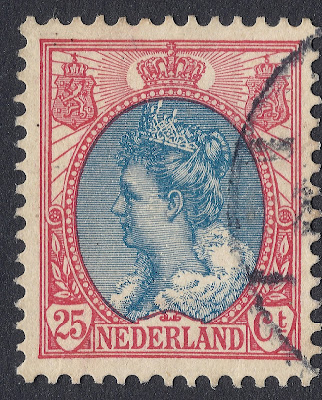
Wilhelmina bontkraag NVPH 71
NVPH 71 - 1899 - Queen Wilhelmina 15c

Definitive series queen Wilhelmina 'Veth' 1924-1930  

Wilhelmina Veth postzegel NVPH 165
NVPH 165 - 1926- Queen Wilhelmina 5g 

The first stamps of the next definitive series of queen Wilhelmina were issued in 1924 and they bear a handsome engraving of her with a different tiara. I’ve chosen the 5 guilder as example here, since it was printed in a larger size than the lower values. After searching a while through some online depots, I found the following two drafts of designer Jan Veth. 

2nd draft by Veth
1st draft by Veth

It strikes me that in the first draft he had drawn the Württemberg tiara, while in the second one he obviously opted for a different tiara. A problem remained though: I couldn’t find a single tiara belonging to the royal family with at least 9 pearls on one side. It seems to me Prof. Veth produced a brand new tiara out of his pencil…

1931 Photo Queen
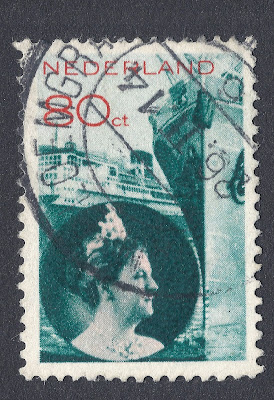
Wilhelmina 1931 NVPH 237
NVPH 237 - 1931- Queen Wilhelmina 80c 

A special stamp appeared in 1931 with a photo of Queen Wilhelmina. A first, since the P.T.T. had never used photo’s on its stamps before. In 1933 the 80c value was issued. Because of the photo we do not have to be afraid some designer made up an artificial tiara (or do we?). Still, it was not easy to trace down this particular tiara as the photo quality isn’t spectacular and we only see Wilhelmina en profil . After comparing it to other stamps (especially colonial ones) and the 40th anniversary of Wilhelmina’s reign stamp of 1938, I’m fairly convinced though that this is the so-called Wedding Gift Tiara. A Dutch jeweler crafted this now-lost voluminous diamond and sapphire tiara in 1900 on the occasion of Wilhelmina’s wedding to Henry of Mecklenburg-Schwerin in 1901.


Juliana had dismantled this tiara – maybe because of its sheer size – and several new jewels were made out of it for her daughters.  

Crisis 1934

Wilhelmina Crisiszegel 1934 NVPH 265
NVPH 265 - 1934- Queen Wilhelmina 5c
In 1934 the P.T.T. issued two charity stamps on behalf of the Dutch National Crisis Committee. The other stamp bears an image of princess Juliana – alas without a tiara! On the depicted stamp we observe a very regal queen Wilhelmina wearing a tiara, but we’re in for a second disappointment: this is also an imaginary fabrication of an artist (Fokko Mees). The photo upon which this engraving was based is the same one which was used for the 1931 stamp with the Wedding Gift Tiara (see below).


Fokko Mees did draw a more true to nature draft version though:


Ruby Jubilee 1938

In 1938 a series of stamps was issued in honour of queen Wilhelmina’s 40th ‘ruby’ jubilee. A fine and detailed drawing by designer Pijke Koch can be found online. She does wear the Wedding Gift Tiara here again.    


40-jarig jubileum Wilhelmina NVPH 311
NVPH 311 - 1938 - Queen Wilhelmina 5c
Drawing by Pijke Koch


1940-1947 definitive series Queen Wilhelmina 'Konijnenburg'

Wilhelmina Konijnenburg NVPH 332
NVPH 332 - 1940 - Queen Wilhelmina 5c
Last but not least we have the so-called Konijnenburg definitive series, named after designer Willem van Konijnenburg. He produced plain but very elegant stamps but had the misfortune that his series was printed in the spring of 1940 and therefore saw only limited use during WWII. Even more unfortunate was that he died of flu in 1943 and therefore never enjoyed a liberated Holland again. His stamps though were granted a proper renaissance when they were reprinted after the war. The lower values were based upon a drawing of Konijnenburg, but the higher values (1,2½, 5 and 10 guilder) only appeared for the first time after the war. They differed from the lower values in size and were handsomely engraved by Sem Hartz. Luckily engraved portraits were not something of the past yet!
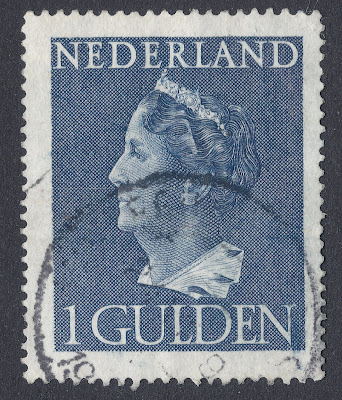
Wilhelmina Konijnenburg Hartz NVPH 349
NVPH 349 - 1946 - Queen Wilhelmina 1g
If I'm not mistaken Queen Wilhelmina wears the so-called ruby Mellerio Tiara on these stamps. Especially the engraved version clearly shows us this particular tiara. I was grateful to find an original drawing of Van Konijnenburg and the photo upon which he modeled his stamp:

Queen Wilhelmina with Mellerio Tiara
Drawing by Willem van Konijnenburg - 1939
The Mellerio Parure is a set of jewels which the royal family owns since the late 1800s. William III asked the French jeweler Mellerio to craft a tiara, necklace, brooches and armbands for his second wife Queen Emma. He acquired it for a mere ƒ160,000 in 1889...

Koningin Máxima Mellerio
Queen Máxima with the Mellerio tiara

Oily forwarding mystery - Delft to Port Swettenham via Babo

Newspaper wrapper sent from Delft 17-1-1938 via Pladjoe and Babo to Port Swettenham via Singapore (4-6-1938) The newspaper wrapper shown abo...