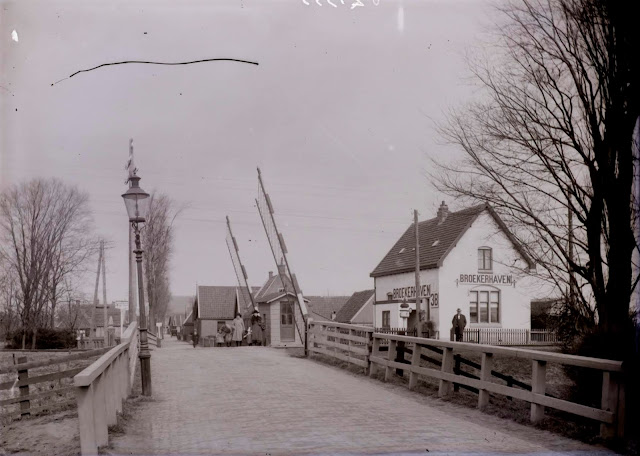
The next picture postcard was sent from the hamlet of Westeinde (between Bovenkarspel and Enkhuizen) to the Bangert, another Hamlet which was particularly renowned for its beautiful orchards. As I have already mentioned in several of my previous posts about agriculture in West Frisia, the yield was in general (very) positive and because of the dawn of agricultural auctions around the turn of the 20th century farmers and (here specifically) fruit growers benefited from increased trade flows. Of course the Great Depression did harm West Frisia as well eventually, and then slowly the inevitable decline kicked in... Today the once thriving orchards of the Bangert have all but a few been erased and replaced by newly constructed neighborhoods to accommodate the ever growing city of Hoorn. Progress, as we now call it.
The journey
Before turning to some contemporary photo's, we should pay attention to the (meager) philatelic aspects of this postcard and the route it travelled.
 |
| Westeinde to the Bangert 1922 |
The postcard was sent by a certain W. Singer who lived in Westeinde. The addition 'Enkhuizen' tells me that he resided in the Enkhuizen part of Westeinde, rather than the Bovenkarspel area of the hamlet. Therefore I am also inclined to believe the postcard was brought to the railway station of Enkhuizen rather than the Bovenkarspel stop.
 |
| Interior of the waiting room of the Enkhuizen railway station in 1941, by the looks of it 1st or 2nd class. |
You might wonder why I'm talking about the railways in the first place. Well, that's because of the quaint postmark on the Vürtheim stamp. This so-called 'Block-cancel' (Vellinga) was introduced in 1910 to cancel mail on various routes/sections of the Dutch railways. This particular postmark was used on the stretch Enkhuizen-Amsterdam. The serving postman on the train could swap the place name blocks upon arrival in Amsterdam: the name of the departing station should always be on top. This proved to be a big improvement over the older large round and typenrader postmarks where the name of the stretch was a fixed part. This particular block-cancel invalidated a 2c Vürtheim stamp which represented the rate for postal stationary in 1922. The 'C' which comes after the date might mean that this was the 3rd train departing Enkhuizen that day. The sender did presumably drop his/her card in a postbox attached to the mail wagon / 'travelling post office' in Enkhuizen or - less likely - at the Bovenkarspel stop.
 |
| Enkhuizen-Amsterdam block-cancel reading 31.1.22. C on a 2c Vürtheim stamp |
The 31st of January 1922 had a cold touch. Without any sunshine and an average temperature of about
3°C it probably was a miserable day for many folks across the Netherlands. Periods of even colder, freezing weather preceded and proceeded the end of January.
 |
| Westeinde near Enkhuizen (top right) to the Bangert near Hoorn. |
The postcard was thus posted on a train heading west to Amsterdam, but at the rural Blokker railway station the postman in charge of the travelling post office probably unloaded several items including our postcard. At least, that's how I think the postcard was eventually delivered.
 |
| Blokker railway station, approx. 1920s |
Two agrarian hamlets - two different crop cultures
 |
| The hamlet of Westeinde between the village of Bovenkarspel and the city of Enkhuizen |
When exploring the map above, you will soon realize that Westeinde (still) only consists out of one long road connecting Bovenkarspel with Enkhuizen. At the end of the 19th century two large seed cultivators from the village of Andijk moved their companies to Westeinde due to its strategic location near a city with good (rail)infrastructure. Read more about these companies here. Ever since Westeinde is known as a hub for global seed trade and since a few years the Dutch governments is eager to call this area 'Seed Valley': obviously a playful allusion to Silicon Valley. The map above shows different colours for the various types of land use. Unfortunately these colours faded a bith over time, but if you look closely you could still discern green from white. The green patches used to be pastures, whereas the white areas indicate crop fields. Nowadays almost all meadows surrounding Westeinde have vanished because of the growth of 'Seed Valley'.
 |
| Sluis and Groot Seeds at Westeinde in 1965 |
The destination of our postcard was home to a totally other agricultural business. I might not even call it agricultural, since it generates fruit rather than crops: fruit cultivation. The Bangert (yes, with a 'T' rather than the 'D' Singer wrote) enjoyed global attention as well. Not only because of its good-quality fruits, but foremost for its lush and majestic orchards. A Belgian teacher - Van Hulle - in agriculture visited the Bangert in 1875 and wrote in his diary:
~
Around half past eleven we reached the small village of Zwaag, from which we went to visit the famous currant bushes of Bangert by foot. You would think you were in a province of China or Japan. Small, decently paved paths and small turning bridges. Plots of about 500 meters long by 20 meters wide, totally surrounded by a canal/ditch. At the front of each plot stands a house with barn and stable under one roof, the orchard begins directly behind it. In the middle (of the plot) there is a footpath with on both sides the currant bushes (each a meter apart). In between there are every 15 to 20 meters rows of 3,5 en 6 mostly apple trees, but also a lot of medlar trees and hazelnuts. Alongside the canals/ditches there grow numerous trees to be used for timber. In similar fashion there are 100s of orchards which in total comprise about 100 hectares.
~
The foreigner was clearly impressed by the scale and neatness of the Bangert and its diversity of different fruit species. In 1875 the Bangert already belonged to one of the oldest fruit cultivation area's in the Netherlands. 'Bangert' is even derived from the Dutch Boomgaard which means orchard. Apparently people could earn proper money out of their orchards. The Enkhuizer Courant reports in 1875 that Bangert hazelnuts had sold with exceptional profits in England: up to 20 guilders per kilo. At the turn of the century some fruit grower still largely relied on the hazelnut trade. West Frisians cultivated various local fruit species such as the 'Pride of Wijdenes', 'Enkhuizer Aagje' or the 'Hoorn yellow currant'. West Frisia as a whole was by large the most important fruit cultivation area in Noord-Holland with Blokker counting 23 hectares of orchards, followed by Wijdenes with 18, Bovenkarspel with 12 and Hoorn with almost 6 hectares of fruit trees in 1880. So orchards were not only limited to the Bangert, but this area just northeast of Hoorn remained the real hotspot. In 1897 the total area of berry orchards had grown to a staggering 65 hectares!
 |
| The Bangert near the end of the 19th century. The dotted area's indicate orchards. The Blokker railway station was located at the only crossing on the excerpt near the abbreviation Stoppl. (halt). |
During the first half of the 20h century fruit cultivation remained a very profitable business even though diseases could wreck havoc. Nevertheless, after the second world war export stagnated a bit because of global competition on the fruit market. Combined with the introduction of health and safety regulations in agriculture, this proved to be the deathblow to the lavish Arcadian orchards. Standard orchards with their characteristic tall trees were not deemed safe anymore. In recent years another threat wiped out the last remnants of the once famous Bangert: housing development. Because of the rate the city of Hoorn increased in size, almost the entire area on the map above has been 'developed' now. Only the name of this new residential area reminds of the orchards now: Bangert-Oosterpolder.
 |
| Very rare autochrome (1910s) of the Bangert with the small decorated turning bridges and modest houses as described by Van Hulle in 1875. |