Showing posts with label Leeuwarden. Show all posts

Wednesday, 16 October 2019

Frisian Knighthood

Cover sent from Leeuwarden and addressed to a member of the Frisian Knighthood in The Hague bearing the first Dutch date cancel type (type I) reading LEEUWARDEN 14 MEI.

This printed cover sheet could have contained quite some heavy papers since the rate was 30 cents. Alas, the contents have been removed from their cover at some point in history, and therefore we cannot really deduce what the Frisian Knighthood shared with the addressee. Robert van Breugel esq. received the letter in the latter half of the 1820s or early 1830s, as the first recorded use of this Leeuwarden postmark dates from 1829. Moreover, because Robert van Breugel is still being addressed as Jonkhr. (Jonkheer) here, the letter cannot be younger than the 1st of June 1833 when his title was upgraded to 'baron'.

Robert van Breugel Douglas in his function as corporal
of the Frisian Volunteer Force of 1815
Robert van Breugel Douglas as member of the Dutch Council of State, engraving made by J.H. Hoffmeister (1823-1904)

Robert van Breugel Douglas (1791-1873) as his full name goes was a member of the Dutch Council of State between 1842 and 1862. This body advises the Dutch government and States General on numerous topics and consists out of members of the Dutch royal family and crown-appointed members. So Baron van Breugel Douglas was a very eminent figure indeed. His mother was a member of the Scottish gentry and his father was granted the title of 'baron' in 1826. In 1821 he married jonkvrouwe Louisa Albertina Glinstra van Sminia (1799-1837). I think we should place this letter in her context as she is the only Frisian connection to Robert van Breugel.

Van Breugel studied Roman and Contemporary Law in Leiden and became lawyer in The Hague in the early 1810s. In this politically unstable times he probably met dame Glinstra van Sminia and subsequently he joined the Frisian Knighthood in 1811 (he even became the Chairman of the organisation at some point). Since Van Breugel was very interested in Dutch gentry, especially due to his own ancestry, he advocated in 1867 that the Dutch nobility wasn't abolished in 1795, but that it had rather ceased to exist. Only in 1956 professor W.F. Prins proved him wrong... Moreover, Van Breugel addressed the issue that British nobility couldn't be incorporated in the Dutch nobility under Dutch law of 1867. A major flaw in reasoning, he argued, because foreign nobility could be incorporated in British nobility. 

Zegel
Wax seal of the Frisian Knighthood on the back of the cover


Sunday, 22 September 2019

Leeuwarden - Sint Annaparochie 1844

postmark Leeuwarden
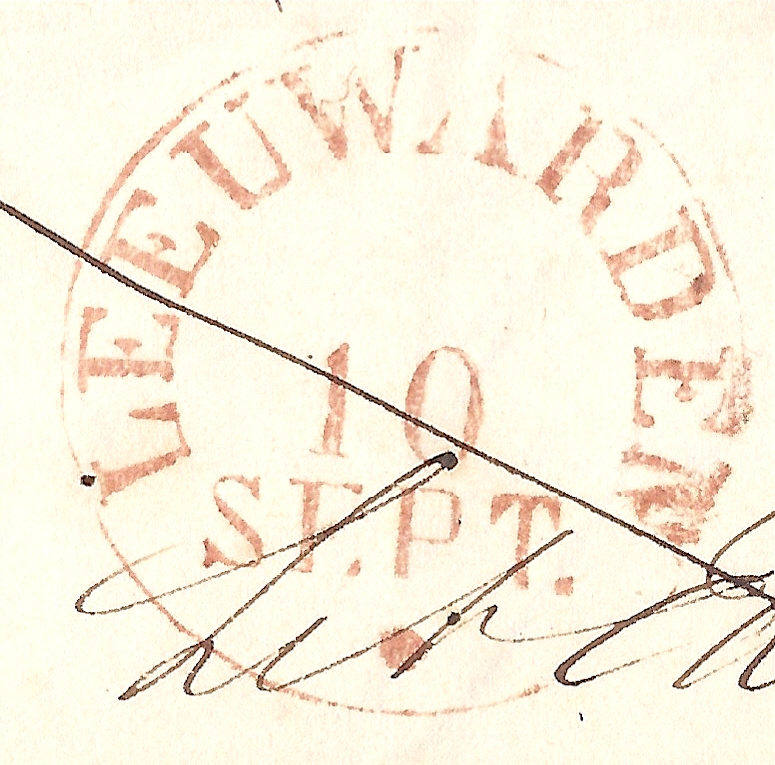
Folded letter sent from Leeuwarden to Sint Annaparochie on the 10th of September 1844 bearing the first Dutch date cancel type (type II) reading LEEUWARDEN 10 SEPT.. 
In the Netherlands the first 3 postage stamps were introduced on the 1st of January 1852, prior to that date the sender or addressee of letters, documents and printed matter etc. had to pay the due amount of the services provided to the courier or postman. In 1829 the Dutch postal service had introduced the first Dutch postmarks which denoted the exact date. These so-called date marks (I rather do not prefer to label them as cancels since such a 'cancel' would require a stamp to be devalued) were circular, bore the name of the city and indicated the day and month. A rosette or small cross can be found beneath the month. In our Leeuwarden postmark the rosette seems a bit blurred, which is a shame since the rosette makes this kind of marks aesthetically pleasing. Despite this minor deficit I decided to show you this entire nevertheless since it was posted exactly 150 years before my birth!  

This particular folded letter was sent from Leeuwarden on the 10th of September 1844 and according to the unrivalled reference work Postmerken & Postinrichtingen the Leeuwarden date mark belongs to subtype II of the 1829 type. Subtype I (used between 1829-1836) had the day and month indicators placed somewhat higher and more central in the actual postmark. Our example though clearly shows that the day and month are placed in the lower half of the mark.

Leeuwarden to Sint Annaparochie in red
The distance between the city of Leeuwarden  (23,400 souls in 1840) and the farmer's village of Sint Annaparochie is a mere 12 km as the crow flies, but for some reason it took the post 2 to 3 days to reach St. Annaparochie in 1844. The weather couldn't have delayed the Frisian letter-carrying flat bottoms boats, which were responsible for most of the traffic in Frisia back then, but I can imagine the post office in Leeuwarden had some difficulties in finding a 'pieton' (messenger) for taking the letter to Sint Annaparochie. There  was no distribution office in the village (i.e. a small, local sub post office with a distributor arranging incoming and outgoing mail), so a private messenger had to be found. A messenger earned 2 stuivers by delivering a similar letter sent from Leeuwarden to Sint Annaparochie in 1832. The weather should not have been an issue: it hadn't rained for a while and the wind was calm albeit a tat unsettled on the 10th of September.

'Received 13 September 1844' as stated on one of the folds of the letter
The letter is addressed to the council of the 'Grietenij' Het Bildt. On the map below it's obvious St. Annaparochie is situated in the heart of the Bildt. 'Grietenij' is the Frisian equivalent for the Dutch 'Gemeente': a municipality. I haven't found any marks on the letter which reveal something about a possible rate between the two places. I therefore suspect this particular entire was free of any postage, since the addressee seems to have been the director of the post office in Leeuwarden: a certain Mr De Graaff. Could the cross on the front indicate this special service? 

Indication distance between Leeuwarden and Sint Annaparochie on contemporary map
The postal service strongly advised their employees to use a reddish colour to impress the mark on letters etc. I guess that this colour resulted in the starkest contrast possible on beige paper, or was it just a cheaper option to use red ink instead of black? In 1844 a similar albeit smaller circular postmark replaced our type. They can easily be distinguished since the smaller type has the month placed above the day, whether the 1829 marks have the day placed above the month.

LEEUWARDEN 10 SEPT.
I hope to continue this story in the near future since many Dutch pre-philately items come in the shape of folded letters, i.e. their contents are preserved...:


The contents seem to involve the costs for 8 lots for an exhibition to be held somewhere in Frisia, most probably in Leeuwarden. De Graaff writes: "On behalf of his excellency Mr Straatzand, Gouvernor of the Province of Frisia, I have the honour to present to you, my lord, 8 lots on request in favour of those participants named below, for which you, my lord, will send me the sum of fl. 24,- by post to my address after their collection." Then follows a list of 8 names and lot numbers. The only clue that the purpose of these lots was for an exhibition to be held, hides in the subscript the addressee wrote down on the 13th of September. He signs the letter with his function: Secretary of the Commission of the Exhibition. At the moment I'm still searching for information about the kind of exhibition this would have been.      

Oily forwarding mystery - Delft to Port Swettenham via Babo

Newspaper wrapper sent from Delft 17-1-1938 via Pladjoe and Babo to Port Swettenham via Singapore (4-6-1938) The newspaper wrapper shown abo...