Showing posts with label Dutch Indies. Show all posts

Sunday, 2 February 2020

Moll and Levius - Dutch-Indies to Bratislava 1938

Toelangan 1938
Partially opened registered cover which was sent from Toelangan (Dutch Indies) to Bratislava on the 15th of November 1938. The Registered Fee to other countries apart from the Netherlands and colonies was 20c at that time. Add up the 15c rate to European countries and you're at 35c. Than you're still left with an extra 12c, so I guess that this is the additional Airmail Fee, although I'm not entirely sure about it. According to my resources the Airmail fee was 30c in 1938...  Nevertheless, it seems to me that all the 4 values of the Queen Wilhelmina Ruby Jubilee series of 1938 were correctly used to make up the rate to Bratislava. So this implies a non-philatelic franking!

In 1938 postal services between the Dutch Indies and other countries worldwide were already firmly established. Due to the increased volume of airmail and the introduction of telephone and radio the Indies seemed not longer 'out of reach' or on another planet in the latter half of the 1930s. Still, Queen Wilhelmina never visited her colony and governance remained very bureaucratic and rigid.

Prague cds
Reverse of the cover with 2 cds Prague transit machine cancellations  

The sender of the cover - Cornelis Lodewijk Moll - worked at SF. Kremboong. I discovered he was known as '1e Geëmpl." A chic name for an employee high up in the ranks of a factory. SF. Kremboong made sugar (SF stands for Suikerfabriek, Sugar Factory) and continues to exist as PG Krembung nowadays. When browsing through Google Streetview it seems to me nothing really has changed since the Dutch left in the 1940s. Many of the older architecture, infrastructure etc. still appear to be in use as of today!

SF Kremboong which is now known as PG Krembung. 

I couldn't find anything on Mr Moll by using Google of even the Dutch digital newspaper archives (Delpher.nl). The only time a 'C.L. Moll' pops up was in the obituary below.

Obituary of A.M. van Hamel 17-10-1925. She was the mother in law of C.L. Moll. 

Update 22-2-2020: "Mr Cornelis Lodewijk Moll was born on 28 March 1893 in Utrecht. He married Suzanna Antoinette van Hamel on 24 November 1921 in Haarlem. Suzanna was born on 22 August 1888 in Haarlem. Cornelis was a widower when he married Suzanna, and his profession is listed on his wedding certificate as ‘administrator’ (Suzanna had no profession)." All credits to Ben Jansen!

Still, Cornelis Moll remains a bit of a mystery person. But when compared to the addressee, we could state we almost knew him personally. I found nothing on the addressee. This Arpad Levius lived at the Fochgasse in Bratislava but I'm afraid he didn't survive WOII because of his Jewish sounding surname. Every combination of Arpad (not your ordinary first name) and Levius makes no sense when I put them in Google. This makes the relation between him and C.L. Moll difficult to interpret. Mr Levius might have been a customer of some sort - though Google gives me no clue if Levius or the Arpad family were merchants. Moreover, Moll addressed the letter to him personally, not using any company name etc.

Tulangan registration label
Toelangan registration label and 'Long Beam' cds reading 15.11.38.8-9 V meaning the cover was sent between 8 and 9 a.m.
Prague transit postmark

Whatever their relation has been like, the cover itself is quite a gem - albeit an incomplete entire. The destination is odd (Bratislava only had approx. 140.000 inhabitants in 1939) as is the franking. The registration label might be quite scarce as well, although Toelangan was located on the important east-west Java railway and the big city of Soerabaja lied in close proximity of SF. Kremboong. I hope that the relation between Moll and Levius will become clear one day though - even if Levius only turns out to have been an avid Dutch Indies stamp collector!

Sunday, 31 March 2019

Sarangan (Dutch East Indies) - Westwoud 1937

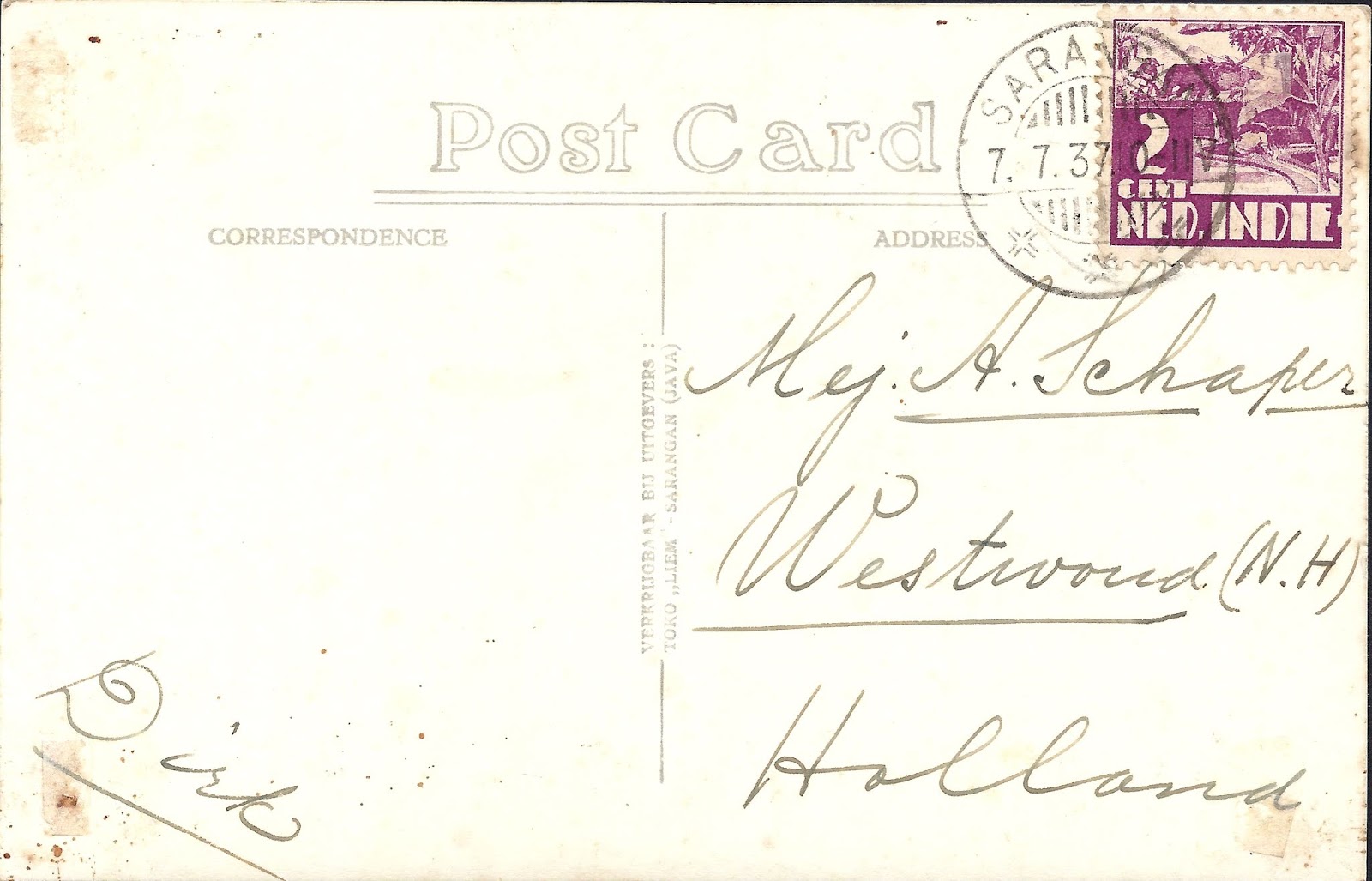
old postcard
Sarangan - Java


In the years before the devastating Second World War and the Indonesian National Revolution in the 1940s, some previously economically inviable areas of the Indonesian archipelago began to thrive due to Dutch technological innovation in tropical agriculture and forestry. Apart from Java, the other islands (Sumatra, Borneo, Celebes, numerous other small islands and especially the vast area of Dutch Guinea) had previously not been colonized at all. In the 19th century the Dutch governor-general of the Indies was supported by Dutch ‘residents’ who had to supervise the local native rulers, known as ‘regents’. On Java this system worked quite well most of the times, although there were obviously various uprisings throughout its existence. Dutch rule (i.e. supervision) outside Java was less stringent and to a certain degree less important as the other islands couldn't sustain an extensive Dutch bureaucratic apparatus yet.    

This all changed in the early 20th century when spectacular innovations in technology, infrastructure, agriculture etc. reached the Indies as well. Increasing numbers of students at the Technical University of Delft and the National Agricultural College in Wageningen caused recently graduated engineers and agricultural experts to move to the Indies. The cultivation of large area’s outside Java became priority number one: mining of raw material and the cultivation of rubber figs (ficus elastica) was perceived as extremely lucrative.      

The increase of economic activity in the Indies triggered or activated other processes as well: in the Netherlands it was felt that education of children in the Indies should be similar to the Dutch system. Since a lot of Dutch people which moved to the Indies in these years had received some kind of degree back in the Netherlands, they wanted to be sure that their children would receive sufficient education as well. Besides education for European children, the Dutch government accepted an ethical policy in 1901 which had as purpose to stimulate welfare and progress amongst the native people. Education was seen as a key to unlock this process and therefore many schools for Indonesian children opened in subsequent years. I might – unnecessarily – add that the goal of educating every Indonesian child was utopian and thus never reached. In the end only children of the higher ‘regent’ classes received education and then primarily on Java.      

Westwoud
Reverse of the card with address details 


Now we should return to this particular picture postcard. Besides that it captures a fabulous view of the Sarangan mountain, a mountain which attracted many Dutch tourists from the 1930s (below you'll find more information about this place), the sender and especially the address caught my attention when it appeared on my screen online. The card was sent to a certain miss (Mej.: Mejuffrouw) Schaper in Westwoud. This village neighbours Hoogkarspel where I grew up. Apart from this surprise, I was intrigued that before the war and revolt (card was sent in July 1937) someone who was probably related to miss Schaper lived on Java. The people of Westwoud were mainly catholic back then (I know that the Schaper family was for sure) and this collided with my views of the Dutch rule over the Indies. I thought that almost all civil servants, engineers and agricultural experts were of protestant descent. At least I didn’t know anyone from the catholic villages in West Frisia to have moved to the Indies.           

So I went online and to little surprise I discovered that the sender Dirk is in all likelihood the brother of A. Schaper. After some more research I found out that Dirk Schaper had been a teacher on Java! This took away all my doubts who the sender could have been. 

Dutch east indies stamp
Sarangan Typenrader Langebalk (longbeam) postmark reading 7.7.37.10-11V


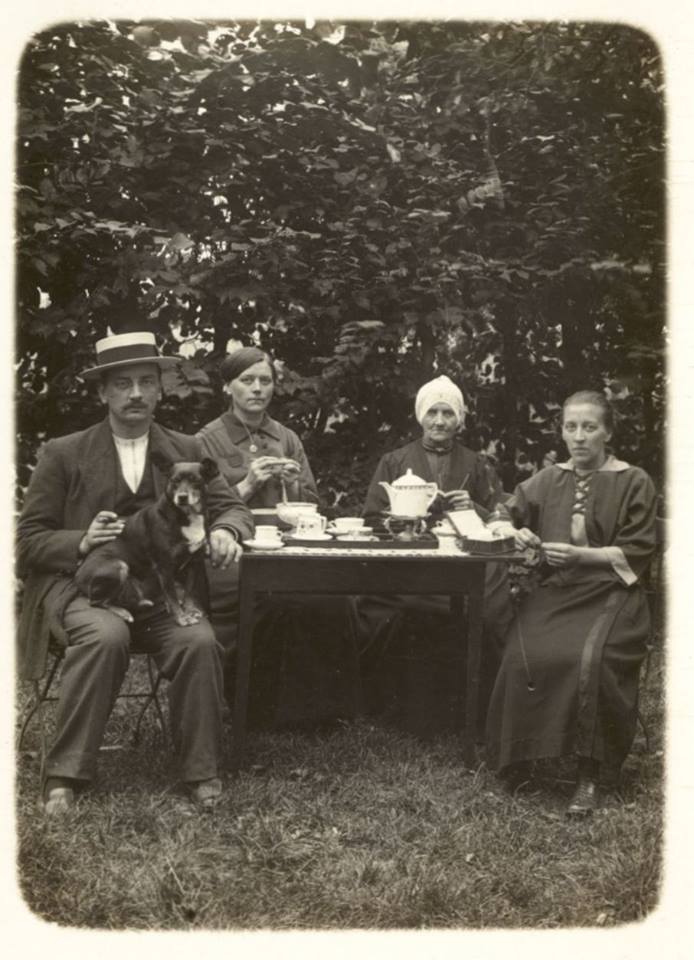
In 1937 Dirk Schaper (1892-1962) sent this postcard to his sister Aagje Schaper (1889-1965) who then lived in the Halfweg (Halfway) inn. Together with her brother Piet Schaper (1895-1965) and her sister Catharina (Ka) Schaper (1878-1949) she run this inn from 1919 (death of her father) till its closure in the 1950s or ‘60s. The family originally came from the Binnenwijzend (small hamlet south of Westwoud), but their father quit his job as farmer because of his health. As his son Piet Schaper wrote in the Westfrisian chronicle of 1965: “In 1894 kocht mijn vader de herberg. Hoi was boer in Binnenwoizend, maar deur tongblaar, longziekte, varkenspest en houge huur en drougte kon dat niet langer. Nei m’n vaders dôôd in 1919 bin ik kasteloin worren en dat bin ik nou nag…(Translation: "My father bought the inn in 1894. He was a farmer on the Binnenwijzend, but because of footh-and-mouth disease, lung disease, swine fever, high rent and drought he wasn’t able to continue. After his death in 1919 I became innkeeper and that’s my job still…").


Schaper family of the Halfweg Inn in Westwoud: f.l.t.r. Piet Schaper, Ka Schaper, Mother Schaper (Maartje Snip) and Aagje Schaper (receiver of our postcard). © Het Geheugen van Westwoud

My father pointed out that Dirk, Aagje and all other Schaper family members are related to me. The grandmother of my great-grandmother Maartje van der Gulik (1897-2000) was called Maartje Schaper (1842-1915). Subsequently her grandfather was called Sijfert Schaper (1779-1829). Sijfert Schaper is our common ancestor. So after all, this philatelicly not so interesting postcard has proved to be an extraordinary postcard history- and familywise!

Café Halfweg (Halfway Inn) with allegedly father Dirk Schaper in the doorway. Picture taken in 1918 or 1919 since the rails of the famous horse-drawn streetcar had already been removed (service stopped on the 31st of December 1917). Father Dirk Schaper passed away in 1919. 

Sarangan 

Dirk Schaper stayed in Sarangan in July 1937 and I think it's likely he enjoyed his holidays there. From the early 1920s on Dutchmen gradually found there way to this hidden gem, located on the green eastern slope of the Lawu volcano thus basically being isolated from western Java. It took until 1937 before a road was opened from Sarangan to the west. And only 10 years earlier the last kilometers from the town of Magetan to the east were only accessible by horse or foot. No easy place to reach. Which raises a question: why were the Dutchmen and other Europeans so eager to come to this mountain lake? The following Dutch account might give you the answer:

“Toen de bestuurder de auto aan de voet van het hotel tot stilstand bracht, aanschouwden wij voor het eerst het meer van Sarangan. Veel hebben wij gereisd: door China en Japan, door Amerika, door de Europese Alpen, genietende van de schitterendste natuurtaferelen. Van dít oord kunnen wij echter verklaren dat het door zijn schoonheid, zijn liefelijkheid, zó’n wondere indruk op ons maakte dat we onszelf beloofden, hier onze vakantie eens door te zullen brengen. [….] Sarangan, met zijn meer, zijn eilandje, zijn omringende heuvelen en bossen, is voor ons een openbaring geweest.”

"When the driver parked the car right on the curb of the hotel, we saw the lake of Sarangan for the first time. We've travelled a lot: we've been in China and Japan, in America and the Europeans alps, enjoying the very best of nature. We could state of this place though that due to its beauty and sweetness it made such a marvelous impression on us that we promised ourselves to celebrate our holidays here once. [....] Sarangan, with its lake, its islet, its surrounding hills and forests proved to be a revelation for us."  

Besides its stunning location, natural swimming pool and lush forests, one distinct feature lured many Europeans to the resort: its cool climate. At 1500 meters above sea level they could cool down there overheated bodies in the lake and its surrounding rain forests. A truly European refuge. 

Sarangan - view to the northeast

Monday, 19 November 2018

Heldring in Venedig


PH-AKR 'Rietvink'. This DC-2 aircraft carried the letter from Bandoeng to Amsterdam Schiphol
In the 1930s the world became increasingly smaller by the introduction of regular flights between every possible destination. The aircraft industry could barely keep pace with the ever demanding airlines, which asked for safe, less noisy, air-pressured cabins and larger aircraft. Comfort and luxury were key words for 1930s passenger airlines. But aircraft were of more use than only transporting passengers: they became a very important means of transporting freight and mail. Especially the last category could be transported in large quantities. For the first time in history Dutch inhabitants of the Indies (West and East) could communicate with their relatives in the Netherlands without having to wait six or more weeks for an answer. In addition to this the leading Dutch airline (KLM) improved her service every year. In the early 1930s it took more than ten days for a KLM aircraft to fly from Bandoeng to Amsterdam. In the late 1930s new modern (American) DC-3 aircraft could make the journey in a time span of only two days! That's what you call progress!
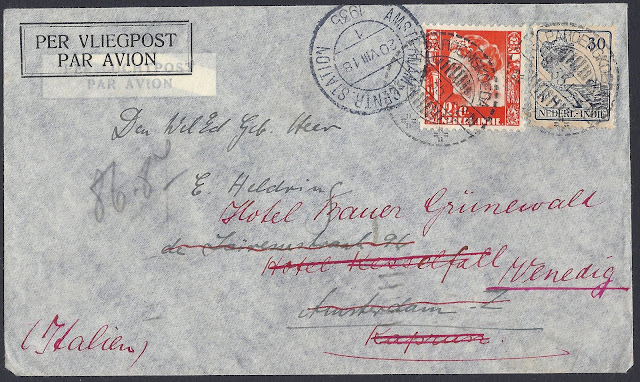
Heldring
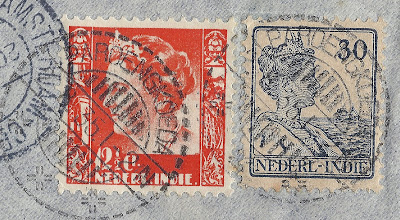
Letter departed Bandoeng on the 2nd of August 1935 and was probably forwarded from Amsterdam to Venice on the 20th of August. Attractive stamping of the square 12 1/2c Queen Wilhelmina 'Kreisler' and the 30c Seegers' lonely ship stamp.
This letter departed Paroengkoeda (now Parungkuda) on the 2nd of August 1936. First you might think that it arrived in Amsterdam on the 20th of the same month. A longer than usual travel time, isn't that a bit odd? With the introduction of the modern DC-2 flying machines a journey from the Indies to the Netherlands took only 5 days in the summer of 1935...so first thing what came to my mind was an engine failure. They often occurred in these days.

After a while though I wasn't so sure anymore: I looked the flight up in TSchroots' great airmail encyclopedia and read that the DC-2 'Rietvink' departed Bandoeng on the 3rd of August and arrived accordingly to its flight schedule in Amsterdam on the 8th. No engine failure whatsoever, just a lazy philatelist which jumped to conclusions too quickly.       

It think we might have been tricked by the Amsterdam postmark. This 'pseudo-arrival' postmark is probably only an indication of the time and day on which the letter was forwarded to Venice (and since you're probably more shrewd as I am, you might have guessed that already).

'Forwarding postmark' Amsterdam Central Station?
The sender of the letter was not aware of Mr Heldring's departure to Italy - obviously - so Mr Biesenbach's of Paroengkoeda letter was at the mercy of the postal services now. In these days you could still rely on such an forwarding immaculate service. The European postal agencies quickly forwarded his letter to Venice. It arrived there only two days later on the 22nd of August.
Wilhelmina
Close-up of the two stamps and postmarks

Now two questions come to mind:
  • What is the reason of the 18-day gap between the send date and forwarding date?  Did it took Heldring's family so long to forward the letter to him from their home address in Amsterdam? Or did Mr Biesenbach's letter linger in the Javanese forests for some time before reaching Bandoeng? Or...? 
  • What were Mr Heldring businesses in Kaprun and Venice? His wife (or assistant) first wrote down the wrong address (Hotel Kesselfall, Kaprun) before correcting it into the more famous Grünewald Hotel in Venice. I think the 'corrector' was perfectly aware of Mr Heldring's travel schedule. He appears to me as an important man. Moreover, his name rung a bell when my eyes met this cover. In fact, in the end I bought the cover because of this name and not because of it's attractive stamping and neat postmarks.

Ernst Heldring - Dutch entrepreneur
Much Dutchmen probably don't remember his name, and if they do they remember his name because of his son. The addressee - Ernst Heldring - nevertheless was a famous and very influential individual during the first half of the last century. Born in 1871, he was educated at the Public School of Trade in Amsterdam during the 1880s. Within 10 years he had established good contacts with the Dutch Indies where he was responsible for numerous (industrial) initiatives, such as the the construction of a harbour in Sabang and a new ship route which connected Java to Japan. He started this last venture in 1902 after having becoming president of the prestigious Royal Dutch Steamboat Company (KNSM) in 1899. Perhaps more important for philatelists is his function as president of the Royal Dutch West India Mail (KWIM) between 1912 and 1928. By that time people called him a proper shipowner ('reder' in Dutch) and in the Netherlands with its long history of trade and ships such a function meant (and still means) influence and prestige. Soon he became known as the Viceroy of Amsterdam. He made it into the upper class of Dutch society. 

Ernst Heldring on the roof of his house (De Lairessestraat 96). Viceroy of Amsterdam.
In the 1930s Heldring occupied numerous functions, most of them commissionerships, at the Dutch National Bank, the Hoogovens and the Dutch Trade Company. Most notably for our letter tracing process could have been the position he held at the Holland Bank for the Mediterranean in the mid thirties. Which sort of other business could possible distract you from simmering Italian summers.... 

For the sake of all of us, he had the extraordinary gift to keep his diary up to date. So here are some notes of his own hand, written in September 1935 which will tell you his real activities in the summer of 1935.

~
Gisteravond thuisgekomen van 4 weken vacantie in Beieren, Oostenrijk en Italië met Jet als reisgezelle. We hadden prachtig weer, behalve in de bergen, waar we ons voornemen tochten te maken moesten opgeven, toen we voldoende getraind waren. De laatste 8 à 9 dagen brachten we te Venetië, Padua en Verona, Brescia, Bergamo en Milaan door. Venetië is een oude bekende, die ik gaarne terugzie. Ditmaal was er in het Palazzo Pisaro een prachtige tentoonstelling van werken van Titiaan, waar zijn meesterschap in portretkunst, het coloriet en de compositie, doch ook zijn tekortschieten in geestelijke diepte - geheel overeenkomstig zijn tijd en omgeving - gedemonstreerd werden. Ditmaal bezocht ik ook het oud-Romaansche, half-Byzantijnsche kerkje te Torcello op een afgelegen lagune-eiland. Heel mooi. De Giotto's en Mantegna's te Padua waren een verrukking bij het weerzien na 30 jaren, zoo ook Verona. De musea in beide steden, vooral dat te Padua, vond ik uitmuntend gereorganiseerd. Te Brescia waren we slechts een paar uur tusschen 2 treinen, wegens slagregen grootendeels in een café. Het oude Bergamo op den berg gelegen met zijn door kerken en loggia's omgeven piazza is een juweel.
~
Translation:

Yesterday I returned after having spend 4 weeks of holidays in Bavaria, Austria and Italy with Jet as my travel companion. The weather was great, except in the mountains, where we had to give up our intention of making walks after sufficient training. The last 8/9 days we stayed in Venice, Padua, Verona, Brescia, Bergama and Milan. Venice is like an old acquaintance, whom I very much like to visit again. This time there was a beautiful exposition of pieces of Titian, where his mastery in portrait art, of colorite and composition, but also his under performance in philosophy- which perfectly corresponds to his age and surroundings - was demonstrated. I visited the old and small Romanic, half Byzantine church of Torcello as well this time, which stands on a remote island in the lagoon. Very pretty. To see  the paintings of Giotto and Mantegna again in Padua was a sheer delight after 30 years. The same applies to Verona. I found that the museums in both cities were very well organized, especially in Padua. Since we had to switch trains in Brescia, we had only a couple of hours to visit this city. (Unfortunately) We had to take shelter in a cafe because of a downpour. The ancient city of Bergamo situated on its mountain and its piazza surrounded by churches and loggia's is a gem.

So Mr Heldring was not for business in Italy and Austria: he enjoyed a lengthy holiday there! One mystery solved.


Thursday, 8 November 2018

Sparkling tiara's on Curaçao stamps

Last but not least in this series of studying Wilhelmina's tiara's, we will cross the Atlantic to the Dutch Caribbean. Although all stamps during Wilhelmina's reign carry the name 'Curaçao', they were used on the other Dutch Antilles as well (Aruba and Bonaire and St. Maarten, St. Eustatius and Saba). We will see that most designs match the Dutch Indies stamps, starting with the Veth 1903 series. By 1916 the new series by Seegers and Harting was introduced:

postzegel, stamp, NVPH 64
NVPH 64 - 1915 - Queen Wilhelmina 22 1/2c
postzegel, stamp, NVPH 68
NVPH 68 - 1916 - Queen Wilhelmina 50c


I always felt these designs suited the Dutch possessions in the Caribbean much better than the Dutch Indies territories. This 'feeling' might result from the fact that the Seegers' design only displays an empty horizon and a lonely ship. When thinking of the Dutch Indies I always imagine mighty volcano's and inaccessible mountain ranges which are draped in dense tropical forests. The Dutch Antilles on the other hand remind me of small windswept islands exposed to hurricanes, the sea and whatever more. The Seegers' 'lonely ship' design nears this feeling the closest, but Harting's design with its plain palm trees does invoke this same 'barren' atmosphere. Only when you try very hard, you will uncover the mystic mountain ranges of the Indies:

Detail of NVPH 68 with focus on the mountain ranges
When we continue we will see Cheffer's Jubilee design of 1923 again, which I decided not to review here again - see this post for his design.. Unlike the Dutch Indies however, the colony of Curaçao decided to grant these stamps a second life as definitive series by slightly altering the frame. It appeared between 1928 and 1930:

postzegel, stamp, NVPH 89
NVPH 89 - 1930 - Queen Wilhelmina 6c
I don't know if this design does the trick: I find myself somewhat puzzled by the three ships. I think that Mr Seegers tried reworking the frame, but he pushed the design too far by engraving three seemingly random ships below the queen in my modest opinion. I think it would have better suited the stamp to have only one ship displayed or a combination between the outline of an island and a single ship -  or even better: no display of ships at all. 

postzegel, stamp, NVPH 126
NVPH 126 - 1936 - Queen Wilhelmina 6c
Next comes a stamp which was only used on the Dutch Antilles and in Suriname, since the Dutch Indies had their own iconic square Kreisler stamps. Of course I do not want to suggest that this stamp is inferior to Kreisler's design, but I have to admit it is a bit dull ... On the other hand the designer - Mr Mees -  chose to depict Wilhelmina with a veil. This really makes her a bit magical and quite exotic. A remarkable choice and therefore the design will get my stamp of approval nevertheless. Wilhelmina seems to wear three strands of pearls on a plain tiara. I seriously doubt if Wilhelmina ever possessed a jewel of this kind.

postzegel, stamp, NVPH 138
NVPH 138 - 1938 - Queen Wilhelmina 1 1/2c
We will end with the ruby jubilee stamps which were a shared issue between the Netherlands, Suriname, Curaçao and the Dutch Indies. Mr Koch made a fine drawing of Queen Wilhelmina with the massive Wedding Gift Tiara which was so quickly dismantled after Juliana became our queen in 1948. A very stylized stamp.

Wednesday, 7 November 2018

Sparkling tiara's on Dutch Indies stamps

In my previous post I wrote about the various tiara's worn by Queen Wilhelmina which appear on Dutch stamps. Now time has come to do the same for Dutch colonial stamps (Curaçao and the Dutch Indies). While some colonial series share resemblances with Dutch stamps and are based on the same photographs, various series belong solely to the colonies. They really give you a more exotic impression when compared to the quite frugal Dutch designs. We will commence with the Dutch Indies.

Veth 1903
The first Dutch Indian series of Wilhelmina was designed by Jan Veth and introduced in 1903. Veth was also responsible for the definitive 1924-1930 series which was used in the Netherlands. His 1903 Indies design was even more attractive than his Dutch series in my opinion. Have a look at this 10c overprint variety:

postzegel, stamp, 1908
NVPH 88 - 1908 - Queen Wilhelmina 10c 'Buiten Bezit' overprint

Even with the heavy postmark and obtrusive overprint the stamp still possesses a simple grace. The overprint 'Buiten Bezit' indicates that this stamp was meant for post offices in the Dutch Indies which were not located on the isle of Java. Since this island was the first real colonial property of the Netherlands, officials used the term 'Buiten Bezit' (~ outer possessions) for the numerous other islands, especially Sumatra, Celebes and Borneo.  

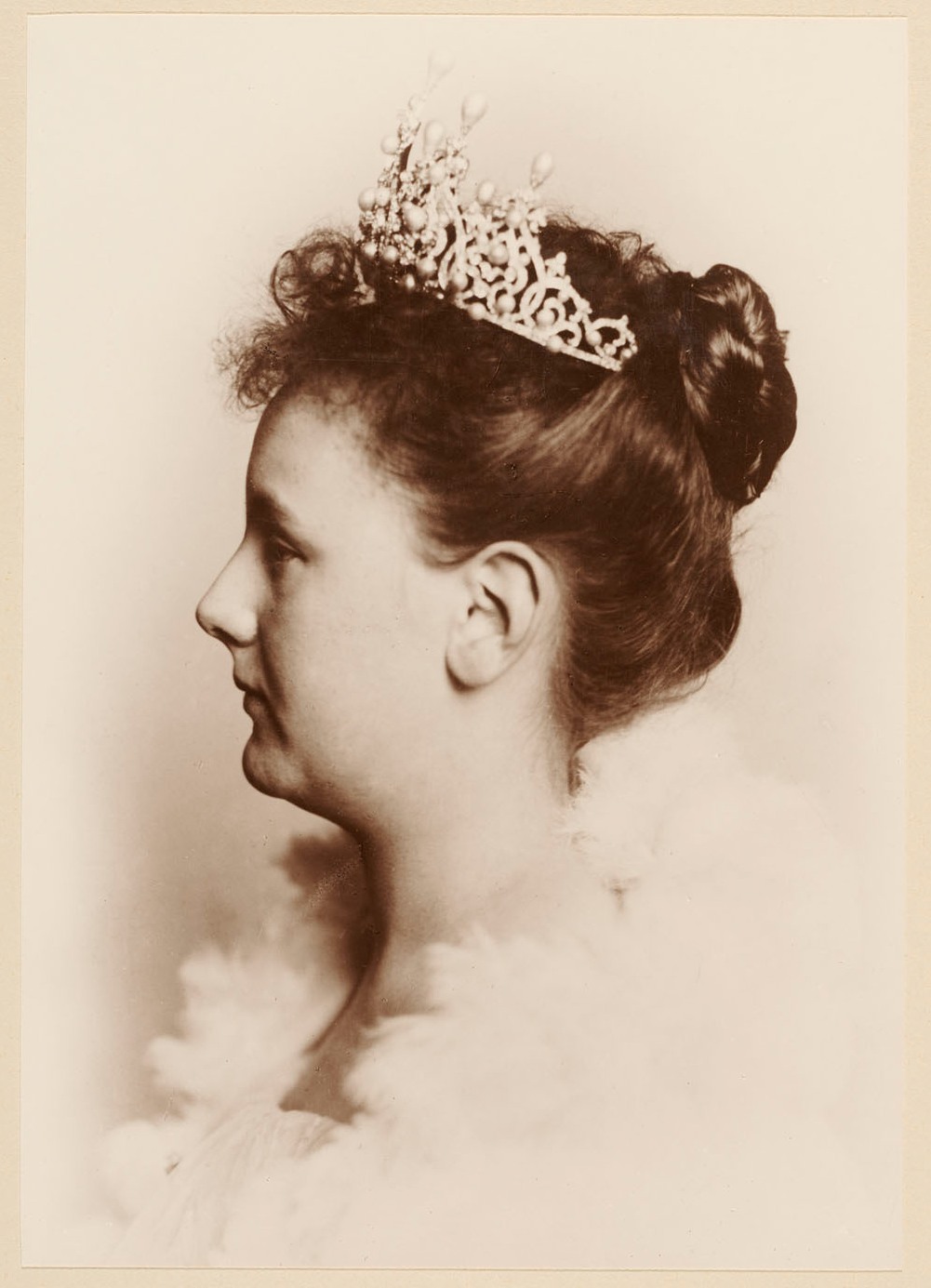
Queen Wilhelmina 1897 photograph
I'm convinced Mr Veth used the photograph above for his design, the same photograph which was used for the Dutch 1899 Mouchon 'Fur Collar' stamps. Wilhelmina wore her Württemberg Ornate Pearl Tiara on that occasion but I have to admit Veth didn't succeed in engraving this tiara. He has turned it into a rather clumsy diadem on his stamps. 

postzegel, stamp, dienst, 1911
NVPH D26 - 1911 - Queen Wilhelmina 1g 'Dienst.' overprint
The stamp above belongs to the same series, but is larger in size (together with the 2 1/2g) and is embellished with two Olympic gods (Hermes and Ceres) and two ships in its frame. A very handsome design, although this particular one is gravely ruined by the 'Dienst' overprint. 'Dienst' stamps are officials.

Seegers and Harting 1913

postzegel, stamp, 1914
NVPH 120 - 1914 - Wilhelmina 20c
In the early 1910s H. Seegers designed a new series of stamps, to be used in the Dutch Indies, Curacao and Suriname. A plain engraving showing Wilhelmina en profil and a lonely ship was used for the lower values up to 50c. From 50c onwards a more elaborate and a larger stamp was used, designed by D. Harting (see below). I daresay both designers used the 1897 photograph again (15 years after it was made...) and Harting obviously did a better job. Wilhelmina's ear on Mr Seegers' stamp is simply too grotesque.  

postzegel, stamp, 1913
NVPH 132 - 1913 - Queen Wilhelmina 1g
What I do like when looking at Harting's stamp is the very exotic though elegant framework. Much attention has been given to design the denomination and country designation, which makes me think of this stamp as a particularly charming one.     

Jubilee 1923

postzegel, stamp, 1923
NVPH 162 - 1923 - Queen Wilhelmina 20c
In 1923 Wilhelmina had reigned for 25 years: a jubilee which the P.T.T. did not miss. In the Netherlands and the colonies series of stamps were issued which commemorated her achievement. The colonial stamps differed a great deal from the Dutch series, which was designed in art deco style. The stamp above though can be described as very conservative and '19th centurish', but was apparently deemed perfectly apt for the Dutch colonies associated with all their opulence and richness. We see a heavily illuminated frame surrounding Wilhelmina who wears a grand diadem. You could almost imagine that this diadem should be called the 'pearl of the Indies' when taking its gigantic proportions into consideration. Not frugal at all and very un-Dutch. On top of this she wears an eye-catching necklace. 

1923 photograph by H. Deutmann
In the archives I found the photo on which the series was based. Cheffer made the excellent engraving, whilst Seegers resorted to the framework. He probably hadn't forgot his clumsy ear (nor had the P.T.T.), but he made it up by lovely adorning this series. Wilhelmina wears the so-called Wedding Gift Tiara. Because of its gigantic proportions her daughter - queen Juliana - had dismantled the parure when she became queen. Maybe she thought it a too opulent display for the Netherlands, especially after we lost the Indies in 1949.  

Kreisler 1934

postzegel, stamp, 1934
NVPH 196 - 1934 - Queen Wilhelmina 12 1/2c
To complete the Indies diadem tour, we cannot exclude Kreisler's magnificent 1934 Wilhelmina series. Why magnificent? Well, he dared to present the P.T.T. with a square stamp design. That was a first and a gamble. Moreover, his design consists out of a very humble but at the same time proud depiction of the queen within a neat though elegant framework. This and the combination of native art with two important Dutch elements (shipping & infrastructure) makes the stamp truly iconic. Where the 1923 jubilee series overwhelms you a bit too heavily, this stamp does not make any presumptions. That's quite an achievement, since Wilhelmina is depicted with her Wedding Gift Tiara again. Kreisler didn't make this diadem look preposterous though (a feeling which I got with the jubilee series), since the diadem softly sinks away in her hair. Very refined. 

Oily forwarding mystery - Delft to Port Swettenham via Babo

Newspaper wrapper sent from Delft 17-1-1938 via Pladjoe and Babo to Port Swettenham via Singapore (4-6-1938) The newspaper wrapper shown abo...