Showing posts with label pre-philately. Show all posts

Sunday, 4 July 2021

Iron Rhine: from sand track to mud fight

Vlodrop Station
Signal House at Vlodrop along the Iron Rhine railway near the German border in the 1930s. The area surrounding Vlodrop has been declared a national park in 1990 which resulted in the closure of the railway.

To this day, needless disputes between nation states stand in the way of closer European cooperation. At a time when Europe should have a democratic response ready to destructive dictatorships and pandemics, stupid trifles such as border disputes ensure that the EU remains ineffective and, more importantly, indecisive when it comes to foreign policy and rapid action. Even closely cooperating states such as Belgium and the Netherlands deal with disputes which date back centuries. One example is the Iron Rhine, a railway which has fallen into disuse since the late 1980s and which once formed an important trade artery between Antwerp and the Ruhr area.

In the treaty of London of 1839, in which the actual division between the Netherlands and Belgium is recorded, both parties agreed that Belgium should reserve the right to establish a direct connection between Antwerp and Prussia through Dutch Limburg. During the ten years that Dutch Limburg fell under Belgian rule, the economy of Belgium had increasingly focused on the strong Prussian economy of the Ruhr area. The stipulation that eastern Limburg would become part of the Netherlands could mean a death blow for the port of Antwerp. A solution was therefore found in a connection in the form of either a new canal to be dug or a railway line to be built. Just as the right of way will continue to generate court cases for landowners, the international variant of it will also cause friction between two states.

IJzeren Rijn
Route of the Iron Rhine between Antwerp and Mönchengladbach and thereby crossing the Netherlands

The route of the to be established connection between Antwerp and Prussia already became a point of contention in the 1860s. Belgium saw the benefit of building a railway at the point where Dutch Limburg is narrowest: at Echt. The Netherlands tried to change the route to Northern Limburg. I believe that the interests of the regional economy played a major role in this. Although a railway line had already been built between Maastricht and Venlo in 1865, an East-West connection was still missing in North Limburg. Weert could thus be added to the Dutch rail network by means of a rail project – an this would partly be financed by Belgium. In the end it was decided to build a route from Hamont in Belgium via Budel, Weert and Roermond to Mönchengladbach. Instead of 15 km of track over Dutch territory, the final length of the route was almost 30 km! The Dutch concession was granted in 1873 to the Belgian Compagnie des Chemins de Fer du Nord de la Belgique. This concession would expire after 99 years in 1973. In 1879 the route was ready.

IJzeren Rijn
Route of the Iron Rhine in the Netherlands with Roermond right of the centre.

In terms of postal history the Iron Rhine railway has not overtly been spoiled with postal markings. Nevertheless there existed TPO (travelling post offices) on board trains which ran Roermond/Vlodrop v.v. and Budel/Roermond v.v. which used their own postmarks. Several stations along the route will also have had their own baggage office markers. It should be pointed out though that the share of domestic passengers on the route sections Budel-Weert and Roermond-Vlodrop was small. The Iron Rhine was mainly used for freight transport and international passenger trains. 

The border crossing between Belgium and the Netherlands near the town of Hamont is really curious from a postal history point of view. As early as 1810, in the middle of the wild Brabant moorland, there was already a border office where mail travelling to France was marked with the three-line Hollande/Par/Hammont marker. The choice of the Iron Rhine route therefore does not seem entirely coincidental. But why was this medieval town surrounded by peat and bracken a border office in the first place?

Hollande Par Hammont
Entire letter from Haarlem to Francomont near Vervier in French occupied Belgium (13-2-1810). The Marque d'entrée which reads Hollande/Par/Hammont was applied in Hamont close to Budel.

Since the Peace of Münster in 1648, the medieval town of Hamont had grown into an international hub for postal traffic. Mail from the Republic found the quickest way to the garrison of Maastricht and cities such as Liège, Aachen and beyond by crossing the border at Hamont. The central exchange point in the Netherlands being Alphen aan de Rijn where mail from several cities was collected before being forwarded to the south. Private initiatives were the basis of postal traffic in those days, but the strong economy of the Republic ensured a steady influx of correspondence. From 1667, postilions even carried out night trips to Maastricht. From about 1750 these private enterprises were gradually transferred to the States (State Post). The ride Alphen-Hamont and beyond was also maintained. 

In the Napoleonic period a postal treaty was concluded between the puppet Kingdom of Holland and the French Empire in 1808. Hamont and nearby Achel remained two important customs points en route to France. The Décret Impérial came into effect on 1 August 1809 and would eventually remain in effect until 1 April 1811. This in spite of the incorporation of the Kingdom of Holland into the French Empire in 1810 and the subsequent applicable declaration of all French laws and regulations. For the territory of the former kingdom, therefore, nothing changed until April 1 1811. The 1809 Décret Impérial stipulated that the Kingdom of Holland would be divided into 3 rayons or districts for the sake of a more unified rate calculation. This division surely had some benefits, but rate calculation remained a somewhat cumbersome practice. Four official border crossing points were created. One at Hamont and the Hollande/Par/Hammont border marker was created for outgoing mail. There was no Dutch equivalent for this marker. Incoming mail would incidentally be marked with a red crayon capital M (for Middelburg), B (for Breda) etc.  Because the Hollande/Par/Hammont marker was only in use until the expiration of the postal treaty on the 1st of April 1811, strikes are quite rare.

Hamont kaart
Hamont and surroundings during the time of the reunited Netherlands (1815-1830)

In contrast to the route of the Iron Rhine, which is oriented east-west, the previous postal route was north-south. A substantial difference. In this light, the two routes have only one common denominator: that both traverse Hamont. In recent years there has been much talk about a possible reactivation of the Iron Rhine with a view to international commuter transport and the active promotion of public transport in the context of climate laws. A first step has already been taken: the electrification of the still existing passenger line Mol-Hamont in Belgium. The Netherlands had stipulated this condition in order to realise the reopening of the Iron Rhine. One of the arguments with which the line was closed in the 1980s was the endangered fauna in the Mijnweg national park near Vlodrop, which was threatened by the diesel fumes of the freight trains. 

Vlodrop station
The disused stretch of railway at Vlodrop in 2007

Reopening can only take place if the route is fully electrified. But even now an important condition (the electrification of the Belgium stretch of railway) has been met, the reopening of the relatively short Hamont-Budel-Weert section of track is currently being derailed by the Dutch government. Prorail (the Dutch rail manager) estimates that the cost to reactivate and electrify the stretch would amount to a staggering 50 million euro's - which equals €5000 for every meter of track! The Flemish press now suspects that other interests are at play: if the section up to Weert is reopened, the reopening of the entire Iron Rhine will only be a matter of time. The port of Rotterdam has a lot to lose from this, as do Dutch rail carriers and therefore -  to continue this (railway) line of thought - Prorail as well. If (largely) green freight transport becomes faster and easier from the Ruhr area via Hamont to Antwerp, the Dutch state will suffer a loss of income. So the neoliberal spirit that (still) controls The Hague makes up enough arguments not to reopen the Iron Rhine for the time being e.g. the outrageous cost estimate. The result: an old-fashioned, vulgar border dispute  which is silently being fight out. The students and commuters living in East Flanders and for whom a direct rail link to Weert and from there to Eindhoven and beyond would be a great win, lose out on this political game. 

Let's hope that the old international post route through Hamont may inspire the Dutch state to put aside their nonsense arguments and old objections to solve this unhelpful obstacle for further EU cooperation.

A great Podcast on the recent mud fight over the Iron Rhine railway can be listened to here. Two journalist (Kato Poelmans and Timmie van Diepen) of the Flemish newspaper Het Belang van Limburg discuss the history and uncertain future of the line.  

Monday, 10 February 2020

Dutch field post from the Waterloo campaign


Quatre-bras, Napoleon
15-6-1815 Brain-le-Comte Field post entire with the very scarce postmark Genaal = Postkantoor te Velde written by Otto van Limburg Stirum, who served as aide-de-camp to Prince Willem of Orange during the Waterloo Campaign 

Throughout the Waterloo campaign of 1815 the allied forces maintained a semi-regular field post system in order to communicate efficiently with each other and the anxious home front. The prospect of Napoleon invading his lost territories (including The Low Countries), defeating Wellington and subsequently consolidating his rule in France sent shivers down the spines of many allied generals and the populace. A certain defeat of Napoleon couldn't be taken for granted.

Napoleon's return
Napoleon's return from Elba by Charles Auguste Guillaume Steuben 1818

Before we scrutinize the letter, we should embed its contents into the situation at the time. Napoleon returned from his exile on the small Italian isle of Elba on the 26th of February 1815 with a small personal guard of 600 men. On the 1st of March he reached France and he immediately marched on Paris. By that time the king of France, the unpopular Louis XVIII, still deemed it possible to stop him in his tracks. On the 14th of March however one of Louis’ generals, Michel Ney, joined his former emperor with 6000 men. Several days later Napoleon entered Paris and Louis had fled to Ghent.

PEP M360
The extremely rare Genaal = Postkantoor te Velde postmark which was used between May and June 1815 during the Waterloo Campaign. Only 4 examples are known to exist (PEPII p. 456).  

In the months before June the 15th both Napoleon and the allied forces mobilised for war. Eventually Napoleon succeeded in raising over 200,000 soldiers which formed his l’Armée du Nord. During the congress of Vienna the allied forced declared Napoleon an outlaw and subsequently the Seventh Coalition was formed to defeat him. Initially they thought they could invade France before Napoleon would even dare to start with any hostilities. They were wrong. In the early hours of June 15th Napoleon’s l’Armée du Nord crossed the river Sambre at Charleroi – the very day our letter was written.

Otto van Limburg Stirum (1789-1851) wrote this letter in 2 parts on the day the French commenced their hostilities. As one of the personal aide-de-camps to Prince Willem of the Netherlands, he reports his personal thoughts about the situation to his father Leopold. Leopold resided in Amsterdam at the time and had close contacts to King Willem I. He was part of the famous triumvirate which returned the banished Stadtholder-heir to the Netherlands after the withdrawal of French troops from the Low Countries in the 2nd part of 1813. Prince Willem the VI was proclaimed King Willem I of the Netherlands in November of 1813.

To reinforce the close bond between Leopold and King Willem, the king made Leopold’s son Otto aide-de-camp to his son Willem (who later became king Willem II) during the Waterloo campaign.

Because of his close ties to the Prince of Orange, Otto gives us first-hand insights into the very day Napoleon rushed into Belgium. He states that Napoleon, Jérôme and Murat have camped at Fontaine-l’Évêque near Charleroi, but that Le Prince (Prince of Orange) and the Duke of Wellington are still at a ball in Brussels. If the situation would worsen though he estimates that his Prince would return as soon as possible. He also ponders about military tactics which could be used, e.g. general Hill should replace the Dutch detachment in order to combat the French. A rather strange passage appears near the end of the actual letter: Otto seems to warn his father not to enrage the prince (Mais surtout gardez vous je vous prie de dire que vous tenez quelque chose de moi le Prince serait furieux). To be explained by an earlier letter between the two?

Napoleon, battle of Waterloo,
Detail of the letter 

In a postscript written that evening, Otto shares the latest information with his father. He appears to be a bit pessimistic about their chances. The Prince hasn't returned from Brussels yet and a French paper confirms the report that Napoleon and his army are making progress. According to the paper the last sighting of his l’Armée du Nord was done at Valenciennes, but the Allied Force knew that the French were at Charleroi already. Otto ends the letter by saying that it would probably take a while before they would see each other again.

The day after Otto wrote this historical document, he was severely injured during the battle of Quatre-Bras. The French troops misidentified him for the Prince of Orange due to his young age. They allegedly said: “tuons-le, c'est le Prince!”. He was left for dead on the battlefield but eventually recovered from his wounds.

Otto van Limburg Stirum (1789-1851)

On the 18th of June the Allied Force defeated Napoleon at Waterloo.

In summary: this field post entire with a clear strike of the very rare Genaal = Postkantoor te Velde mark gives us a concise, but detailed and unique insight into the very upper levels of the Waterloo military campaign.

This letter will figure in Corinphila's April 2020 (Auction 244)


Transcript of the letter - by G. Vink


Braine le Comte le 15 juin 1815

Je m’emporte mon cher Père a vous communiquer en hate qu’en le moment le Prince vient de recevoir la nouvelle que les français ont commencés les hostilités du cote de CharleRoi. A Fontaine l’Eveque  Napoléon,  Jérome & Murat sont à l’armée.

Les Prussiens qui occupant la ligne celon l’ordre qu’ils en avoient prennent position dessus la Sambre. Sur le fameux champ de bataille de Fleurus bientôt prépare on va s’engage sérieusement, je ne doute pas on nous allons faire un mouvement, parfois nous illustrons ce fameux champ par une 3eme bataille a y [...]  de manière a le pousse jusqu’a Laon.

Le P[rince] qui a fait 18 heures ce matin est encore allé a Bruxelles, parler au Duc de Wellington. S’il y a quelque chose de sérieux, il reviendre encore ce soir, nous languissons tous de le voir rentrer d’après mon idée nous devrons être remplacés ici par le 2ond Corps du General Hill, pour pouvoir faire un mouvement vers la gauche a tomber les français dans le flanc s’ils osent s’aventurer s’il y a quelque chose de nouveau demain a que je puisse vous écrire je le serai.

Mais surtout gardez vous je vous prie de dire que vous tenez quelque chose de moi le Prince serait furieux. Adieu mon cher Père parfois vous apprendre quelque chose de moi par les Papiers ayez …. de rassurer ma femme s’il engage quelque chose de sérieux. Adieu je vous embrace tous tendrement a m dis votre fils affectionné

Othon

Le Soir P.S. Nos espérances sont plus ou moins réduit en fermé, le Prince ne revient p. Bruxelles, mais il a envoyé l’ordre de faire rentrer les trouppes dans leur cantonnements d’ou ils étaient sortés pour ressembler les brigades croyant que demain il y aurent quelque chose a faire. –
Les Papiers français que nous venons et voir affirment le départ de Nap: de Paris, et la marche de ses Corps d’Armée sur Charleville, Maubeuge et Valenciennes; Il me semble cependant que nous ne pouvons pas tandis de nous voir bientôt de près

Sunday, 22 September 2019

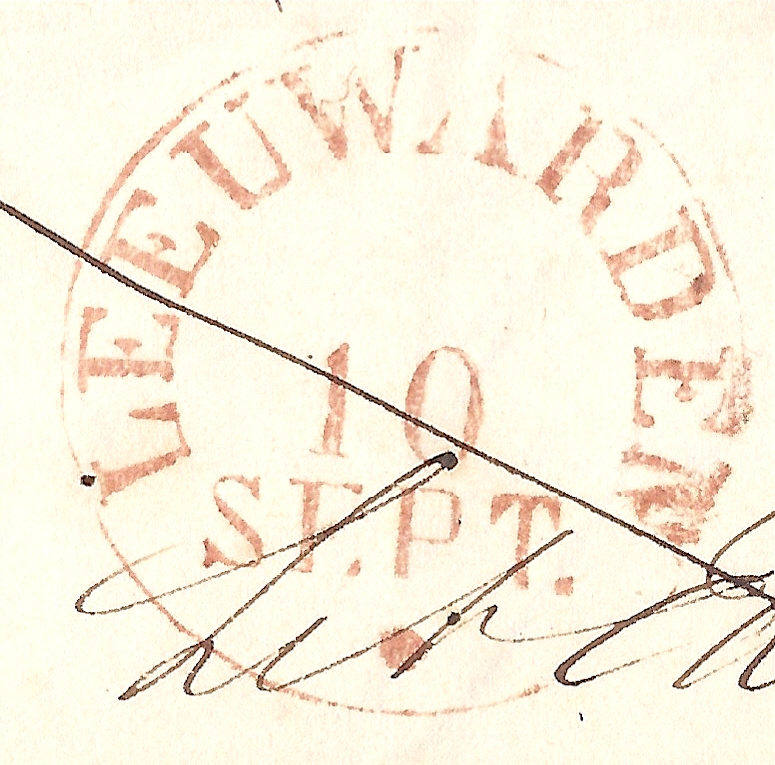
Leeuwarden - Sint Annaparochie 1844

postmark Leeuwarden
Folded letter sent from Leeuwarden to Sint Annaparochie on the 10th of September 1844 bearing the first Dutch date cancel type (type II) reading LEEUWARDEN 10 SEPT.. 
In the Netherlands the first 3 postage stamps were introduced on the 1st of January 1852, prior to that date the sender or addressee of letters, documents and printed matter etc. had to pay the due amount of the services provided to the courier or postman. In 1829 the Dutch postal service had introduced the first Dutch postmarks which denoted the exact date. These so-called date marks (I rather do not prefer to label them as cancels since such a 'cancel' would require a stamp to be devalued) were circular, bore the name of the city and indicated the day and month. A rosette or small cross can be found beneath the month. In our Leeuwarden postmark the rosette seems a bit blurred, which is a shame since the rosette makes this kind of marks aesthetically pleasing. Despite this minor deficit I decided to show you this entire nevertheless since it was posted exactly 150 years before my birth!  

This particular folded letter was sent from Leeuwarden on the 10th of September 1844 and according to the unrivalled reference work Postmerken & Postinrichtingen the Leeuwarden date mark belongs to subtype II of the 1829 type. Subtype I (used between 1829-1836) had the day and month indicators placed somewhat higher and more central in the actual postmark. Our example though clearly shows that the day and month are placed in the lower half of the mark.

Leeuwarden to Sint Annaparochie in red
The distance between the city of Leeuwarden  (23,400 souls in 1840) and the farmer's village of Sint Annaparochie is a mere 12 km as the crow flies, but for some reason it took the post 2 to 3 days to reach St. Annaparochie in 1844. The weather couldn't have delayed the Frisian letter-carrying flat bottoms boats, which were responsible for most of the traffic in Frisia back then, but I can imagine the post office in Leeuwarden had some difficulties in finding a 'pieton' (messenger) for taking the letter to Sint Annaparochie. There  was no distribution office in the village (i.e. a small, local sub post office with a distributor arranging incoming and outgoing mail), so a private messenger had to be found. A messenger earned 2 stuivers by delivering a similar letter sent from Leeuwarden to Sint Annaparochie in 1832. The weather should not have been an issue: it hadn't rained for a while and the wind was calm albeit a tat unsettled on the 10th of September.

'Received 13 September 1844' as stated on one of the folds of the letter
The letter is addressed to the council of the 'Grietenij' Het Bildt. On the map below it's obvious St. Annaparochie is situated in the heart of the Bildt. 'Grietenij' is the Frisian equivalent for the Dutch 'Gemeente': a municipality. I haven't found any marks on the letter which reveal something about a possible rate between the two places. I therefore suspect this particular entire was free of any postage, since the addressee seems to have been the director of the post office in Leeuwarden: a certain Mr De Graaff. Could the cross on the front indicate this special service? 

Indication distance between Leeuwarden and Sint Annaparochie on contemporary map
The postal service strongly advised their employees to use a reddish colour to impress the mark on letters etc. I guess that this colour resulted in the starkest contrast possible on beige paper, or was it just a cheaper option to use red ink instead of black? In 1844 a similar albeit smaller circular postmark replaced our type. They can easily be distinguished since the smaller type has the month placed above the day, whether the 1829 marks have the day placed above the month.

LEEUWARDEN 10 SEPT.
I hope to continue this story in the near future since many Dutch pre-philately items come in the shape of folded letters, i.e. their contents are preserved...:


The contents seem to involve the costs for 8 lots for an exhibition to be held somewhere in Frisia, most probably in Leeuwarden. De Graaff writes: "On behalf of his excellency Mr Straatzand, Gouvernor of the Province of Frisia, I have the honour to present to you, my lord, 8 lots on request in favour of those participants named below, for which you, my lord, will send me the sum of fl. 24,- by post to my address after their collection." Then follows a list of 8 names and lot numbers. The only clue that the purpose of these lots was for an exhibition to be held, hides in the subscript the addressee wrote down on the 13th of September. He signs the letter with his function: Secretary of the Commission of the Exhibition. At the moment I'm still searching for information about the kind of exhibition this would have been.      

Oily forwarding mystery - Delft to Port Swettenham via Babo

Newspaper wrapper sent from Delft 17-1-1938 via Pladjoe and Babo to Port Swettenham via Singapore (4-6-1938) The newspaper wrapper shown abo...