Showing posts with label Stamp. Show all posts

Wednesday, 7 November 2018

Sparkling tiara's on Dutch Indies stamps

In my previous post I wrote about the various tiara's worn by Queen Wilhelmina which appear on Dutch stamps. Now time has come to do the same for Dutch colonial stamps (Curaçao and the Dutch Indies). While some colonial series share resemblances with Dutch stamps and are based on the same photographs, various series belong solely to the colonies. They really give you a more exotic impression when compared to the quite frugal Dutch designs. We will commence with the Dutch Indies.

Veth 1903
The first Dutch Indian series of Wilhelmina was designed by Jan Veth and introduced in 1903. Veth was also responsible for the definitive 1924-1930 series which was used in the Netherlands. His 1903 Indies design was even more attractive than his Dutch series in my opinion. Have a look at this 10c overprint variety:

postzegel, stamp, 1908
NVPH 88 - 1908 - Queen Wilhelmina 10c 'Buiten Bezit' overprint

Even with the heavy postmark and obtrusive overprint the stamp still possesses a simple grace. The overprint 'Buiten Bezit' indicates that this stamp was meant for post offices in the Dutch Indies which were not located on the isle of Java. Since this island was the first real colonial property of the Netherlands, officials used the term 'Buiten Bezit' (~ outer possessions) for the numerous other islands, especially Sumatra, Celebes and Borneo.  
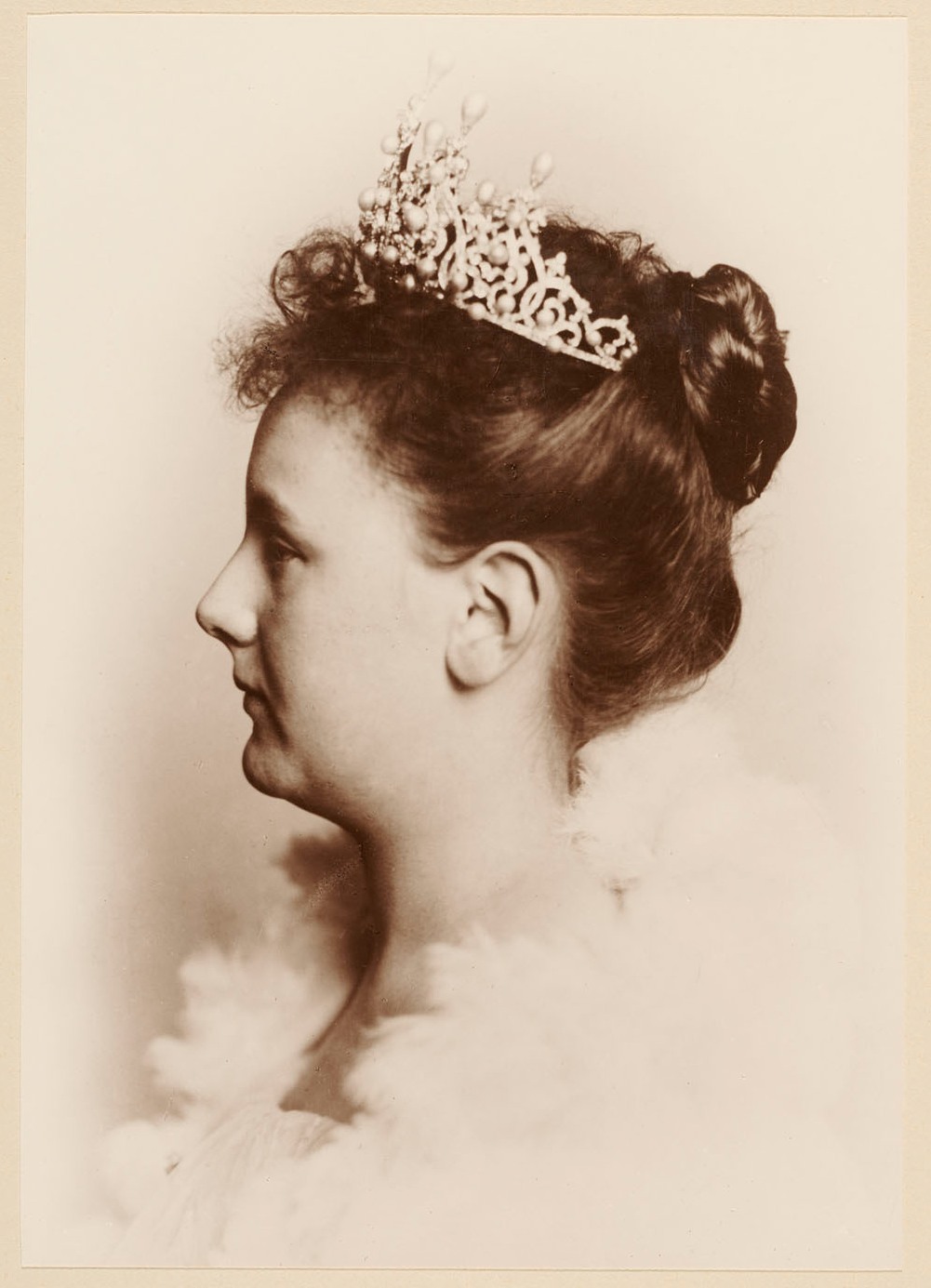
Queen Wilhelmina 1897 photograph
I'm convinced Mr Veth used the photograph above for his design, the same photograph which was used for the Dutch 1899 Mouchon 'Fur Collar' stamps. Wilhelmina wore her Württemberg Ornate Pearl Tiara on that occasion but I have to admit Veth didn't succeed in engraving this tiara. He has turned it into a rather clumsy diadem on his stamps. 

postzegel, stamp, dienst, 1911
NVPH D26 - 1911 - Queen Wilhelmina 1g 'Dienst.' overprint
The stamp above belongs to the same series, but is larger in size (together with the 2 1/2g) and is embellished with two Olympic gods (Hermes and Ceres) and two ships in its frame. A very handsome design, although this particular one is gravely ruined by the 'Dienst' overprint. 'Dienst' stamps are officials.

Seegers and Harting 1913

postzegel, stamp, 1914
NVPH 120 - 1914 - Wilhelmina 20c
In the early 1910s H. Seegers designed a new series of stamps, to be used in the Dutch Indies, Curacao and Suriname. A plain engraving showing Wilhelmina en profil and a lonely ship was used for the lower values up to 50c. From 50c onwards a more elaborate and a larger stamp was used, designed by D. Harting (see below). I daresay both designers used the 1897 photograph again (15 years after it was made...) and Harting obviously did a better job. Wilhelmina's ear on Mr Seegers' stamp is simply too grotesque.  

postzegel, stamp, 1913
NVPH 132 - 1913 - Queen Wilhelmina 1g
What I do like when looking at Harting's stamp is the very exotic though elegant framework. Much attention has been given to design the denomination and country designation, which makes me think of this stamp as a particularly charming one.     

Jubilee 1923

postzegel, stamp, 1923
NVPH 162 - 1923 - Queen Wilhelmina 20c
In 1923 Wilhelmina had reigned for 25 years: a jubilee which the P.T.T. did not miss. In the Netherlands and the colonies series of stamps were issued which commemorated her achievement. The colonial stamps differed a great deal from the Dutch series, which was designed in art deco style. The stamp above though can be described as very conservative and '19th centurish', but was apparently deemed perfectly apt for the Dutch colonies associated with all their opulence and richness. We see a heavily illuminated frame surrounding Wilhelmina who wears a grand diadem. You could almost imagine that this diadem should be called the 'pearl of the Indies' when taking its gigantic proportions into consideration. Not frugal at all and very un-Dutch. On top of this she wears an eye-catching necklace. 

1923 photograph by H. Deutmann
In the archives I found the photo on which the series was based. Cheffer made the excellent engraving, whilst Seegers resorted to the framework. He probably hadn't forgot his clumsy ear (nor had the P.T.T.), but he made it up by lovely adorning this series. Wilhelmina wears the so-called Wedding Gift Tiara. Because of its gigantic proportions her daughter - queen Juliana - had dismantled the parure when she became queen. Maybe she thought it a too opulent display for the Netherlands, especially after we lost the Indies in 1949.  

Kreisler 1934

postzegel, stamp, 1934
NVPH 196 - 1934 - Queen Wilhelmina 12 1/2c
To complete the Indies diadem tour, we cannot exclude Kreisler's magnificent 1934 Wilhelmina series. Why magnificent? Well, he dared to present the P.T.T. with a square stamp design. That was a first and a gamble. Moreover, his design consists out of a very humble but at the same time proud depiction of the queen within a neat though elegant framework. This and the combination of native art with two important Dutch elements (shipping & infrastructure) makes the stamp truly iconic. Where the 1923 jubilee series overwhelms you a bit too heavily, this stamp does not make any presumptions. That's quite an achievement, since Wilhelmina is depicted with her Wedding Gift Tiara again. Kreisler didn't make this diadem look preposterous though (a feeling which I got with the jubilee series), since the diadem softly sinks away in her hair. Very refined. 

Wednesday, 26 September 2018

A wrecked French Brig


Cover Vlieland to Amsterdam 1871, Naamstempel Vlieland, Tweeletterstempel Den Helder
Cover which travelled from the island of Vlieland to Amsterdam in November 1871
Sometimes you just stumble upon an interesting piece of postal history by chance. A few weeks ago I enjoyed such a moment when I discovered the envelope depicted above. At first sight a very ordinary cover and - to be honest - even a bit ugly because of  the discolouring of the lower half. Still, I found myself struggling to put it aside and continue my search for covers which would suit my collections better. Several reasons tempted me though not to put the cover aside:

  • The unusual location from which the cover was sent: the isle of Vlieland. 
  • The unusual addressee of the cover: the French ambassador/consul to the Netherlands.
  • The mysterious and quite attractive red wax seal on the reverse (see below).

In the end I bought the cover...

Vlieland
In November 1871 Vlieland could consider itself as the least populated island of the Dutch Frisian Islands (Dutch: Waddeneilanden). Only about 650 souls inhabited the elongated sandy stretch of land and most of them earned their living from fishing and occasionally they plundered wrecked ships...

Locations of the isle of Vlieland (upper arrow) and Amsterdam (lower arrow)

It needs no explanation that most of the Dutch were unaware of the nature of the island, since back in the 1870s tourism wasn't as thriving as in 2018. Nowadays a large ferry shuttles between the island and Harlingen in Frisia which brings thousands of tourists to Vlieland every summer. The island's actual population though remains still quite small: about 1.100 people. The island today belongs to the province of Frisia, although the dialect and more cultural aspects share more resemblances with Texel and North-Holland.

The isle of Vlieland with its sole village Oost-Vlieland on the southeastern side.
Postal pieces travelling to and from the island went by ship via the neighbouring island of Texel to Den Helder in North-Holland. Our piece travelled this route too.

Postmarks
The "Vlieland" town name marker (see below) was placed in blue ink on the cover before reaching the first proper (main) post office in Den Helder. Only main post offices were allowed to cancel the stamp when a postal item travelled beyond the border of a postal district (rayon). In 1871 this happened by the combination of a so-called "hour postmark with letter" (departure) postmark reading Den Helder 4A-8A and its corresponding numeral postmark 53 which was used for the actual cancellation of the stamp. 

3e Emissie NVPH 7 Willem III 5 cent nummerstempel Den Helder
Numeral Cancel of Den Helder '53' on a King William III 5c blue (1867-68): Scott 7/NVPH 7 
Tweeletterstempel Den Helder 1871 4A-8A
Den Helder's Hour Postmark with Letter reading "24 NOV 71 / 4A-8A" 'A' stands for the Dutch Avond (evening), so this interval means between 16:00-20:00. A bit inconvenient and therefore replaced by a more logical postmark from 1877 onwards.

Naamstempel / Langstempel Vlieland 1871 blauw
Vlieland Town Name Marker in blue
Although both the Den Helder numeral as hour postmark are quite common to find (even on complete postal pieces), the Vlieland Name Marker is scarcer on piece. This is of course due to the relative isolation and the low population number of the island. There was no real need of an advanced and speedy postal service so Vlieland always remained a sub-post office.

Mysterious sender
How odd it is then that the cover above was addressed to French ambassador to the Netherlands (Le Consul Général) in Amsterdam? My first guess was that the cover carried a request made by an inhabitant of Vlieland because he/she wanted to settle in France. Odd indeed, but I couldn't think of anything else until I closely looked at the wax seal on the reverse.

Lakzegel / Red wax seal
Wax Seal of ?  
Initially I was inclined to see the ornament above the proper shield as the French Fleur-de-Lis. Now I am not so sure anymore, but this initial thought gave me the impetus to look beyond Vlieland's horizon for other reasons why this letter could have been posted. Could this cover has been sent by a French delegate or attaché for instance? An attaché reporting on French trade with Vlieland? Very unlikely, but I continued my search on the great online resource of Dutch newspapers delpher.nl and curbed my search results "Vlieland", "Frankrijk" and "1871" to the months of October, November and December. After 10 minutes or so the following entry caught my attention (Leeuwarder Courant, 05-12-1871):


~
Public Sale
 Vlieland
On Monday the 11th of December 1871, half past ten in the morning Mr L. Zunderdorp will sell by court order of the right honourable Consul-General of France to the Netherlands and in presence of bailiff P. Hoedemaker on Vlieland 
The Body or Vessel  
of the French Brig Adèle, Capt. Frouillon, which headed for St. Malo (Frankrijk) from Sundsvall, but now lays wrecked on the northern shore of Vlieland, approximately a half hour walk from the village of Vlieland, as well as the rigging of the ship, consisting of: Anchors, Chains, Cables, Hawsers, Ropes, Ironwork, Blocks, Sails, Spars, Water casks etc. etc.

- Then a piece about the cargo of the ship: pine and fir wood sheets/plates -          

For more information you could apply in writing to the French Consulate near the Weteringbarrière, B B 153 in Amsterdam, as well to Mr L. Zunderdorp on Vlieland.
~
So there we are! Our cover very likely contained a message about this stranded French vessel. I continued my research and soon afterwards I found two very short articles in which the shipwreck was being reported. The first is from the Algemeen Handelsblad of 19-11-1871:

  
~
Shipping Reports
Amsterdam, 17 Nov. The French Brig Adèle, capt. Trouillon, headed for St. Malo from Sundsvall has run ashore on Vlieland last night according to a telegram from the island today. One man perished in the event ; the cargo is being salvaged.  
~
The second article is from the Helderse en Nieuwedieper Courant of the same date:


~
-- Last night the French brig Adèle, capt. Troullon, run ashore on Vlieland, carrying timber from Sundsvall to St. Malo. One of the rig men drowned, all others have been rescued.  
~

Apparently this ship, Adèle, ran aground on the 17th or 18th of November: the two reports differ on the exact night. That makes 6-8 days for its captain (or a French attaché) to have sent our cover to Amsterdam. Bearing in mind that Vlieland certainly wasn't an easy place to reach in these days, I think it was the captain himself who sent the letter. Maybe he had already sent another one earlier on, or - because of the unknown territory he set foot on - he waited a few days in order to sort everything out before he updated the Consul on the dire situation. 

Alas, I haven't found any information on this particular ship and on its captain Trouillon. I will update this post whenever I have found some additional (and eagerly wished for!) details. Obviously no waste of money this cover!    

Lakzegel en tweeletterstempel Amsterdam + bestellersstempel
Reverse of the cover with wax seal, Amsterdam Arrival Postmark (12M-8M: between 12 p.m. and 8 a.m.) and Post Man Mark indicating this cover  has been delivered during his first round of the day (on the 25th of November).

Oily forwarding mystery - Delft to Port Swettenham via Babo

Newspaper wrapper sent from Delft 17-1-1938 via Pladjoe and Babo to Port Swettenham via Singapore (4-6-1938) The newspaper wrapper shown abo...