Showing posts with label Hoogkarspel. Show all posts

Saturday, 30 May 2020

Catching the 19:58 train from Hoogkarspel


Hoogkarspel
1940 express delivery cover which was sent from Hoogkarspel to The Hague by semi-private
 train mail. Rate: 10c (letter over 20 g) + 10c express delivery fee + 10c railway fee.  

In 1924 the Dutch postal service (P.T.T.) came to an agreement with the railways which allowed any railway company who signed up to this agreement to run their own station to station express delivery service. This new semi-private postal service had speed and its regular time-table as a big advantage over the ordinary mail system. Especially small railway towns and villages which used to see a once-a-day collection profited from this service. Initially the agreement between the P.T.T. and the railways was limited to express delivery only. From 15 May 1927 onwards however ordinary postcards and letters were allowed as well.

Hoogkarspel stempel
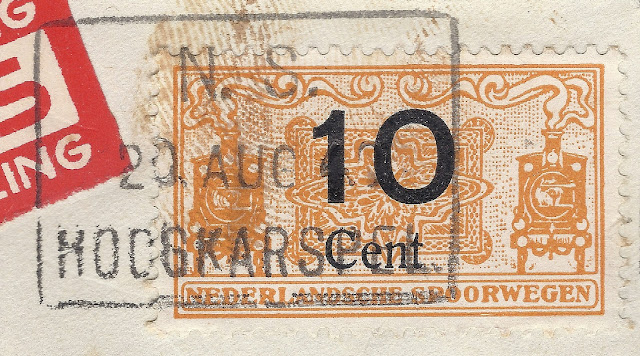
10c railway stamp cancelled by a boxed N.S. Hoogkarspel railway postmark. To this day (May 2020) there doesn't exist a compendium or even a list of these boxed railway hand stamps (bagagebureaustempel).   

Of course the railways charged a fee to finance their new service. Customers had to buy a 10c railway stamp at the station on top of the ordinary (express) letter rate. The cover would be handed over to a railway clerk at the luggage office who would take care of the right train and who would give instructions to the conductor: where the piece should change trains etc. At the station closest to the destination the item would be handed over to the P.T.T. for the final leg. 

Hoogkarspel postzegel
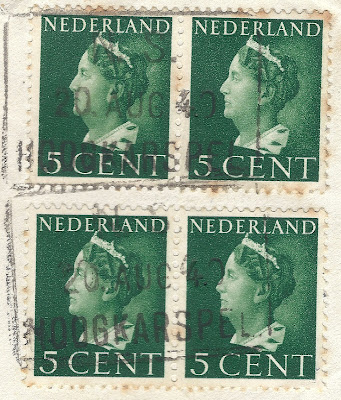
4x 5c green Wilhelmina Van Konijnenburg 

The cover which serves as illustration to this blog was picked up by the N.S. at Hoogkarspel and travelled with train 374 (blue pencil mark) which departed at 19:58 that evening (20-8-1940). Although the Dutch queen and cabinet sought refuge in the U.K. after the Germans invaded the Netherlands in May of that year, people still used stamps with her portrait. Reichskommisar Seyss-Inquart declared them invalid however on 10-10-1940. The P.T.T. stamps and the additional 10c railway stamp were cancelled by a boxed N.S. Hoogkarspel railway hand stamp. The express delivery was highlighted by the red Exprès label (type 37 L). Unfortunately the cover didn't make it to The Hague the same day. The arrival date stamp on the reverse makes clear that the item reached the capital on Wednesday 21-8-1940 between 9 and 10 AM.

Hoogkarspel station
The old railway station of Hoogkarspel. Sadly this station was replaced in 1965.

Sunday, 15 December 2019

1952 Child Welfare Fund

Kinderpostzegels
Order Postcard (bestelkaart) franked with a 1952 Child Welfare Fund 2c + 3c tied by a so-called 'Short Beam' Hoogkarspel cds 13-IV-5n 1953. Posted at 5pm on the 13th of April that year.

Verso of the order card

The 1952 Child Welfare Fund stamps were designed by Ms Janzen-Dalenoord. She produced 5 different designs for 5 different values. 

Wednesday, 20 November 2019

1864 issue tied by Hoog-carspel straight-line mark on cover - a stunning discovery!

Hoogkarspel Hoorn France postmark
Folded letter from Hoogkarspel to Tourcoing (France) 28-12-1866 franked by two Willem III 5c stamps (1864 issue) both tied by a HOOG-CARSPEL straight-line mark. The letter was sent to France but the sender/postal clerk put insufficient stamps on the item for a letter of this weight (up to 7½ grams). I suspect a sample of seed was included but not charged... If the sample would have been charged a letter up to 7½ grams to France in 1866 meant that 30c should have been put on the letter. The French Post taxed 12 decimes (120 centimes) which the recipient had to pay (60 Dutch cents (2x the original 30c rate)). The exchange rate Franc-Guilder was about 1:½ in 1866. The French post had already been warned by two Dutch ONTOEREIKEND (insufficient) marks in both black and red. Another mistake was certainly made by the postal clerk at Hoogkarspel, since the stamps shouldn't been cancelled by the HOOG-CARSPEL straight-line mark at all as the letter was sent to a destination located outside the rayon of Hoorn (franked letters sent within the Hoorn district were allowed to be cancelled by local straight-line marks). In Hoorn they corrected the mistake by placing two Boxed Franco cancellations over the stamps. Bureaucracy at its finest. A proper gem. 

Yesterday I came across this item by chance. By the kind permission of its owner I'm allowed to use several scans of it to demonstrate a rare - maybe even unique - item in West-Frisian philately.

Years of searching finally came to an end yesterday, when this letter surfaced. Since I live in Hoogkarspel, finding an item cancelled by one of Hoogkarspel's straight-line markers (either Hoog-carspel or Hoogcarspel) topped my search lists on Ebay and Delcampe for years. But due to the small and largely illiterate population of Hoogkarspel in the 3rd quarter of the 19th century (a dozen persons?) I had already given up hope of ever finding such an item. And now this letter crossed my path by pure chance! And what a gem it is.


Hoogkarspel
Reverse with transit postmark Lille 29 DEC 66 and faint arrival mark Tourcoing 30 DEC 66  

Hoogkarspel was upgraded to a sub-post office in 1866 and the Hoog-carspel postmark had been delivered on the 28th of June that year - just 6 months prior to the date on which the cover was sent. Maybe this novelty in the village caused the postal clerk to accidentally cancel the stamps... How many franked letters would have been sent with a destination outside the rayon of Hoorn since the introduction of the Hoog-carspel postmark only a couple of months earlier. A dozen again? We don't know, but it's properly rare.

Hoog-carspel postmark
1864 issue (Utrecht printing) with HOOG-CARSPEL straight-line cancel. 

Apart from very early use of this straight-line postmark, the stamps on the cover also gave me a little shock. The 1864 issue were to be replaced by a totally new design the next year. The stock of the blue 1864 5c stamps would have dried up soon - even in a small village like Hoogkarspel - after they stopped printing them. So the combination of the Hoog-carspel mark on this issue and this stamp in particular could have only been possible for a few months to one year at most... Extraordinary that this entire survived! I just cannot imagine there would have been sent over a 100 franked letters from Hoogkarspel in 1866-1867 cancelled by the Hoog-carspel mark. Moreover, they all should have been addressed to people/businesses within the Hoorn district, if not the mark should have been placed on the letter instead. So this mistake or happy accident was probably already unique in 1866. I repeat: extraordinary that this item survived all these 153 years largely unscratched. Extraordinary it turned up.

From mayor of Hoogkarspel to representative in The Hague


Letter written by Klaas Harshoorn de Jong. Transcription:

                                                                                                                    Hoog carspel, ce 28 Dec. 1866
                               Monsieur J Toulemonde
                                        à Tourcoing


                               Après un absence de quelques semaines, j'ai trouvé votre honoré [?] des 19 de l'écoulé.
                               Selon votre desire je vous envoie un Prix courant des graines de notre pays. Moi je fais le commerce de                                                                             Carvis et Moutarde brun tandisque c'est un des mes cousins qui cultive  tous les autres graines. 
                               Je serai bien heureux si vous pouviez me donner des ordres.
                                     En attendant le plaisir de vous lire Agnecy [?] Monsieur mes salutations sincères.

                                                                                                                   K. H. de Jong

Klaas Harshoorn de Jong (1815-1866) was born in the so-called Medemblikker Tolhuis on the 14th of December 1815. This toll house had been constructed in 1729 on the new junction of the old paved road between Hoorn and Enkhuizen (Streekweg) and the newly built Tolweg to Medemblik. Napoleon travelled to Medemblik over this road 4 years prior to De Jong's birth. His father Melchert farmed several pastures in Hoogkarspel and was innkeeper of the toll house. After having finished school Klaas de Jong became wholesaler and merchant in cheese, wine and liquor in Hoorn which he combined with his occupation as farmer and agriculturalist in Hoogkarspel. Besides this already busy lifestyle for a person in the early 1800s he trained himself to become a teacher. A remarkable person!

Map Hoogkarspel
Contemporary map of Hoogkarspel and surroundings which dates from ca. 1864. In the red balloon you could just read Medemblikker Tol. The red arrow points to the location of the Medemblik Toll House and the blue arrow to the Church and Ons Huis of Hoogkarspel.


Map West-Frisia
Location of Hoogkarspel in West Frisia in 1866 

Klaas also aspired a political career in later life which culminated in his function as representative of the Hoorn District between 1871 and 1884 and again between 1884 until his death in 1886. Before this he had been local council member of the Hoogkarspel municipality and he even served as mayor of Hoogkarspel between 1859 until his death. Apparently he had established himself as a popular political figure in the 3rd quarter of the 19th century and in the light of his various additional functions (Poldermeester, i.e. chair of a the Grootslag polder water board; church warden of the Dutch reformed church of Hoogkarspel; agricultural consultant to the Dutch Lower House etc. etc.) on may conclude Klaas Harshoorn de Jong certainly thrived as public man.

Painting Dutch 1855 Vorderman
Klaas Harshoorn de Jong and (I suppose) his second wife Ietske Rodenburg with his children (f.l.t.r. Aaltje, Grietje and Melchert de Jong). Klaas' first wife Elisabeth Pool died after Grietje was born in 1848. I assume the little girl holding Ietske's hand is a child of a previous marriage of her... The painting dates from 1855 and was allegedly painted by H. Vorderman. All rights reserved Het Westfries Museum Hoorn.      
  
On the painting above you can see the old reformed church of Hoogkarspel through the window. Klaas convinced the church board of replacing this medieval church by a new one in 1860. Above his sons head you could see a fictional (?) painting of 'Ons Huis' (Our House). Klaas thrived as business man as well and his earning allowed him to construct this large and modern mayor's residence/wine storage right beside the old church. After Klaas died in 1886 (he survived all his 3 wives) his house was subsequently owned by Klaas Koster, his son-in-law who was a merchant in wine too. He sold the building in 1903 to 't Nut (Society for Public Welfare) for fl. 5000,- The specific purpose of t' Nut in Hoogkarspel was to educate the villagers in things culturally and several rooms were used to exhibit photo's, moving images etc. Alas, Ons Huis was demolished in 1970, along with several other buildings in the center of the village to make room for a modern shopping mall, church and town hall. 

Sadly Klaas de Jong would not have been able to recognize his Hoogkarspel if he would be alive today. Not only his own house is no more: his newly constructed church was demolished in 1966 - it's said the foundations were in such a bad shape the building was beyond repair. His birthplace managed to survive until 1973 when fire ruined this historical building. Although in 1881 Medemblik had stopped levying the tolls over the Tolweg, the Toll House remained a place of community and an inn to its last days when it accommodated as snack bar. Only a few buildings which were built prior to De Jong's death in 1886 survive - most remarkable is the so-called Zonnehuis which he had commissioned in 1860 - but most of them have been replaced by modern structures, all inferior to their predecessors... Below I've attached a few photo's of the Toll House, De Jong's church and his house when they were still intact and palatable to observe. 


Hoogkarspel
Medemblikker Tolhuis (Toll House and inn) looking eastwards  around 1900-1910 - birthplace of mayor and representative Klaas Harshoorn de Jong

Hoogkarspel
Another image of the Medemblikker Tolhuis now looking westwards again between 1900-1910. The chariot right seems to have come from Medemblik over the Tolweg and is about to turn on the paved road between Hoorn and Enkhuizen. Also notice the way how the Toll House inn is described on the card: as an Hotel and Café Restaurant - brilliant. 

Dutch reformed church Hoogkarspel
Reformed Church of Hoogkarspel which replaced the older medieval church on Klaas de Jong's initiative of 1860. This Gothic Revival place of worship barely survived its centenary - it was demolished in 1966. The tree in the front - a variegated Norway maple - still exists and is probably the oldest tree of Hoogkarspel by now.   


Ons Huis (lit. Our House) where Klaas de Jong lived and had his office as merchant in wine and cheese. The name Ons Huis is coined after 1903 when the building was purchased by 't Nut (Society for Public Welfare). It was demolished in 1970.

Hoogkarspel
Another photograph of Ons Huis looking to the east which almost resembles the 'painting in the painting' of Klaas de Jong's family from 1855.  

Both the very interesting philatelic and historical value of this letter from 1866 make it a true document of note for Hoogkarspel. 

With special credits to a friendly collector and the Westfries Museum for making this blog understandable and attractive. 

Sunday, 6 January 2019

Happy New Year - 1914

Gelukkig Nieuw jaar
Happy New Year!
While browsing through my collection, I stumbled upon the embossed Happy New Year postcard above. A proper reminder for me to convey you all my - now belated - best wishes for 2019!

Although the picture postcard itself seems philately wise quite irrelevant, it suits my West Frisia collection nicely since it bears the postmark of the town of Hoogkarspel:

Postmark
Large round postmark of Hoogkarspel, reading 31 DEC 13 on 1c Vürtheim
Since the sender chose to apply a 1c stamp (printed matter rate) she wasn't allowed to write anything on the card apart from the address. She did cheat however by discretely placing her name under 'Bovenkarspel': T. Broers. After some research online a very respected genealogist found a certain Catharina Broers who lived in Hoogkarspel in these years. In the West Frisian dialect the catholic name of Catharina is often abbreviated to Trien or Trijntje, hence the 'T'. She was the daughter of Cornelis Broers and Aaltje Neefjes and married with Nicolaas Koopman in 1917 at age 23.


Postmark
Reverse of the postcard
New Year 1914 was quite chilly, temperatures did hover around freezing. Frederik van Eeden, a famous Dutch author added to his diary on the 1st of January: "Stil, matig vriezend weer." Tranquil weather, moderate frost. January 1914 turned into a below average cold month in the Netherlands: from the 10th until the 25th people had to cope with a period of frost with an average temperature of -3°C. Compared to today's Dutch standards: extremely cold. Alas, the period fell only one day short for a 3rd Elfstedentocht to be organized. 

A tumultuous year

We all know now that 1914 didn't turn in a happy year at all, although the Netherlands did escape the bloody consequences of the assassination of Archduke Franz Ferdinand. The town of Bovenkarspel and its hamlet Broerkerhaven, situated in West Frisia (Holland) probably didn't witness even one of the approx. 1 million Belgian refugees who fled their country after Germany had successfully occupied it. It really was (and still is) on the edge of the country, far from every border.

1914
Map of the upper part of the province of Noord-Holland, the protruding part (the 'Nose') is the eastern part of West Frisia. Bovenkarspel below the red arrow. 


Hoogkarspel-Broekerhaven

The actual route the postcard travelled was not very exiting: from the town of Hoogkarspel the postcard could either have made the journey by rail or by tram taking the old route through the various villages of the 'Streek'. In Dutch 'streek' means a region, or part of a country. The Streek is the long road (already paved in 1671) between the VOC cities of Hoorn and Enkhuizen. Since the villages between these cities were of vital importance for the people living and working there, a good quality road was deemed essential. Many people who lived alongside the paved road benefited from this fast connection to Hoorn and Enkhuizen and therefore local trade flourished. In 1889 a horse drawn tram was introduced, but the dawn of motorized traffic turned the tram into an old-fashioned and eventually superfluous means of transport. Services ceased in 1918.

The route between Hoogkarspel and Broekerhaven over the Streekweg in red. To the left we see the once proud city of Enkhuizen, large parts of it were demolished after 1800 because of Napoleon and consequently decreased trade flows.  
The card was addressed to Catharina Botman, probably a daughter (or wife) of Willem Botman. It's a rather strange since mej. (mejuffrouw) is the form of address used for unmarried girls in Dutch and therefore the equivalent of the English miss. But in 1913 Catharina Botman was already married to Willem for a long time, so maybe this card was addressed to her daughter with the same name. By sheer chance Catharina's own family name was also Botman, so she was called Catharina Botman-Botman.  


Transport over water

Willem Botman was trained into a special trade, that of schuitenpik. Schuitenpikkers build so-called schuiten (Dutch barge or schuyt), which are the type of flat-bottom ships farmers and agrarians used in West Frisia and other parts of Noord-Holland to bring e.g. cattle to and fro their lands in the wet polder area's. You only have to look at the map above to see that most of the fertile lands were inaccessible by foot, everything had to be transported over water. You'll find more about Westfrisian agriculture here

Schuitenhelling (barge ramp) of the Botman family in Broekerhaven. The third person from the right is Willem Botman (1865-1929),  the fourth person from the right is his wife Catharina Botman (1870-1954) to whom the postcard could have been addressed. Copyright and courtesy of Historische Vereniging Stede Broec. 

Two schuyts entering the city of Enkhuizen with one of them carrying a tractor. © Collectie Rijksdienst voor het Cultureel Erfgoed, F002889 

This all changed as late as the 1960s when the polders were 'verkaveld', which means that the land and numerous ditches were straightened, raised and filled. At the same time new roads were introduced to make this vast area accessible for motorized vehicles. I do not have to stress how this process literally wrecked the unrivalled beauty of West Frisia, particularly ruining the Streek region.
       
PS I've added three - I think - relatively contemporary photo's which were taken along the route the postcard travelled. Could you guess where exactly the pictures were taken?

Hoogkarspel autochrome
Hoogkarspel approx. 1907-1915. Autochrome photograph of a freshly painted West Frisian farm (Stolp) in the early 1900s, before the introduction of electricity. The tram rails laid claim on the southern part of the Streekweg, so the photographer looked to the west.   
Catholic Church Netherlands
Spire of the Catholic Church of Bovenkarspel (now demolished) and the tram rails (removed in 1924). © Collectie Rijksdienst voor het Cultureel Erfgoed, BR00885-81357 

Railway crossing Netherlands
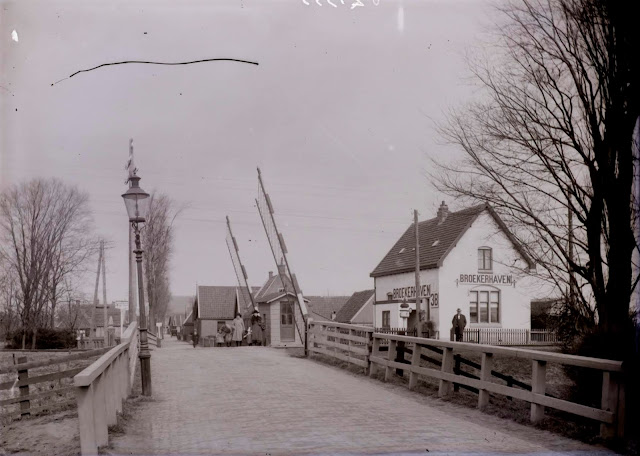
Railway crossing Broekerhaven. © Collectie Rijksdienst voor het Cultureel Erfgoed, BR00883-81355

Oily forwarding mystery - Delft to Port Swettenham via Babo

Newspaper wrapper sent from Delft 17-1-1938 via Pladjoe and Babo to Port Swettenham via Singapore (4-6-1938) The newspaper wrapper shown abo...