Showing posts with label Manokwari. Show all posts

Tuesday, 15 December 2020

Into the heart of New Guinea - The Central New Guinea Expedition of 1920

New Guinea
Postcard sent from Pionierbivak in December 1920 via Manokwari (early January 1921) to France, before being redirected to Rome in March 1921.

When interest in the western part of New Guinea grew at the end of the 19th century, Batavia - modern Jakarta - was faced with an extensive topographical job to map this huge island. Traditionally, the sultan of the small island of Tidore controlled this area after the Sultanate had reached a 'thin' agreement with the VOC in 1660. This agreement stated that "The Papuan areas, or similar islands, all belong to the King of Tidore." The VOC  closed this deal with the Sultan of Tidore without having any basic knowledge of the enormous archipelago (approx. 19x times the size current area of ​​the Netherlands, more than 2x the size of Germany). Only a few journeys were endeavored by the VOC to ensure that no illegal clove growers were active in this vast area. When it turned out that this was not the case, indifference to New Guinea rose to a degree which bordered on contempt, and this remained to be the case in the centuries that followed.

At times, Batavia feared that other colonial powers might be interested in this unexplored country. That this was a well-founded fear is evident from the efforts of the British Captain John Hayes, who claimed New Guinea for Great Britain in 1793 and founded a small stockade fortress which he called Fort Coronation. It took its occupiers three years - until 1795 - to abandon. Later Manokwari was built on this spot.

1920
Manokwari in 1920

Rather startled by this "surprise attack" by a British merchant and later in the 19th century by the Scramble for Africa, Batavia resolved to gradually colonize the area. It took until 1897 however before the colonial government decided to do so. In this year, two districts were formed: Northern New Guinea with Manokwari as capital and West and South New Guinea with Fakfak as capital. It was believed that the need for (limited) Dutch rule would also limit the unbridled power of the Tidorese sultan. Until the beginning of the 20th century, the monarch regularly held (illegal) slave raids in the Geelvinkbaai to obtain cheap manpower for his plantations.

In order to thoroughly explore the area, Batavia sent various military expeditions to the yet unknown heartland of New Guinea to colourize this white spot on the map. From 1903 scientific expeditions were also ventured. One of these scientific expeditions is known as the Central New Guinea Expedition of 1920, which aimed to reach the Wilhelmina Summit (now Puncak Trikora) in the central mountain range. In general, the scientific team also wanted to know which (unknown) peoples lived in the area between the so-called Meervlakte and the central ridge. In addition, five scientists focused on issues such as native flora, fauna, geology, etc.

Pionierbivak on the Mamberamo river is located in the most northwards pointing tip of the main body of West New Guinea (excluding the large Bird's Head Peninsula to the west). 

The Central New Guinea Expedition started in late January 1920 after the entire crew had gathered in Manokwari. From there they sailed about 400 km east before they entered the mouth of the mighty Mamberamo river on the  2nd of February. A military expedition had already explored this river and its headwaters in 1914 and had established some camp sites. A fascinating account (in Dutch) of this military expedition is available online: https://www.gutenberg.org/files/20167/20167-h/20167-h.htm.
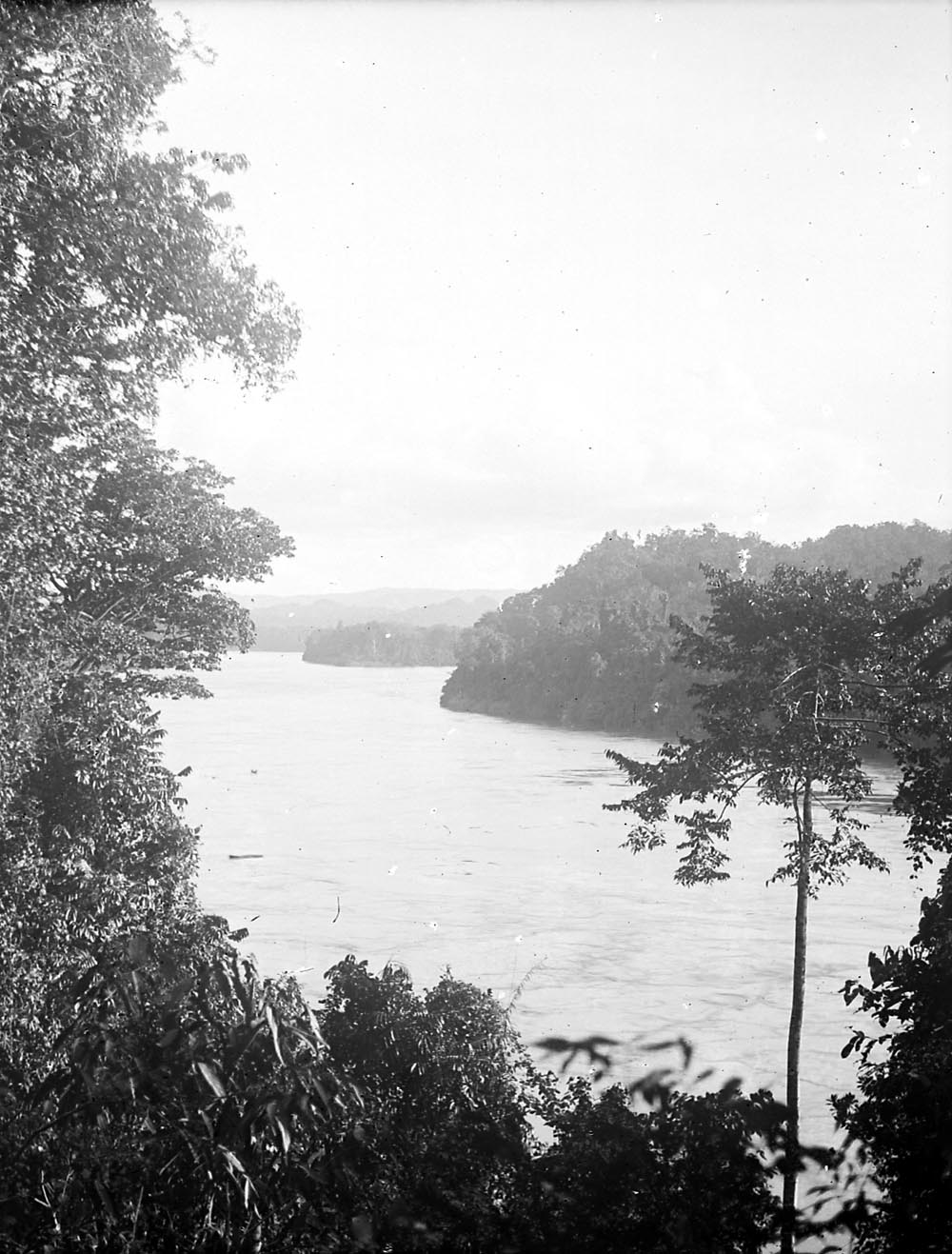
New Guinea, Pionierbivak
The bend in Mamberamo river near Pionierbivak

The main bivouac - called Pionierbivak (Pioneer Bivouac) - was situated along a strategic bend in the river. From the mouth of the Mamberamo it took several days to reach this place. From this "base camp" the Central New Guinea Expedition explored the dense flora and fauna of central  New Guinea. Besides, they encountered very friendly peoples near the central ridge. Not to be compared with the relentless headhunters around Merauke on the south coast!

1920
Pionierbivak in 1920 

The journey of this postcard also starts in Pionierbivak. Although philatelic in nature, I am not aware of any other postal (value) item sent from Pionierbivak, let alone an item sent from another bivouac. The expedition maintained a regular freight link across the river and sea with Manokwari. The card was sent by the expedition's zoologist, Dr. W.C. van Heurn. W.C. van Heurn (1887-1972) was of noble descent and carried the title of Jonkheer (comparable with squire in English). His younger brother had studied zoology as well and was active in the Sultanate of Deli on Sumatra. W.C. van Heurn has been described by the famous biologist and author Stephen Gould as a "taxonomist's taxonomist". Van Heurn was a keen collector (and hoarder) of 'ordinary' (i.e. not rare) species such as the European Mole and Grove Snail. The Dutch Museum of Natural Science - Naturalis - still houses Van Heurn's collection in a wide variety of jars. Specialists often discovered new species in Van Heurn's diverse collection and no less than 38 species has been named after our author. 

Some members of the Central New Guinea Expedition in front of a shelter (possibly in Pionierbivak): Standing from left to right: zoologist W.C. van Heurn, Lieutenant J. Kooy, Lieutenant Drost, Botanist H.J. Lam; Sitting: Medical Officer H.J.T. Bijlmer and Controleur J. Jongejans.

The addressee was a Frenchman who often asked Van Heurn to send him cards. The postcard was probably written in early December 1920 but was not postmarked in Manokwari until  (1) 4 (?) January 1921. Upon arrival in France in March (?) 1921, the postcard was forwarded to Rome. 
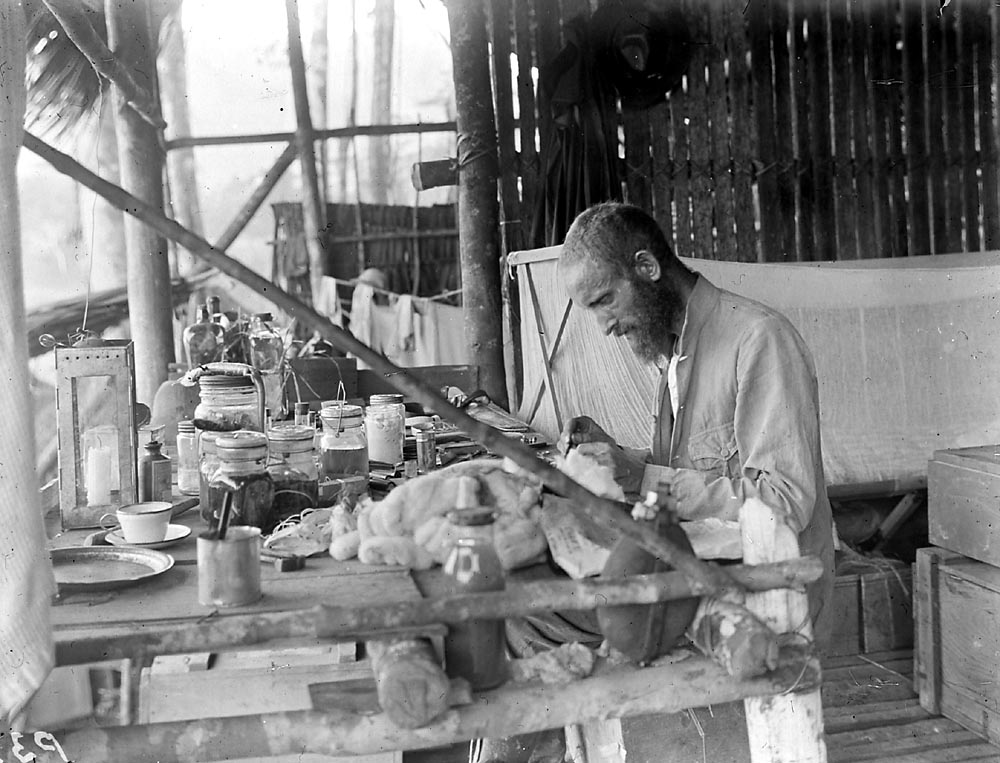
Nieuw-Guinea
The zoologist and writer of the postcard - W.C. van Heurn. This photograph was taken inside his hut in Pionierbivak. He probably wrote this very postcard at this desk.


Postcard
The reverse side of the postcard with written 'Pionier-bivak' and Dec. 1920. The rather formal message was written in French. 

1st update: 7th of April 2021 - new photo, text additions Van Heurn

Thursday, 14 March 2019

Manokwari to Budapest - Netherlands New Guinea

Veilig Verkeer 1962
Postcard from Manokwari (NNG) to Budapest on the 18th of April 1962 with the postage stamps 'Veilig Verkeer' applied
My next post will be devoted to this extraordinary postcard which was sent from Netherlands New Guinea to Budapest, Hungary. In philatelic circles modern, post-war items rarely make the stage in exhibitions and - especially in the case of picture postcards - collectors of older material simply despise 1950s and 1960s material. And than I'm not even daring to mention postcoded covers and cards...

This item will hopefully prove otherwise. I think it is an extremely rare postcard because of two facts: the country of origin (Netherlands New Guinea) and its destination (Hungary) and the set of postage stamps used to make up the rate to Hungary. We will return to the stamps later on, but first we have to return to Netherlands New Guinea in 1962. In short: the Dutch were willing to hand their last colony in Asia over to Indonesia in the early months of that year. To read more about the circumstances in which this transfer took place and the history of this short-lived colony, click here. About 12.000 Dutch citizens still lived in NNG by mid 1962, but they were all due to return to the Netherlands. The Dutch army labelled this repatriation task operation spectrum. There were few other Europeans around, especially since the large part of this colony was never 'properly' cultivated by the Dutch before. They possessed and exploited Java, Sumatra and Celebes, but Guinea only became of any interest after they lost these more populated islands to Indonesia in 1949.       

Netherlands New Guinea
Front of the postcard with a contemporary view close to the capital of NNG: Hollandia

Now we return to the stamps. In the last 9 months when New Guinea was still a Dutch possession, 9 stamps were issued. Two of them are shown here and were issued in March 1962. The other stamps had the following topics: 1) a single 55c stamp commemorating the silver wedding anniversary of Queen Juliana and Bernhard; 2) 2 stamps commemorating the 5th South Pacific Conference in Pago Pago and 3) 4 semi-postal stamps depicting shellfish.

The stamps applied to our card were devoted to road safety (veilig verkeer). A bit odd since there existed only a small amount of motorized traffic in NNG, but entirely understandable when taking into account the Dutch 'campaign' to educate the native people in building their own future. However, by March 1962 it would have been absolutely clear in the Hague that Indonesia would simply annex NNG, rendering this self-awareness campaign quite futile... Nonetheless, the stamps were issued on the 16th of March. They were designed by P.M. van Lienden based upon photographs of A. de Vos. As Hungary was such an extraordinary destination the complete series was needed to make up the sufficient postage. Either the sender didn't want to use the regular 55c Juliana 'En Profil' stamp or the 'Veilig Verkeer' stamps were the only stamps available in Manokwari at the time to make up this scarce rate.   

Nederlands Nieuw Guinea
Netherlands New Guinea 25c blue Road Safety stamp - 1962
It's more likely though that the sender didn't think about the stamps at all; he had more important matters to take care of. E.A. Polansky (according to the Nieuwe Leidsche Courant of 28-11-1960) wanted to study 'Indology' in Delft or Utrecht after his secondary education. Since this study became seemingly futile after the loss of the Dutch Indies, it was discontinued after 1949. Polansky left for Asia nevertheless and became a junior civil servant in NNG in the early 1950s. He studied at the NNG governing institute in Hollandia and    
Nederlands Nieuw Guinea
Netherlands New Guinea 30c green Road Safety stamp - 1962
became a senior civil servant in Sorong and Selawati. The article in the Nieuwe Leidsche Courant states that Polansky studied non-western social studies at the time of writing (i.e. in 1960) and that he hoped to return to NNG after his graduation. The article itself features a summary of a panel discussion between 5 NNG experts about a potential independent future of New Guinea. Only a year later this utopia was smashed down by constant threats of Indonesia. This ultimately resulted in the UNTEA-government and annexation.

Mr Polansky probably witnessed these events with profound regret as he truly seemed to have believed that NNG could have become a successful sovereign Melanesian nation. The poignant power play of Indonesia and the U.S.A. aside in the early 1960s, Dutch politics was only starting to invest time and money to take care of the numerous problems which so often troubled underdeveloped colonies back then. A combination of both factors led to the detested annexation.

At the time of writing Polansky resided in Timinabuan, a small semi-coastal settlement relatively close to Indonesia. In this area (Bird Head's Peninsula) the were some skirmishes between Dutch and Indonesian troops in the early 1960s and especially in 1962. He was senior civil servant in the area and had to inform the Dutch public about the escalating moves of Sukarno in the 'hot' May days of 1962. Earlier that year he still lived in the Netherlands, so I expect that he wrote this postcard in Manokwari on his way to his destination. Timinabuan escaped the destructive force of warfare in the last year of Dutch rule, but nevertheless was shamefully bombed in 1967 by Indonesian troops. By that time Polansky did not interfere in New Guinean state of affairs anymore. During the 'transfer' of power (UNTEA) in late 1962 and the beginning of 1963 he acted as one out of eleven Dutch senior civil servants responsible for a fluid transmission of the civil apparatus into Indonesian hands. 

E.A. Polansky during a panel discussion in 1960
 

Oily forwarding mystery - Delft to Port Swettenham via Babo

Newspaper wrapper sent from Delft 17-1-1938 via Pladjoe and Babo to Port Swettenham via Singapore (4-6-1938) The newspaper wrapper shown abo...