Showing posts with label Hem. Show all posts

Saturday, 30 May 2020

Catching the 19:58 train from Hoogkarspel


Hoogkarspel
1940 express delivery cover which was sent from Hoogkarspel to The Hague by semi-private
 train mail. Rate: 10c (letter over 20 g) + 10c express delivery fee + 10c railway fee.  

In 1924 the Dutch postal service (P.T.T.) came to an agreement with the railways which allowed any railway company who signed up to this agreement to run their own station to station express delivery service. This new semi-private postal service had speed and its regular time-table as a big advantage over the ordinary mail system. Especially small railway towns and villages which used to see a once-a-day collection profited from this service. Initially the agreement between the P.T.T. and the railways was limited to express delivery only. From 15 May 1927 onwards however ordinary postcards and letters were allowed as well.
Hoogkarspel stempel
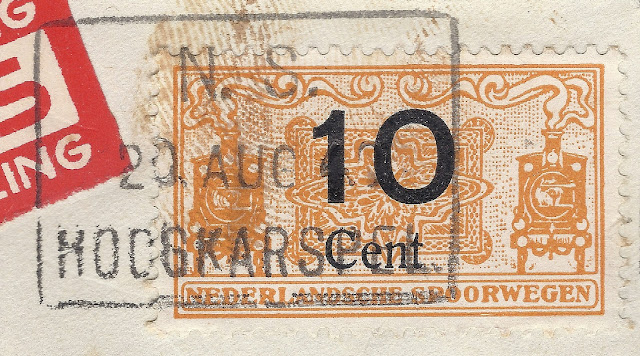
10c railway stamp cancelled by a boxed N.S. Hoogkarspel railway postmark. To this day (May 2020) there doesn't exist a compendium or even a list of these boxed railway hand stamps (bagagebureaustempel).   

Of course the railways charged a fee to finance their new service. Customers had to buy a 10c railway stamp at the station on top of the ordinary (express) letter rate. The cover would be handed over to a railway clerk at the luggage office who would take care of the right train and who would give instructions to the conductor: where the piece should change trains etc. At the station closest to the destination the item would be handed over to the P.T.T. for the final leg. 
Hoogkarspel postzegel
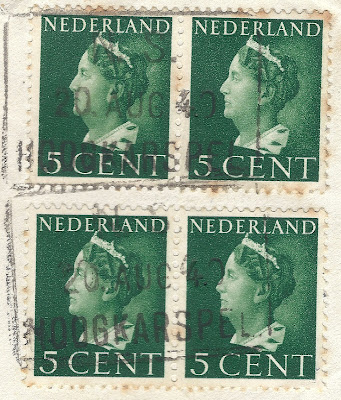
4x 5c green Wilhelmina Van Konijnenburg 

The cover which serves as illustration to this blog was picked up by the N.S. at Hoogkarspel and travelled with train 374 (blue pencil mark) which departed at 19:58 that evening (20-8-1940). Although the Dutch queen and cabinet sought refuge in the U.K. after the Germans invaded the Netherlands in May of that year, people still used stamps with her portrait. Reichskommisar Seyss-Inquart declared them invalid however on 10-10-1940. The P.T.T. stamps and the additional 10c railway stamp were cancelled by a boxed N.S. Hoogkarspel railway hand stamp. The express delivery was highlighted by the red Exprès label (type 37 L). Unfortunately the cover didn't make it to The Hague the same day. The arrival date stamp on the reverse makes clear that the item reached the capital on Wednesday 21-8-1940 between 9 and 10 AM.

Hoogkarspel station
The old railway station of Hoogkarspel. Sadly this station was replaced in 1965.

Sunday, 22 December 2019

Dairy plant 'De Volharding' in Hem

zuivelfabriek
Company envelope sent from Hem on the 6th of November 1949 

The small village of Hem in the southern part of West Frisia established its own dairy plant in the early 1900s to streamline the condition of making cheese and other dairy products in the Zuiderkogge Polder. Farmers who supplied the plant with milk had each their share in the products and profit. The 'Coöp'. abbreviation stands for 'cooperation'. 

Hem fabriek
Dairy plant 'De Volharding' in Hem after it operations  in the 1960s. 

Volharding can be translated as 'perseverance'. The postwar building and especially its chimney still dominate the skyline of Hem in 2019. 

Hem Venhuizen
Juliana 'En Face' tied by a Hem (Noord-Holl.) 'Long Beam' postmark reading 6.XI.49.6.


Hem Venhuizen 1950
Hem and surrounding villages and countryside in the 1950s. The red arrow points to the location of the dairy plant.  

Tuesday, 23 October 2018

The Zuiderkogge in 1924

Typenraderstempel Hem
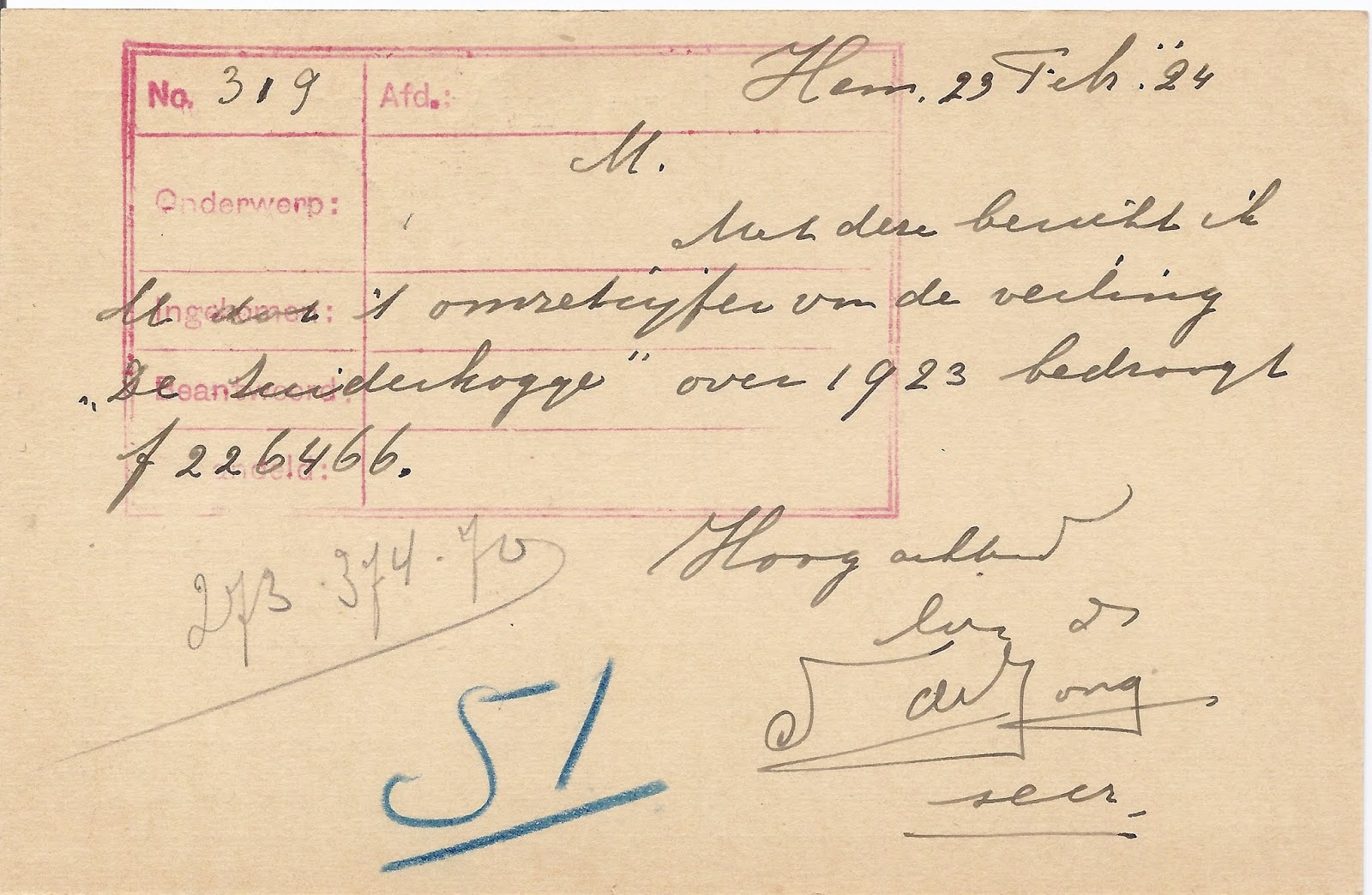
Hem to The Hague - 1924

In a previous post I already mentioned the increasing importance of agriculture for West Frisia during the 18th and 19th centuries. Although seed trade became a very lucrative business for many farmers and smart entrepreneurs, dairy trade did certainly not vanish altogether. On the contrary! West Frisian farmers were as adventurous as the seed traders and advertised their cows by promoting the excellent milk yield of their Dutch Friesian cattle. Farmers across the Atlantic payed staggering amounts for good quality West Frisian bulls, making some farmers fabulously rich during the 1880s.

This postcard travelled from Hem (literally meaning 'Him' in Dutch, which always causes ambiguity when referring to this place...) to The Hague in February 1924. Hem is a corruption of 'Heim' or 'Heem', which indicates a place where people live. Although farming was still the most important livelihood in Hem and neighboring village Venhuizen, here too the agricultural boom slowly transformed many meadows into ploughed fields during the early 20th century. Although this 'agricultural' revolution began later in Hem than some villages more to the north, in 1924 many green fields had become 'white' there as well, as the map below illustrates.

Hem en Venhuizen
Map of the southeastern part of West Frisia

The interest in agriculture only grew by the introduction of so-called 'co-operative auctions' in the region. These joint ventures of local agriculturists increased the attractiveness and range of their products: many West Frisian products found their way to other provinces and even destinations in Germany and the U.K.!

The auctions halls were often located in proximity of water and rail. Since many agricultural products were transported to these auctions by schuiten (barges), these halls were designed in such a fashion that a barge could enter the building in order to let dealers inspect the crop. The photo below shows my great-grandfather (left) who was on the committee of Auction the Eendracht (concord) in Hoogkarspel. You could discern the 'gate' through which the barge entered the building. The man on the right - who stands on his barge, probably carried cauliflower by the looks of  it - offered him a cigar box.

Veiling de Eendracht - Hoogkarspel
Frans Brieffies (left) and agriculturist in auction house the Eendracht - Hoogkarspel

Back to the postcard. As you might have seen, this card was addressed to "Het Centraal Bureau van de Veilingen in Nederland - groep veilingsverenigingen". A mouthful, but roughly translated you will find out that this was the Central Office of Agricultural Trade in the Netherlands.

When we flip the card, we find the following message:


 ~
Hem, 23 Feb. 24
M.
Met deze bericht ik U dat 't omzetcijfer van de veiling 
"De Zuiderkogge'" over 1923 bedraagt ƒ226466. 

Hoogachtend,

~
In English:

~
Hem, 23 Feb. 1924,

Mr
Hereby I report to you that the sale figure of auction 
"De Zuiderkogge" over the year 1923 amounts to ƒ226.466.

Yours faithfully,
~

Big numbers for 1923! The Zuiderkogge auction was located near a new railway (see red arrow on the map), which was specifically built for the agricultural trade in this part of West Frisia. Alas, this railway was defeated by road transport in the early thirties and therefore was never really worth its investment. Although the Eendracht in neighboring Hoogkarspel usually expected to sell for ƒ600.000 annually, for a village which still largely relied on farming ƒ226.466 is a considerably profit.  

Typenrader postmark of Hem on Wilhelmina Fur Collar 7,5c stationery. It reads 23 II 24 2-3N, meaning the 23th of February 1924 between 2-3 afternoon. The abbreviation (Noord-Holl.) stands for the Dutch province of Noord-Holland. It was probably added to prevent any confusion about such a short name.   


Oily forwarding mystery - Delft to Port Swettenham via Babo

Newspaper wrapper sent from Delft 17-1-1938 via Pladjoe and Babo to Port Swettenham via Singapore (4-6-1938) The newspaper wrapper shown abo...