Showing posts with label agriculture. Show all posts

Sunday, 27 January 2019

Westeinde-Bangert 1922


The next picture postcard was sent from the hamlet of Westeinde (between Bovenkarspel and Enkhuizen) to the Bangert, another Hamlet which was particularly renowned for its beautiful orchards. As I have already mentioned in several of my previous posts about agriculture in West Frisia, the yield was in general (very) positive and because of the dawn of agricultural auctions around the turn of the 20th century farmers and (here specifically) fruit growers benefited from increased trade flows. Of course the Great Depression did harm West Frisia as well eventually, and then slowly the inevitable decline kicked in... Today the once thriving orchards of the Bangert have all but a few been erased and replaced by newly constructed neighborhoods to accommodate the ever growing city of Hoorn. Progress, as we now call it.

The journey 

Before turning to some contemporary photo's, we should pay attention to the (meager) philatelic aspects of this postcard and the route it travelled.

block-cancel
Westeinde to the Bangert 1922 
The postcard was sent by a certain W. Singer who lived in Westeinde. The addition 'Enkhuizen' tells me that he resided in the Enkhuizen part of Westeinde, rather than the Bovenkarspel area of the hamlet. Therefore I am also inclined to believe the postcard was brought to the railway station of Enkhuizen rather than the Bovenkarspel stop.

interior
Interior of the waiting room of the Enkhuizen railway station in 1941, by the looks of it 1st or 2nd class. 
You might wonder why I'm talking about the railways in the first place. Well, that's because of the quaint postmark on the Vürtheim stamp. This so-called 'Block-cancel' (Vellinga) was introduced in 1910 to cancel mail on various routes/sections of the Dutch railways. This particular postmark was used on the stretch Enkhuizen-Amsterdam. The serving postman on the train could swap the place name blocks upon arrival in Amsterdam: the name of the departing station should always be on top. This proved to be a big improvement over the older large round and typenrader postmarks where the name of the stretch was a fixed part. This particular block-cancel invalidated a 2c Vürtheim stamp which represented the rate for postal stationary in 1922. The 'C' which comes after the date might mean that this was the 3rd train departing Enkhuizen that day. The sender did presumably drop his/her card in a postbox attached to the mail wagon / 'travelling post office' in Enkhuizen or - less likely - at the Bovenkarspel stop.

block-cancel
Enkhuizen-Amsterdam block-cancel reading 31.1.22. C on a 2c Vürtheim stamp
The 31st of January 1922 had a cold touch. Without any sunshine and an average temperature of about 3°C it probably was a miserable day for many folks across the Netherlands. Periods of even colder, freezing weather preceded and proceeded the end of January.  


1922
Westeinde near Enkhuizen (top right) to the Bangert near Hoorn. 
The postcard was thus posted on a train heading west to Amsterdam, but at the rural Blokker railway station the postman in charge of the travelling post office probably unloaded several items including our postcard. At least, that's how I think the postcard was eventually delivered.   


1920
Blokker railway station, approx. 1920s 

Two agrarian hamlets - two different crop cultures


The hamlet of Westeinde between the village of Bovenkarspel and the city of Enkhuizen
When exploring the map above, you will soon realize that Westeinde (still) only consists out of one long road connecting Bovenkarspel with Enkhuizen. At the end of the 19th century two large seed cultivators from the village of Andijk moved their companies to Westeinde due to its strategic location near a city with good (rail)infrastructure. Read more about these companies here. Ever since Westeinde is known as a hub for global seed trade and since a few years the Dutch governments is eager to call this area 'Seed Valley': obviously a playful allusion to Silicon Valley. The map above shows different colours for the various types of land use. Unfortunately these colours faded a bith over time, but if you look closely you could still discern green from white. The green patches used to be pastures, whereas the white areas indicate crop fields. Nowadays almost all meadows surrounding Westeinde have vanished because of the growth of 'Seed Valley'.


Sluis and Groot Seeds at Westeinde in 1965
The destination of our postcard was home to a totally other agricultural business. I might not even call it agricultural, since it generates fruit rather than crops: fruit cultivation. The Bangert (yes, with a 'T' rather than the 'D' Singer wrote) enjoyed global attention as well. Not only because of its good-quality fruits, but foremost for its lush and majestic orchards. A Belgian teacher - Van Hulle - in agriculture visited the Bangert in 1875 and wrote in his diary: 
~ 
Around half past eleven we reached the small village of Zwaag, from which we went to visit the famous currant bushes of Bangert by foot. You would think you were in a province of China or Japan. Small, decently paved paths and small turning bridges. Plots of about 500 meters long by 20 meters wide, totally surrounded by a canal/ditch. At the front of each plot stands a house with barn and stable under one roof, the orchard begins directly behind it. In the middle (of the plot) there is a footpath with on both sides the currant bushes (each a meter apart). In between there are every 15 to 20 meters rows of 3,5 en 6 mostly apple trees, but also a lot of medlar trees and hazelnuts. Alongside the canals/ditches there grow numerous trees to be used for timber. In similar fashion there are 100s of orchards which in total comprise about 100 hectares.    
~

The foreigner was clearly impressed by the scale and neatness of the Bangert and its diversity of different fruit species. In 1875 the Bangert already belonged to one of the oldest fruit cultivation area's in the Netherlands. 'Bangert' is even derived from the Dutch Boomgaard which means orchard. Apparently people could earn proper money out of their orchards. The Enkhuizer Courant reports in 1875 that Bangert hazelnuts had sold with exceptional profits in England: up to 20 guilders per kilo. At the turn of the century some fruit grower still largely relied on the hazelnut trade. West Frisians cultivated various local fruit species such as the 'Pride of Wijdenes', 'Enkhuizer Aagje' or the 'Hoorn yellow currant'. West Frisia as a whole was by large the most important fruit cultivation area in Noord-Holland with Blokker counting 23 hectares of orchards, followed by Wijdenes with 18, Bovenkarspel with 12 and Hoorn with almost 6 hectares of fruit trees in 1880. So orchards were not only limited to the Bangert, but this area just northeast of Hoorn remained the real hotspot. In 1897 the total area of berry orchards had grown to a staggering 65 hectares!

The Bangert near the end of the 19th century. The dotted area's indicate orchards. The Blokker railway station was located at the only crossing on the excerpt near the abbreviation Stoppl. (halt).  
During the first half of the 20h century fruit cultivation remained a very profitable business even though diseases could wreck havoc. Nevertheless, after the second world war export stagnated a bit because of global competition on the fruit market. Combined with the introduction of health and safety regulations in agriculture, this proved to be the deathblow to the lavish Arcadian orchards. Standard orchards with their characteristic tall trees were not deemed safe anymore. In recent years another threat wiped out the last remnants of the once famous Bangert: housing development. Because of the rate the city of Hoorn increased in size, almost the entire area on the map above has been 'developed' now. Only the name of this new residential area reminds of the orchards now: Bangert-Oosterpolder. 

Very rare autochrome (1910s) of the Bangert with the small decorated turning bridges and modest houses as described by Van Hulle in 1875. 

Tuesday, 23 October 2018

The Zuiderkogge in 1924

Typenraderstempel Hem
Hem to The Hague - 1924

In a previous post I already mentioned the increasing importance of agriculture for West Frisia during the 18th and 19th centuries. Although seed trade became a very lucrative business for many farmers and smart entrepreneurs, dairy trade did certainly not vanish altogether. On the contrary! West Frisian farmers were as adventurous as the seed traders and advertised their cows by promoting the excellent milk yield of their Dutch Friesian cattle. Farmers across the Atlantic payed staggering amounts for good quality West Frisian bulls, making some farmers fabulously rich during the 1880s.

This postcard travelled from Hem (literally meaning 'Him' in Dutch, which always causes ambiguity when referring to this place...) to The Hague in February 1924. Hem is a corruption of 'Heim' or 'Heem', which indicates a place where people live. Although farming was still the most important livelihood in Hem and neighboring village Venhuizen, here too the agricultural boom slowly transformed many meadows into ploughed fields during the early 20th century. Although this 'agricultural' revolution began later in Hem than some villages more to the north, in 1924 many green fields had become 'white' there as well, as the map below illustrates.

Hem en Venhuizen
Map of the southeastern part of West Frisia

The interest in agriculture only grew by the introduction of so-called 'co-operative auctions' in the region. These joint ventures of local agriculturists increased the attractiveness and range of their products: many West Frisian products found their way to other provinces and even destinations in Germany and the U.K.!

The auctions halls were often located in proximity of water and rail. Since many agricultural products were transported to these auctions by schuiten (barges), these halls were designed in such a fashion that a barge could enter the building in order to let dealers inspect the crop. The photo below shows my great-grandfather (left) who was on the committee of Auction the Eendracht (concord) in Hoogkarspel. You could discern the 'gate' through which the barge entered the building. The man on the right - who stands on his barge, probably carried cauliflower by the looks of  it - offered him a cigar box.

Veiling de Eendracht - Hoogkarspel
Frans Brieffies (left) and agriculturist in auction house the Eendracht - Hoogkarspel

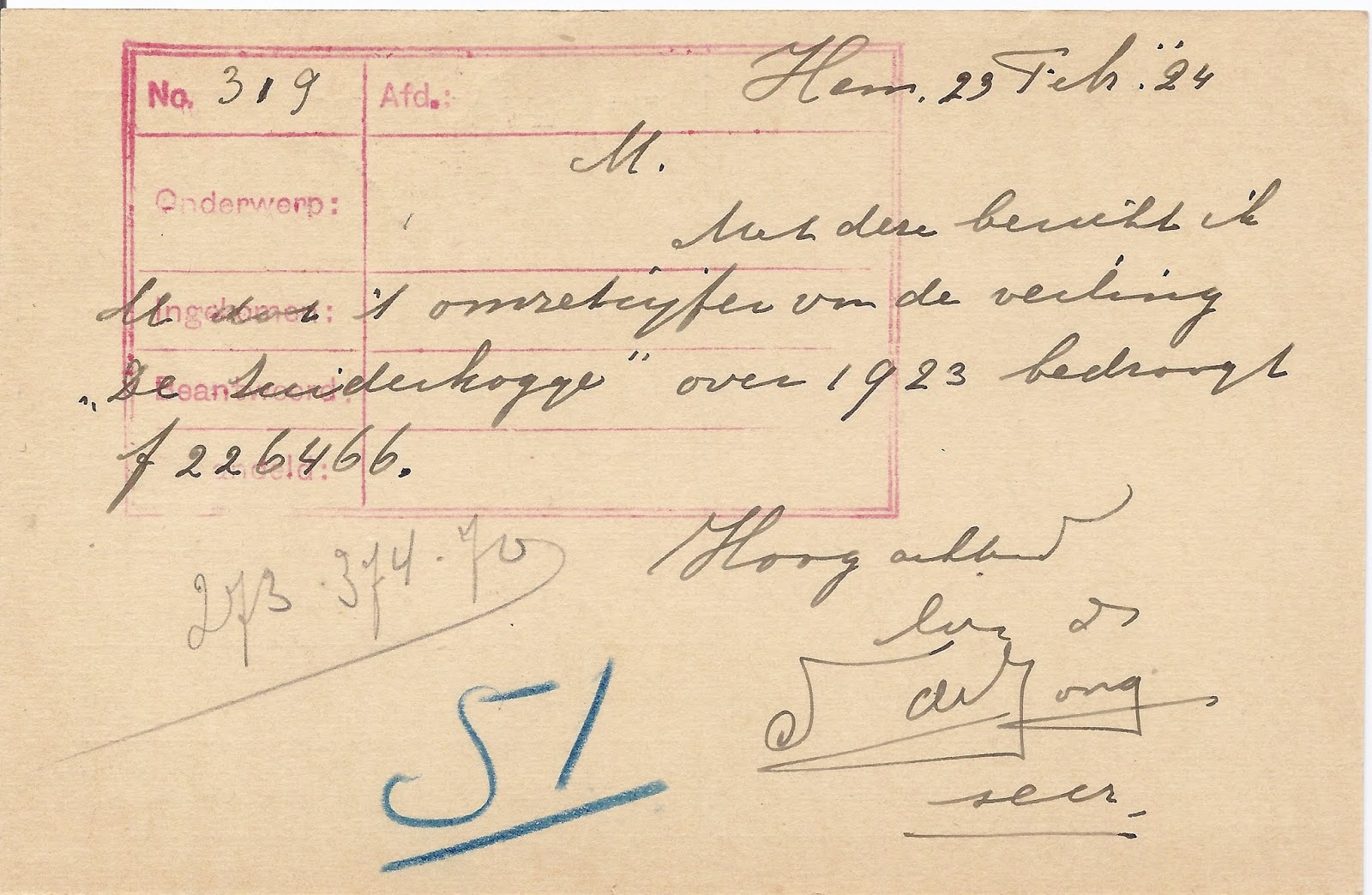
Back to the postcard. As you might have seen, this card was addressed to "Het Centraal Bureau van de Veilingen in Nederland - groep veilingsverenigingen". A mouthful, but roughly translated you will find out that this was the Central Office of Agricultural Trade in the Netherlands.

When we flip the card, we find the following message:


 ~
Hem, 23 Feb. 24
M.
Met deze bericht ik U dat 't omzetcijfer van de veiling 
"De Zuiderkogge'" over 1923 bedraagt ƒ226466. 

Hoogachtend,

~
In English:

~
Hem, 23 Feb. 1924,

Mr
Hereby I report to you that the sale figure of auction 
"De Zuiderkogge" over the year 1923 amounts to ƒ226.466.

Yours faithfully,
~

Big numbers for 1923! The Zuiderkogge auction was located near a new railway (see red arrow on the map), which was specifically built for the agricultural trade in this part of West Frisia. Alas, this railway was defeated by road transport in the early thirties and therefore was never really worth its investment. Although the Eendracht in neighboring Hoogkarspel usually expected to sell for ƒ600.000 annually, for a village which still largely relied on farming ƒ226.466 is a considerably profit.  

Typenrader postmark of Hem on Wilhelmina Fur Collar 7,5c stationery. It reads 23 II 24 2-3N, meaning the 23th of February 1924 between 2-3 afternoon. The abbreviation (Noord-Holl.) stands for the Dutch province of Noord-Holland. It was probably added to prevent any confusion about such a short name.   


Tuesday, 9 October 2018

Netherlands - Summer of 1981


Zomerzegel 1981


Between 1935 and 2011 the Dutch postal service issued a set of charity stamps each summer for  'social and cultural purposes'. These stamps were sold at a premium over their actual postal value and feature a so-called 'surtax amount' (recognizable by a plus sign +)  From 1993 onwards the surtax amount was reserved for the Dutch National Foundation of the Elderly.

In 1980 Ger Dekkers was asked by the Dutch P.T.T. to design the 'Summer stamps' of 1981. His work was (and is still!) lauded for its clear landscape photography, ranging from realistic/true to nature photography to almost abstract photo-series of landscape elements. This last category let us experience landscape differently because of Dekkers' alienating fashion of capturing large scale agriculture, flood defenses and the famous Dutch polders. I have to admit that his 1981 stamps could be definitely labelled as 'alienating', since his photo's draw you into the stamp itself! The vanishing points in the photographs add greatly to this effect.

So - in my humble opinion - these stamps should be considered as one of the most successful stamp series in the Netherlands since WWII. Simple, plain,  sharp, very effective and even alienating. It's a pity they were not printed in a larger format, as they remain just to small to let an ordinary user of these stamps fully experience them.

Zomerzegels 1981
Dyke - 55c  Domestic printer matter rate
Zomerzegels 1981
Newly created land - 45c  Domestic postcard rate


Zomerzegels 1981
Ploughed field - 65c Domestic letter rate up to 20 grams
Zomerzegels 1981
Ploughed field - 60c Printed matter foreign standard rate   
    

Zomerzegels 1981Zomerzegels 1981Zomerzegels 1981Zomerzegels 1981


Friday, 24 August 2018

Sluis & Groot - Seed trade and an insolvable postal rate

Seed
The devastating consequences of the rinderpest which caused many farmers to loose their livestock during the 18th century, made some affected farmer force to change their way of livelihood. In West Frisia some of them opted for a more stable profession in the seed-cultivation. Better drainage systems improved the (already) very fertile grounds in the region and the first generation of market gardeners / agriculturalists grabbed this opportunity not only to generate and cultivate seeds for their own usage, but for sale as well. At first these West Frisian entrepreneurs combined seed-cultivation and trade in one company, but in the industrial 19th century the (inter)national demand for good quality seed increased so strongly that the businesses of old had to be split in seed-cultivation and trade only companies respectively. To this day seed-cultivation remains one of the biggest industries in West Frisia. 

Trust
One of the most essential elements in the 'seed industry' is the trust between seed-cultivator-trader and trader/supplier-customer/agriculturalist. Whereas a greengrocer judges the crops he buys by checking the freshness of the foliage and the colour, a crop farmer who buys the seeds for these products cannot judge for himself if a particular batch of seeds will produce healthy crops. He has to trust his trader in good faith.

Sluis & Groot
It goes without saying that some traders had more reliable contacts in the seed industry than others, which made customers opt for the best-quality traders. The early start of seed-cultivation and trade in West Frisia wouldn't do the reliable dealers any economic harm in the increased international trade of the 19th century. On the contrary: some of the them became fabulously successful. One of them was Nanne Janszoon Groot (1771-1855) who lived in the small village of Andijk. After his death his sons Pieter and Simon continued the business. In 1867 Nanne's grandchildren Nanne Sluis and Nanne Groot formed the company Sluis & Groot and two brothers of Nanne Sluis, Jacob and Pieter began a company called the Sluis Brothers (later on called Royal Sluis). Both companies became part of large multinationals recently (Syngenta, Seminis, now Monsanto).

Sluis & Groot company in Enkhuizen. Shows the room where all seeds were assembled and prepared for being sent away.


Enkhuizen and the world
At the end of the 19th century both companies moved to Enkhuizen due to better means of transport over water and from 1885 the rail connection with Amsterdam. Already in 1855 certain international contacts were established when the company was still stationed in Andijk (seed traders as Vilmorin-Andrieux in Paris and Ernst Benary in Erfurt). After 1855 the international trade exploded due to the trustful relationship and personal contact between Sluis & Groot and the Sluis Brothers with their customers. They even visited their customers and inspected the quality of the grounds and climate in situ to judge how their seeds would grow there and which seeds would perform better. This research was also in the interest of the seed industry in West Frisia as the companies could inform the cultivators to which standards their seeds should comply. A real win-win situation.

Seed and administrative boom 
It should be no surprise that with such expertise the companies rocketed: in 1905 Dutch seed firms exported a 'mere' 750.000 kilos in seed abroad, but already in 1925 they exported a staggering figure of 5.000.000 kilos to every country in the world. Together with the increased interest in Dutch seeds, both companies had to manage their contacts by means of a large administrative office. In the posts on this blog to follow I will often refer to this one as we'll see many postcards, envelopes, bills etc. addressed to and sent by seed traders, agriculturalists etc. The first example is shown below:

Cover (front only) from Sluis & Groot to a crop farmer (landbouwer) in Avereest in the Dutch province of Overijssel. 22th of August 1905. 
The cover above was registered and weighted 30 grams. It was sent registered and insured since an amount of ƒ210,00 was enclosed. The rate was made up as follows: 10c for a domestic destination (2nd weight class 15-50 grams) + a 10c registered fee + 3 times 2,5c for insurance. Per ƒ100 it would have cost the company 2,5c. So that would be (10 + 10 + 7,5 = 27,5) 27,5c.... 27,5c? Yes, according to the handbook by W.S. da Costa on Dutch rates, but why is there a Wilhelmina fur-collar stamp of only 22,5c attached to the cover?


Wilhelmina fur collar 22,5c stamp

The reason why there could be a 22,5c stamp on this cover could have resulted from a (for the PTT) unprofitable arrangement. Until the first of March 1921 the registration fee was (partially) included in the assurance fee. So, Sluis & Groot only had to pay a 2,5c registration fee on top of  the 7,5c insurance costs. Then the sum should tally: 10c 2nd weight class + 7,5c + 2,5 = 20c.......... Ooopsss....

Maybe the postal clerk forgot to charge the 2nd weight class of 10c: the first weight class which goes up to 15 grams needed a 5c stamp in 1905. 5 + 10 + 7,5 = 22,5. However, it is odd to forget such a basic rule and moreover he completely forgot the registration fee inclusion as well.

I cannot believe though that I've more knowledge than a 1905 postal clerk. The rate has to be right, but the difficulty remains: how was is composed?


Oily forwarding mystery - Delft to Port Swettenham via Babo

Newspaper wrapper sent from Delft 17-1-1938 via Pladjoe and Babo to Port Swettenham via Singapore (4-6-1938) The newspaper wrapper shown abo...