Showing posts with label express. Show all posts

Thursday, 28 April 2022

Costly kilometres - express distance fee 1930


Expresse post
1930 letter from Amsterdam Central Station to Groenouwe Villa south of Loenen op de Veluwe. Correct rate of 12c + 10c express fee (22c) and 16c distance fee in postage dues.

On January 1st 1871 a new postal service was introduced in the Netherlands: domestic express mail. In densely populated Holland it was deemed useful by the precursor of the P.T.T. to introduce this express service. Although there were 8 or even 10 regular mail deliveries in the big cities each day, most towns and especially villages saw only one regular mail delivery. Therefore the express service could be particularly useful for persons who lived on the fringes of villages where the regular postman arrived late or at infrequent times. The express delivery times were established between 7 AM and 10:30 PM in 1913 but I doubt if a postman would risk a late night mail run in wintry conditions back then...

It was stipulated that express covers, postcards and parcels had absolute priority over ordinary mail once the mailbag (or dêpeche) had arrived at the local post office. There the office clerks went through the mail and sorted the express pieces from the bulk mail. This process wasn't allowed to take longer than 15 minutes before the postman would start his express mail run.  

The domestic express fee was set at 15c until March 1921 when it was raised to 40c. Subsequently the fee was gradually reduced to 10c in February 1928. When an express cover or postcard had to be delivered outside the PO's delivery zone (a hypothetical 2½ km ring or a 15 minutes walk) an extra 15c fee for each additional 15 minutes walk was added to the express fee from April 1892 onwards. This incremental 15c distance fee was replaced by a fixed 15c distance fee in September 1938. 

The regular express fee had to be paid by the sender with ordinary postage stamps, the distance fee however could only be established at the arrival post office and therefore had to be paid by the addressee by means of postage dues. The 2 covers to Groenouwe villa in this post explain how this process actually worked. It should be noted though that the distance fee often deviates from the stipulated 15c - in this case the distance fee was apparently set at 16c for whatever reason... 

Underrated cover from Blaricum 13-8-1930 posted at 2 PM sent by express mail to Groenouwe Villa south of Loenen op de Veluwe (arrival 8 PM the same day). The ordinary rate of 12c +10c express fee was not met since only 18c (deficiency of 4c) was used. Therefore the cover was taxed (2x 4c = 8c tax). The distance fee to Groenouwe was 16c which corresponds to the previous letter. 16c + 8c makes up the total of 24c of postage dues on this cover. A real study case!

Groenouwe
The enormous Groenouwe Villa was converted to a hotel in the 1930s and renamed Hotel Zilven.  Here the hotel is shown in its prime surrounded by the Veluwe forest. Read more about the villa and its subsequent hotel here.

Groenouwe
Location of Groenouwe villa south of Loenen - situated only 2,5 km south of the village center yet in splendid isolation - hence the distance fee.

Groenouwe
The ruins of Groenouwe after the fatal fire of 1945.

Thursday, 12 July 2018

Netherlands 1939: Dutch express letter by train

Apart from my interest in retrieving information about senders and addressees, contents and messages, I occasionally include covers / postcards in my collection because the postal rate or postal markings intrigue me. The cover below is such an example:


This letter was sent to the 'Dutch agricultural head office' by making use of the Dutch express service. Voermans & Backx had to pay 10c extra to make this a valid express letter. The label 'Spoedbestelling / Exprès / Spoedbestelling' was hence applied which made the PTT aware that this was a special delivery. In these days - and today still - the service was provided for by a separate agency of the postal service, which meant that 'ordinary' postmen weren't allowed to process the item.  

If you carefully read the address of the sender (Voermans & Backx) you might notice that this company which traded in agricultural products was situated alongside the 'Stationsstraat', Dutch for Station Road in Roosendaal. The combination of this address and the unorthodox cancel made me flip the cover: 


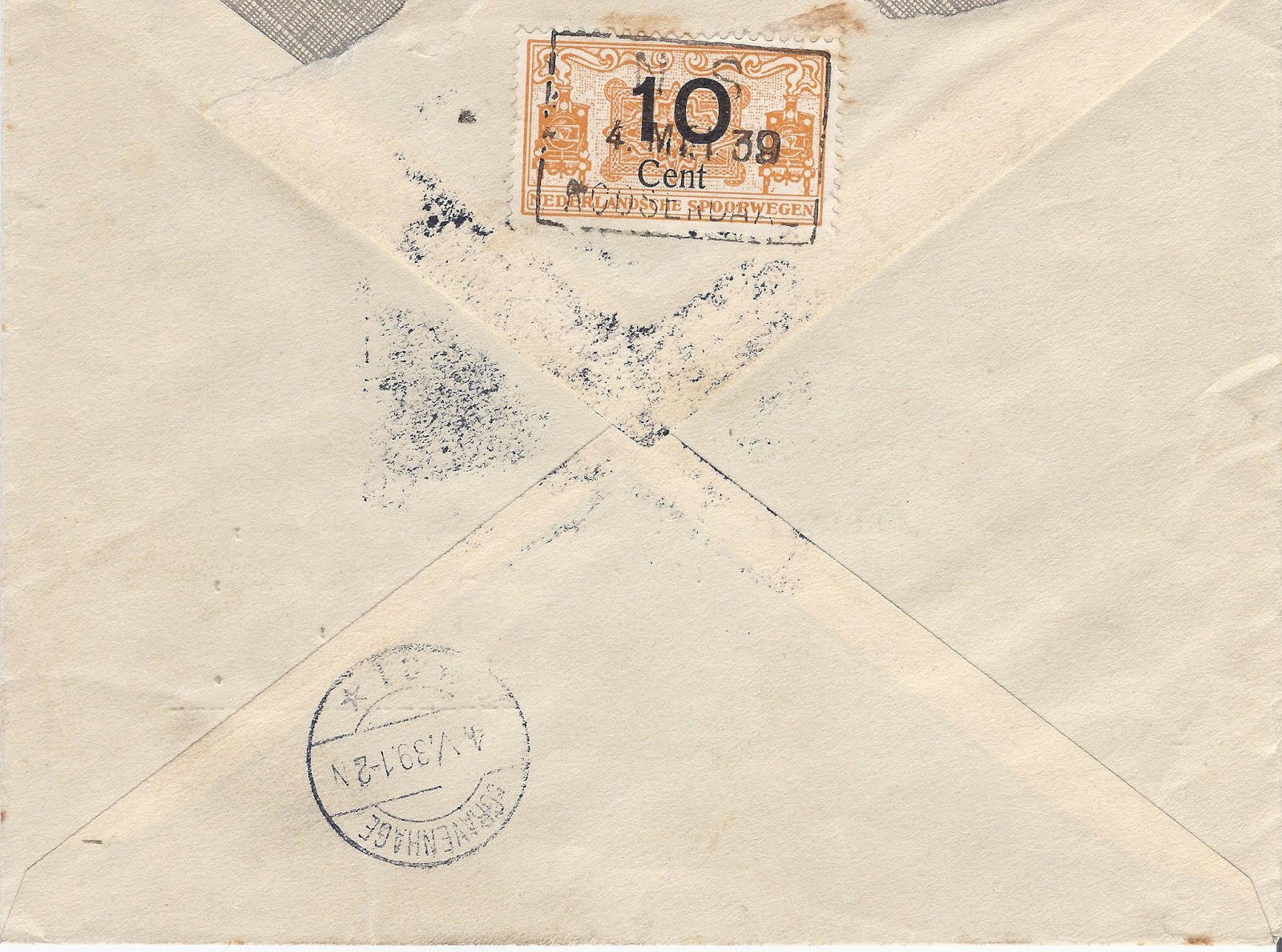
A third stamp is glued to the back flap of the cover! And it is no ordinary one:  


It turns out to be a so-called 'Railway stamp', a type of stamp which was used by various countries in the world to pay the cost of the conveyance of a postal item by train. A steam locomotive adorns the stamp and the text reads: Nederlandse Spoorwegen: the Dutch Railways (NS). 

The marvelous book about Dutch express delivery by Arie Zonjee and Ot Louw (2013) devotes a chapter to the Dutch Rail Express Service:

From 1924 onwards the Dutch Railways (NS) made it possible to send express items by train. In order to do so, the sender had to pay the standard PTT Express fee of 10c + and an extra Train Express fee of 10c. The Dutch Railways produced their own stamps in order to comply with this service. The guard on the train took care for the items during the ride. The (Railway) stamps were to be cancelled with a NS cancel of the local luggage center from which the items were being sent. 

The example above was cancelled at Roosendaal Station on the 4th of May 1939 and arrived in The Hague the same day between 1 and 2 p.m. 

Why did the sender chose to sent this particular cover by train instead of the ordinary service? Maybe this was the fastest way to get the letter from a to b. I doubt this, as the ordinary express service would be almost as fast. Maybe the station was easier to reach than the main post office of Roosendaal. Quite possible, but - then again - most railway stations had a PTT office as well... Oh well, it makes a fine example of a Dutch train cover after all!


Oily forwarding mystery - Delft to Port Swettenham via Babo

Newspaper wrapper sent from Delft 17-1-1938 via Pladjoe and Babo to Port Swettenham via Singapore (4-6-1938) The newspaper wrapper shown abo...