|
| Letter sent to the Chancellor of the Military Order of William located in the Hague on the 12th of May 1832. A circular Amsterdam postmark in red has been used to date stamp the piece |
Pandemic or War?
When you're keeping up with the news on TV or read the papers the last couple of weeks I’m often left wondering if we are about to enter a new dawn of humanity or if we will rather see the end of it. The new corona virus COVID-19 has paralyzed the globalized world of which we’ve grown so fond in the last decades. The virus makes us feel vulnerable and small again. At least, that’s what I deduce from all the live coverage of the onslaught and the prospects of a global economic crisis which will dwarf the 1930s Depression. Yet, at the same time this absolute shelling of fearsome facts feels a bit obsolete. Out of all threats, a virus which attacks the homo sapiens is probably our most predictable enemy in our digital age. Although invisible and absolutely terrifying in the weeks after its first appearance, research and plain facts are already perfectly able to model and compute the growth rate, fatality rate, contamination rate etc. An enemy which behaves itself as your most humble servant. An enemy which nevertheless increases exponentially when we take not enough heed. A difficult situation for sure but one which we could easily overcome by following simple rules and staying focused. If you think this COVID-19 pandemic is awful (fatality rate = < 1%) you should not even contemplate comparing it with the devastation destruction and randomness of war. The letter which I will discuss today reminds us of one.
 |
| Contents of the letter (page I) |
Begging letter
I stumbled upon a rather elegantly written letter which dates from 1832. I was intrigued by the almost calligraphic writing a couple of months ago but found it difficult to fold it open because of its unusual folding. Of course, the last thing I wanted was to ruin the paper. A week ago though the letter caught my attention again and this time I just had to open it. Its contents were rather cheerless.
~
[in zwarte inkt] ? den 13 mei 1832 N28144
[in potlood] aan dit verzoek zal op de voorgestelde wijze niet kunnen worden voldaan
Amsterdam den 6e Mei 1832
Zijn Exellentie !
In afwachting dat UED mijn verzoek niet van de hand zal wijze zoo neeme ik de vrijheid mij langs dezen weg tot UED te begeven om de volgende reden namelijk! Ik ben door een zware ziekte in de behoefte van geld geraakt Alzoo heeft iemand mij zoo gunstig geweest om mij te helpen met ƒ34 waarvoor ik hem dan mij acte van Ridders Pensioen in pand moest geven ervoor [?] 5 centen van de gelden maar toen ik nu met dit laatste kwartaal kwam om te tekenen heeft diezelfde persoon de onheusheid gehad mijne acte aan een ander te verpanden en kan dus geen geld ontvangen dit is dan ook de reden als dat mijn acte de vita niet behoorlijkertijd daar is. In de hoop als dat UED mij na zoo goedgunstig belieft te zijn om mij een klein bewijs over te zenden opdat ik dan zelf persoonlijk zulks aan den weledele Bicker kan vertoonen om mij zelven te betalen dan blijf ik UED ten hoogsten verpligt en zal met die persoon een overeenkomst zien te treffen op een zegeltje om hem dan alle vierendeels jaars een zeker gedeelte van mijn pensioen aftestaan om niet mijn schuld te geraken en dan zoodan mijne acte terug te krijgen.
In afwachting dat UED mij hierin als het u belieft wel zal te gemackd kom [?]
Zoo blijf ik met alle onderdanigheid
UED DW Dienaar
P. Lasance
~
[in pencil] this request cannot be complied with in the proposed manner
Pending my request which I hope Your Right Honourable won’t deny, I take the opportunity to address Your Right Honourable because of the following matter. Due to a severe illness I’m in the need of money. Somebody was so kind to help me with a sum of ƒ34 for which I had to put my Soldiers Pension as collateral. However, in this last quarter, when I returned to this person to sign, it came to light he unfairly put my pension as collateral for another person which makes it impossible to receive any money. This is the reason why my certificate of life cannot duly arrive on time. Pending my hope that Your Right Honourable will send me some evidence after you have proven to be so auspicious, so that I can personally prove Mr Bicker to pay me, I will remain indebted to Your Right Honourable. I will try to reach an agreement with this person to cede him a certain part of my pension every quarter in order not to be in debt and to return my act.
Pending that your honorable if you please will accommodate in this matter
I remain forever in your service,
Your Right Honourable devoted servant
P. Lasance
~
Source of philatelic material
I've warned you: the contents picture a rather sobering message. Especially the apparent denial of the request (in pencil) made me feel sorry. Before we return to P. Lasance, I've to speak about prephilately first. How could historical documents end up in private collections?
The academic approach to philately can only exist by plenty of material available for research. When looking for items which were sent pre-1900, you’ll come to realize that the material often originates from old archives (ranging from personal family documents to big firm archives). Sometimes these archives have been plundered for the sake of the philatelists – with hindsight a rather disgusting ‘side-effect' of the increasing popularity of the hobby –, but in most cases the material was acquired by dealers or auctions houses because the firm filed for bankruptcy or an archive would have to get rid of it anyway. In the latter case the archive deemed certain papers of insufficient interest to preserve for future generations. When interest in philately developed probably 100.000s of folded letters (or address sheets only) were saved and ended up in private hands.
I think that this particular letter originates from a cleared archive. Somebody went through the files of the Kanselarij der Militaire Willemsorde (Military Order of William) because I could find dozens of other similar items online for sale: all addressed to general Janssens who functioned as chancellor of the order between its establishment in 1815 and his death in 1838.
 |
| Contents of the letter (page II) |
The life of P. Las(s)ance
The poor bloke who wrote this letter had fallen gravely ill and is begging for a document which was denied by the chancellor of this Military Order of William. I took me some moments to realize that the man really hoped, begged almost, that his request which he had so carefully wrote, folded and sealed the letter would be honoured. It might have been his last resort.
I already imagined how an old man, probably crippled at the time of writing, would spend his last days on this earth hoping for a miracle to happen since some rude person had taken advantage of his soldiers pension. Soldiers pension? Slowly some pieces of the jigsaw came together. P. Lasance was apparently entitled to be paid a soldiers pension and he asked the chancellor of some prestigious Dutch order for a certificate of life. He most certainly must have been a knight then.
So I started my search. The Military Order of William was established by king Willem I in 1815 after the battles of Quatre-Bras and Waterloo. The sole recipients of the decoration (4 ranks) fought in these battles. When P. Lasance begged for proof of his identity the year was 1832. Until that time the order had only been rewarded to generals, corporals, soldiers and so forth who fought in the Waterloo campaign and in a now almost completely forgotten colonial war on Java (Java war 1825-1830). This letter was therefore likely to have been written by a Waterloo veteran! What a find!
 |
| Register entry of P. Lassance |
Next stop was the website of the Dutch Ministry of Defence. I knew that they maintained a databank in which you could browse through all decorated soldiers of the Netherlands. I typed Lasance – no results. I typed La sance – no results. I typed La Saints – no results. You can imagine that I started to panic now – what if this bloke just tried to fool the chancellor? – based on the denied request this possibility looked more likely by the second.
I tried several more combinations of letters – Lassance did it. What a relief. But what a sobering message – again.
P. Lassance Military Order of William 4th Class Awarded on the 17th of August 1815 on grounds of services rendered in the Battle of Waterloo the 18th of June 1815 in his function as fusilier of the Infantry Battalion of the 13th line.
Birth: 1797
Death: April 10 1833
Less than a year after P. Lassance had his request denied he died. Even in 1833 it was quite uncommon that men died in their 30s after having survived childhood and in Lassance’s case even a terrible battle. I haven’t found details whether he died of the disease he wrote about in his letter or something else. No single file in the Amsterdam archives seems to refer to this particular P. Lassance (or Lasance), but I would like to be proven wrong someday.
 |
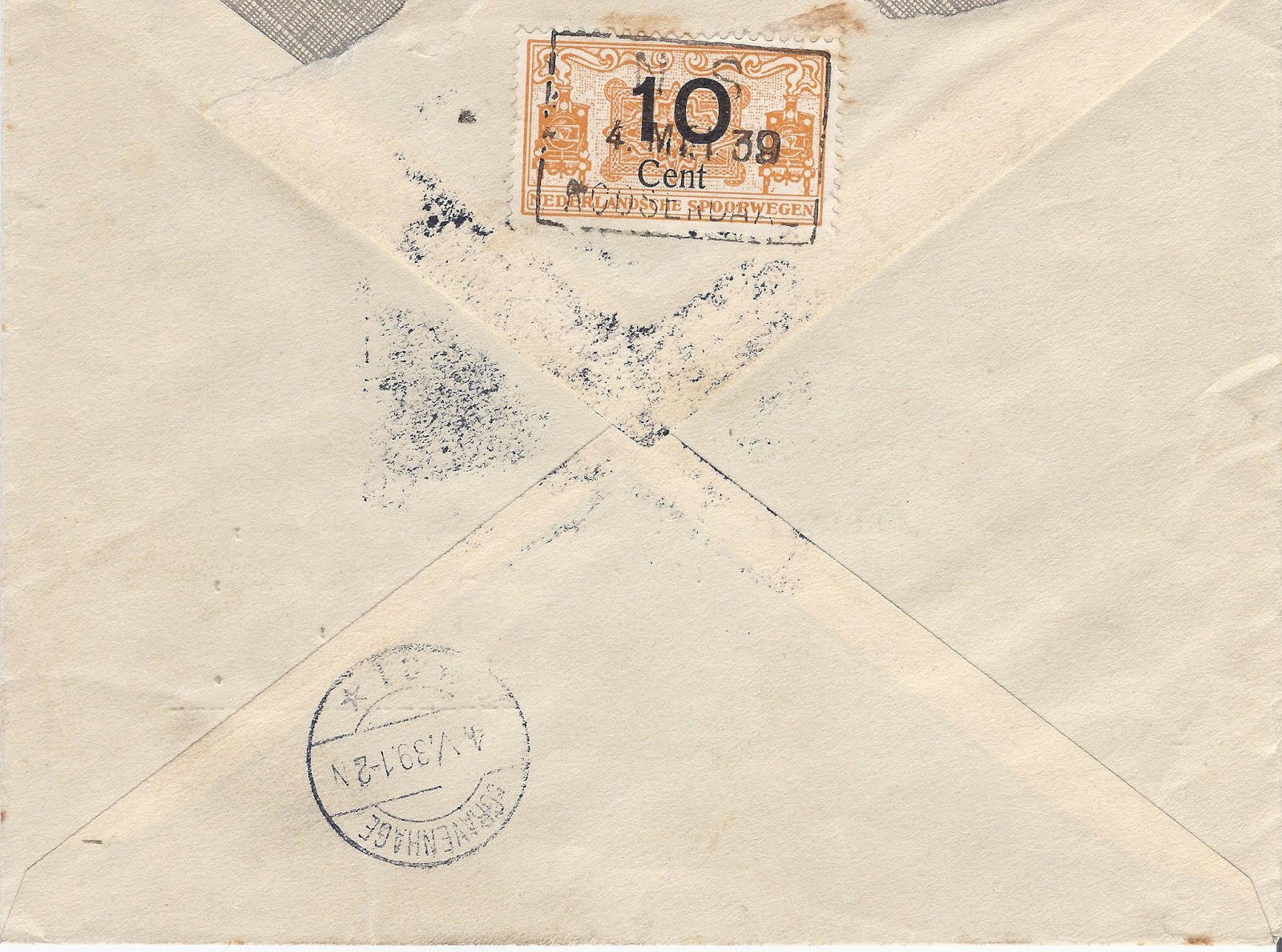
| Back of the cover with an incomplete strike of the circular 's-Gravenhage arrival mark. |
Waterloo
Apart from his last troublesome months and his year of birth we know nothing about P. Lassance other than his apparently remarkable services in the Battle of Waterloo. 30.000 Dutchmen fought there but only 1004 knighthoods were awarded. Alas the register doesn’t mention which remarkable feat led him to be decorated. His fought as a foot soldier in the 13th line (637 men) of the 2nd Brigade of the Netherlands 3rd division under command of general baron Chassé. His interventions at Waterloo came at a pivotal moment when Napoleon sent his imperial guard to attack British troops stationed in front of Chassé. Because Chassé acted quickly with a strong counterattack in response (1st brigade under command of colonel Detmers) Napoleons actions were rendered futile at this particular point in the battle. The coalition held their line. Unfortunately I haven’t found any details on the activities of the 2nd Brigade in which Lassance fought. The 13th line most likely supported the 1st Brigade which stood in the line of fire.
Click here to read more about the Battle of Waterloo.  |
| General D.H. Chassé portrayed by Jan Willem Pieneman in 1832 wearing his decorations of the Military Order of William |