 |
| Vondelpark Amsterdam |
In the Netherlands you won't easily encounter philatelists with an interest in collecting postal items which are sent to extraordinary destinations. I know that this practice is more common abroad, especially when it involves older (pre-1900) definitive series. It is really a pity that so few collectors are interested in this specific field of philately, because you could set up a very wide-ranging but specialized collection!
The picture postcard shown above could be classified as such a 'destination piece'. I acquired it at the weekly Spui book market in Amsterdam some years ago for a bargain. I didn't purchased it out of philatelic interest, but because of the extraordinary route it ostensibly travelled: from the Dutch island of Texel to Terschelling, another island. Therefore this piece could be labelled as a genuine island-hopping postcard!
Dutch possessions Overseas
You all know, as proper philatelists, that the Dutch kingdom encompasses several islands: Aruba, Bonaire and Curaçao just north of Venezuela (of which Bonaire and Curaçao are considered sovereign countries like the Netherlands) and the smaller islands of Sint-Maarten, Sint-Eustatius and Saba which are part of the Leeuward Islands (of which Sint-Maarten is a sovereign country as well). Hence, the Dutch kingdom officially counts four countries and three 'special municipalities', viz. Bonaire, Sint-Eustatius and Saba. Therefore, it's of course wrong of me to talk about 'possessions' when three islands have to function as fully sovereign countries. In practice though these 'independent' nations are heavily dependent on the Netherlands... The other non-independent islands from three ' special municipalities' of the Netherlands, which is quite complicated because of the sheer distance between these islands and their motherland. Sint-Maarten and Curaçao became independent states as late as 2010, formally dissolving the Netherlands Antilles and paving the way for two incapable islands regimes to take control. To nobody's surprise these new sovereign states turned corrupt...Far from these tropical regions five other Dutch islands exist, although I guess you couldn't name them, since they have no special status whatsoever. They are relatively small and are located in the Wadden Sea, which stretches from the Netherlands to Denmark. From the Dutch city of Den Helder (Napoleon called it Europe's northern Gibraltar) to the German sea border in the east the islands are known under the following names: Texel, Vlieland, Terschelling, Ameland and Schiermonnikoog.
 |
| Reverse of the postcard. The 1c postal stationery rate didn't allow for additional text on (picture) postcards. Addresses only! |
Now I have meticulously explained how our kingdom consists out of 4 countries, we turn to this item, sent from one Wadden Island to another, resp. Texel and Terschelling in 1909. Something you won't find everyday, especially since both islands were sparsely populated (and visited) at the time the postcard was sent. We read the the addressee is a certain miss B. Katoen, c/o Mr J. Boekholt living in the Torenstraat in West-Terschelling. 'Katoen' is Dutch for 'cotton'. The sender is a certain T. Reuvers Md. Md. stands for Mdochter: daughter of M.
The route travelled
The postcard could have been sent over the Frisian town of Harlingen by taking some sort of ferry. As we'll see there are many different routes to discuss.
 |
| Option 1: Texel (left) and Terschelling (top) could have been connected by ferries services over Harlingen in 1909 |
De Cocksdorp in the northern part of Texel was founded (1836) by Mr De Cock from Antwerp, after two smaller islands merged together (Texel and Eierland) and the newly gained land became suitable for farming and living. In 1909 the village and surrounding area was still destitute of anything modern and by 2001 the village counted only 481 inhabitants. As most places in the Netherlands during the 19th century, daily life was uneventful and especially tranquil compared to our modern society. Life on an island however had its own particular dangers: storms threatening the fishing fleet which could deprive a town of its male population. This happened to a little town called Moddergat at the end of the 19th century: 83 fishermen died in a furious storm in the night of 5/6 March 1883. Agriculture in low-lying areas such as the Eierlandsepolder (shown on the map below) had to cope with the silt influences of the nearby sea, making it quite impossible for farmers back then to compete with products from the fresh-water and extremely fertile polders in other parts of the Netherlands. In short, people living in De Cocksdorp were more exposed to the elements than in other parts of the Netherlands.
 |
| De Cocksdorp in the early 1930s in the northern part of Texel. At the time a very small village, living from agriculture and fishery. The red arrow points to Dorpzigt farmstead (see below). |
Our postcard arrived in a village called West-Terschelling, which is the most populated place on the entire island of Terschelling and became infamously known because the English burned the place in 1666. People still talk about this 'English fury'. As many villages on the Dutch Wadden Islands it shared many resemblances with De Cocksdorp: fish and small-scale agriculture.
Other possible routes
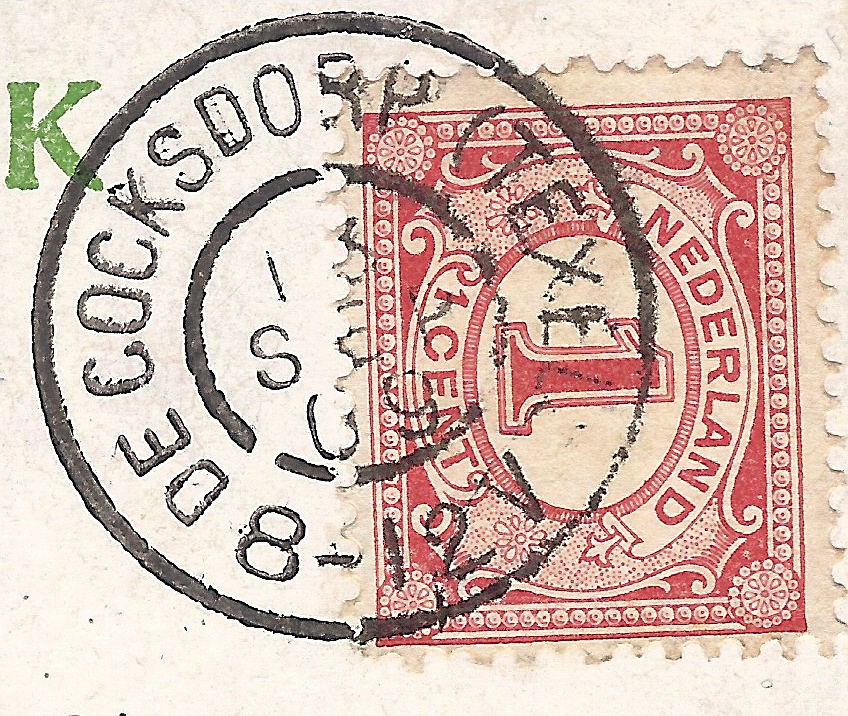 |
| Large round postmark of De Cocksdorp (Texel), reading 13 SEP 09 8-12V on 1c Vürtheim |
 |
| Large round postmark of Terschelling, reading 14 SEP 09 5-6N |
The most obvious route would have been the one I have plotted above. Since both islands were part of Noord-Holland back then, and the dates on the postcard differ quite a bit (De Cocksdorp 8-12V (before noon), September 13) vs. (Terschelling 5-6N (after noon), September 14), we might also include the possibility that the postcard went all the way from De Cocksdorp to mainland Noord-Holland via Amsterdam or by the ferry Enkhuizen-Stavoren to Harlingen, where the postcard would have been shipped to Terschelling. See the map below for the Enkhuizen-Stavoren version.
 |
| Option 2: Texel-Terschelling via Den-Helder-Hoorn-Enkhuizen-Stavoren-Harlingen. The green lines demarcate the current Wieringermeer polder (created in 1930), the yellow line marks the current Afsluitdijk (also from 1930) which protects us from dangerous high tides during storms. |
The fastest route would require an island hopping maneuver: from De Cocksdorp to the sparsely populated Vlieland (or directly) to Terschelling. See below for this alternative, which I guess would have been the most logical route taken in the period when postal institutions didn't exist or were of little importance: before 1840/50.
 |
| Option 3: De Cocksdorp to Terschelling by Vlieland or directly |
Lords and farmers
As interesting as the route might be, we should also pay attention to the sender and addressee of this picture postcard. Did I found anything about them on the internet? Fortunately, I have!
The sender T. Reuvers is the daughter of Maarten Reuvers (1860-1936) and she was born on the 20th of July 1893 in De Cocksdorp. Her family leased a farmstead called Dorpzigt from Izaak van den Borch, Lord of Heemstede since 1840. This noble gent had bought Dorpzigt in 1840 from its first owner, a certain Paulus Langeveld (1774-1850), who was the first Dijkgraaf or dikereef of the newly created Eierelandsepolder. Dorpzigt mansion was specially built for the Eierland board (society) of owners to serve as their official residence.. I assume that its location is somewhat raised (a dune perhaps?) above the Eierlandsepolder, since lush green surrounds the house today (see below) and when browsing through ancient maps the location seems to have already existed before the Eierlandsepolder was created in the 1830s. Dorpzigt however soon lost its function as keepers mansion and became a rather handsome farmstead, leased from the Lord of Heemstede by the Reuvers family. Unfortunately the farm burned down to the ground in 1891, but the insurance payed for the rebuild. In 1903 the farmstead and its surroundings lands were acquired by Baron Tuijll van Serooskerken, who hunted with other gentry in the woods for ducks and other fowl. After the last Reuvers had left their lands, the properties and fields became more or less state property. Dorpzigt was made a monument and the woods were handed over to Staatsbosbeheer (Dutch equivalent of the Forestry Commission).
 |
| Dorpzigt farmstead south of De Cocksdorp © Photograph taken by Agaath |
The full name of T. Reuvers is Trijntje Reuvers: she was called after her grandmother Trijntje van Es who died in 1893. She married Jan Karreman ('Cartman') in 1917. She died young at age 45 in Overschie near Rotterdam. Since her father Maarten Reuvers had 11 siblings, it is by no means certain that Trijntje actually lived at the farm. Of course, I imagine that she would have visited the farm many times during her youth.
Trijntje wrote to miss Katoen on 13 September 1909, an average September day according to the Dutch meteorological service. A light to moderate wind from the northeast brought dry but overcast weather to Texel and an average temperature of about 14 °C. The following day - a Tuesday - the wind continued to blow from the northeast, but it caused most clouds to drift away resulting in sunshine.
 |
| Dorpzigt and shed in the 1930s? |
From Terschelling to Amsterdam
Miss B. Katoen was born on the 13th of June 1890: her full name is Elisabeth Katoen. Elisabeth is often abbreviated to Betje in Dutch. She was thus 3 years older than Trijntje Reuvers and 19 when she received this postcard. Her father, Gerlof Katoen (born 1854) married her mother Trijntje Bakker in 1877. Like Trijntje, Elisabeth had many siblings: 7 in total. Her father was to become a pilot on ships approaching and leaving the harbour of Terschelling.In 1920 she married Hendrik Wolter Alings in Amsterdam, he being 24, she already 30. Her husband was accountant. Since he was born in 1896, it could very well be that Hendrik Wolter Alings is the same man who published many publications and several books about the gables and old billboards of Amsterdam. In 1943 this Hendrik Wolter Alings published a book called "Amsterdamse Gevelstenen" (Amsterdam gables: gevel=gable) and he was co-founder of a club which specializes on Amsterdam local history. Besides, he had a great interest in Esperanto and actively campaigned for this language before WWII. When he died in 1965 a special gable was inserted in his house (Middenweg 410-412) by the local history society 'Ons Amsterdam' which reads "Hij Wist de tAaL van steen en uIthaNGteken in woord en beeld weer te doen Spreken" (He achieved to let language in stone and billboards in text and image speak again). The capital letters shape the name Alings.
 |
| Gable inserted in Middenweg 410-12 Amsterdam in memory of Hendrik Wolter Alings, husband of Elisabeth Katoen, with the text "He achieved to let language in stone and billboards in text and image speak again" and Here lived and worked H.W. Alings from 1925 until 1965. |
Two Hendrik Wolter Alings?
After some additional research I now think that the Hendrik Wolter Alings who married Elisabeth Katoen is another person still. This particular Hendrik was born on the 29th of October 1895 and died almost a century later in March 1995. Elisabeth Katoen died on the 20th of July 1964, at age 74. They had no children it seems.Several questions remain (as always): how did Trijntje Reuvers become acquainted to Elisabeth Katoen in the first place? Both of them were island women, but moved to big cities, resp. Rotterdam and Amsterdam. Why did they leave their islands? Last but not least, who is Mr J. Boekholt, the man living at the address to which the postcard was sent? Will we ever get the answers to this questions?


.jpg)