Showing posts with label Geuzendam. Show all posts

Thursday, 8 April 2021

Netherlands New Guinea in 1956: how to move?

Verhuiskaart
Used Change of Address Card sent from Sorong 3 on the 11th of July 1956 to Amsterdam. 

Until fairly recently there existed a specific type of postal stationary in the Netherlands: the so called Verhuiskaart or Change of address card in English. In the Netherlands it was introduced in the late 1910s as cheaper alternative for the ordinary letter card. Moving to another premises had always caused logistical problems for the PTT and the new and cheap preprinted Verhuiskaart might ease the service's workload. It certainly was a clever device to make people aware of a forthcoming change of address and it must have contributed to a smarter and streamlined postal service. In short: it benefited both the PTT and the users, a win-win game and therefore very Dutch. I'm not aware of foreign change of address cards, but I would be keen to know!

Of course verhuiskaarten were available in the Dutch colonies as well. In the DEI people and businesses used them frequently, since there was a large Dutch presence until the 1950s. It should be noted though that a Malaysian translation was printed below or beside the Dutch text from the introduction from 1909 onwards. So even literate natives and Asian traders might have used them. For the attentive reader: verhuiskaarten were indeed introduced in the DEI 10 years prior to their introduction in Holland.... In the West (as the expression goes) there was no need for change of address cards apparently. The literate population of Suriname and Curacao was very small when compared to the DEI. Hence you might be surprised - and rightly so - why the (still) very large, but almost unpopulated colony of Netherlands New Guinea introduced a verhuiskaart... Even in its heydays the colony counted less than 15.000 literate inhabitants which rarely moved.   

It remains to be seen which argument was used to introduce the verhuiskaart in NNG. It might be suggested that the Dutch 'settlers' from Java and Sumatra were familiar with the concept? The card appeared on the 1st of August 1950. The 3c rate was of course less than the standard 5c letter card rate.  

Verhuiskaart
Reverse of the NNG verhuiskaart

By now it won't come as a surprise that this specific verhuiskaart is a very rare piece in used condition. Extremely rare even when it has been used within NNG. Only contemporary philatelists in New Guinea and the Netherlands seem to have been aware of its existence, so the majority of the used card known to us have been used and stored by philatelists. Unused it's no rarity at all, although only ca. 6400 ex. were ever printed according to Geuzendam.   

The card which serves as illustration to this article is a commercially used example which was sent to the Netherlands. Not as rare as inland use, but nevertheless very rare!! It sold for €600 (ex. buyer's premium ),- at Corinphila NL in 2016.

Sorong
The NNGPM terrain near Sorong - buzzing with economic activity in the late 1940s 

Sorong in the extreme northwest of Papua is home to the country's profitable oil industry. In 1908 oil was discovered by Shell and in the 1930s the first well was drilled by the NNGPM the Nederlandsch Nieuw-Guinea Petroleum Maatschappij. The Sorong oil wells were one of the economical arguments used by the Dutch to maintain power in NNG after the Indonesian war of Independence. In the mid 1950s the industry was booming, but only a few years later the wells dried up to a large extent and Sorong dried up along with it. The oil company entered into liquidation and a real exodus took place in the early 1960s. It would take decades before the new oil companies would find new wells. Nowadays Sorong is Papua's major economical hub again.   

Sorong
Concrete oil storage tankers being erected in Sorong harbour the late 1940s.
The island on the horizon, Sorong Doöm, used to be the administrative centre of Sorong 

 
Sorong
Photo from 1938 which  - I think -  shows the same terrain as the NNGPM area earlier.
Copyright: KB - https://resolver.kb.nl/resolve?urn=urn:gvn:KIT01:219635

Monday, 4 November 2019

Curaçao Postal Stationery used in Medemblik?

Postal Stationery
Postal Stationery Envelope G.31 sent to Voorburg which was cancelled by the Medemblik 3 so-called 'Short Beam' postmark type on the 28th of November 1951 at 7 PM.  

This item lingered in my mind after I first saw it on Delcampe awhile ago. Not an extremely attractive entire I thought back then: a bit smudgy and bleak in a certain way. I scrolled on. For some reason I bumped into the cover again and fortunately I then did some actual research on the stationery envelope type. In the unsurpassed Geuzendam catalog for Dutch postal stationery, I found that the original envelop (without overprint) was purposed to be used on Curaçao from 1940 onwards, but for some reason the cover is only known to have been in circulation there between 1946 and 1956.

G.31 Postal Stationery
Postal Stationery Envelope G.31, recognizable because of the 'Nederland 10 cent' overprint in red.

Out of the 222.400 (!) envelopes which were printed, 122.400 received the 'Nederland 10 cent' overprint in 1950. Confusingly enough, another number in the same catalogue states that the were only 92.803 envelopes which were overprinted. Let's - for the sake of clarity- just take the fictional but not incorrect number of 100.000 as the golden mean. Postal stationery has always suffered from unfair competition with stamps on cover, so I think it's fair to say about 1% or even less of this number of envelopes survives. 100.000/100 gives 1000. So in practice that means that less than 1000 of these envelopes might have made it into 2019: most of them even likely in unused state. That simple calculation made me realize how rare this stationery type of envelope actually is. A G.31 cancelled by a Medemblik short beam postmark is probably unique. And Geuzendam rates this envelop used at a mere € 2,- !

Wilhelmina met Sluier Fokko Mees
The 1936 stamp (NVPH 126) which is similar in design to the envelope. 
The weather on the 28th of November 1951 was stormy (5/6 bft) with severe gusts of wind along the coast (bft > 10). According to an article in the Dutch Leidse Courant of 29-11-1951, the storm reached its apogee during the evening - precisely the moment our stationery envelope was sent to Voorburg, a town near The Hague and therefore close to the coast. The severity of the storm and its sudden character caused the British S.S. Teeswood to break in twain after having grounded a sandbank near the island of Rottum.  

The route which the crow might have flown between Medemblik (north) and Voorburg (south) if  the weather would have been calm on the 28th of November.   

Wednesday, 26 September 2018

Missing Answer

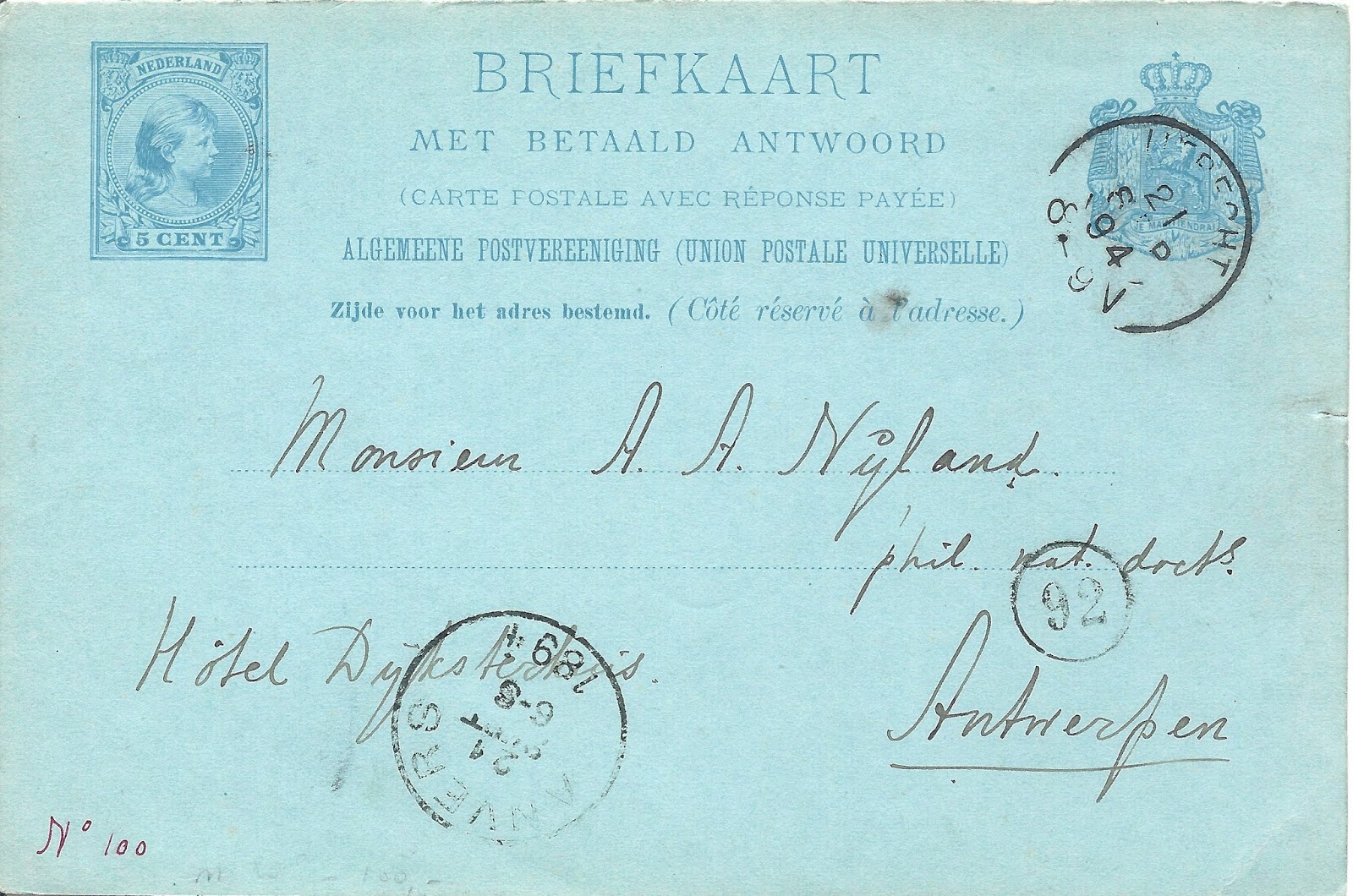
Princess Wilhelmina engraving stationery card 5 cent blue
Princess Wilhelmina "hanging hair", portrait engraved by H. Raeder after a photo of H.R.F. Kameke. 

I've seen hundreds if not thousands of Princess Wilhelmina stationery cards and I only acquire these cards when they are of interest for my special collections. This particular card though is different, but I am still in doubt why... It probably has something to do with the enigmatic message on the reverse and the addressee.

Princess Wilhelmina / Wilhelmina hangend haar
Princess Wilhelmina Stationery 5c (G30)

The card was sent from Utrecht on the 21st of September between 8-9 a.m. and arrived in Antwerp the same day between 6-8 p.m. Apart from the marvelous engraving of princess Wilhelmina, the Dutch coat of arms adorns the card.   

Dutch coat of arms
Dutch coat of Arms and Utrecht departure postmark (Small Round)

The message on the reverse is very simple: "Amice, Please preserve this for me. H g." A very intriguing text but alas the answer part of the card has been lost, so we might never know why the sender wished to keep this card...


Achterkant
The message in Dutch: "Amice, Bewaar deze s.t.p. voor mij. H g."

The card was addressed to Albertus Antonie Nijland (1868-1936), a Dutch astronomer who was known for his sightings of so-called variable stars. A crater on the moon has been named the Nijland Crater in honour of him: https://en.wikipedia.org/wiki/Nijland_(crater) 

Albertus Antonie Nijland
A.A. Nijland


Oily forwarding mystery - Delft to Port Swettenham via Babo

Newspaper wrapper sent from Delft 17-1-1938 via Pladjoe and Babo to Port Swettenham via Singapore (4-6-1938) The newspaper wrapper shown abo...