Tuesday, 15 December 2020

Into the heart of New Guinea - The Central New Guinea Expedition of 1920

New Guinea
Postcard sent from Pionierbivak in December 1920 via Manokwari (early January 1921) to France, before being redirected to Rome in March 1921.

When interest in the western part of New Guinea grew at the end of the 19th century, Batavia - modern Jakarta - was faced with an extensive topographical job to map this huge island. Traditionally, the sultan of the small island of Tidore controlled this area after the Sultanate had reached a 'thin' agreement with the VOC in 1660. This agreement stated that "The Papuan areas, or similar islands, all belong to the King of Tidore." The VOC  closed this deal with the Sultan of Tidore without having any basic knowledge of the enormous archipelago (approx. 19x times the size current area of ​​the Netherlands, more than 2x the size of Germany). Only a few journeys were endeavored by the VOC to ensure that no illegal clove growers were active in this vast area. When it turned out that this was not the case, indifference to New Guinea rose to a degree which bordered on contempt, and this remained to be the case in the centuries that followed.

At times, Batavia feared that other colonial powers might be interested in this unexplored country. That this was a well-founded fear is evident from the efforts of the British Captain John Hayes, who claimed New Guinea for Great Britain in 1793 and founded a small stockade fortress which he called Fort Coronation. It took its occupiers three years - until 1795 - to abandon. Later Manokwari was built on this spot.

1920
Manokwari in 1920

Rather startled by this "surprise attack" by a British merchant and later in the 19th century by the Scramble for Africa, Batavia resolved to gradually colonize the area. It took until 1897 however before the colonial government decided to do so. In this year, two districts were formed: Northern New Guinea with Manokwari as capital and West and South New Guinea with Fakfak as capital. It was believed that the need for (limited) Dutch rule would also limit the unbridled power of the Tidorese sultan. Until the beginning of the 20th century, the monarch regularly held (illegal) slave raids in the Geelvinkbaai to obtain cheap manpower for his plantations.

In order to thoroughly explore the area, Batavia sent various military expeditions to the yet unknown heartland of New Guinea to colourize this white spot on the map. From 1903 scientific expeditions were also ventured. One of these scientific expeditions is known as the Central New Guinea Expedition of 1920, which aimed to reach the Wilhelmina Summit (now Puncak Trikora) in the central mountain range. In general, the scientific team also wanted to know which (unknown) peoples lived in the area between the so-called Meervlakte and the central ridge. In addition, five scientists focused on issues such as native flora, fauna, geology, etc.

Pionierbivak on the Mamberamo river is located in the most northwards pointing tip of the main body of West New Guinea (excluding the large Bird's Head Peninsula to the west). 

The Central New Guinea Expedition started in late January 1920 after the entire crew had gathered in Manokwari. From there they sailed about 400 km east before they entered the mouth of the mighty Mamberamo river on the  2nd of February. A military expedition had already explored this river and its headwaters in 1914 and had established some camp sites. A fascinating account (in Dutch) of this military expedition is available online: https://www.gutenberg.org/files/20167/20167-h/20167-h.htm.
New Guinea, Pionierbivak
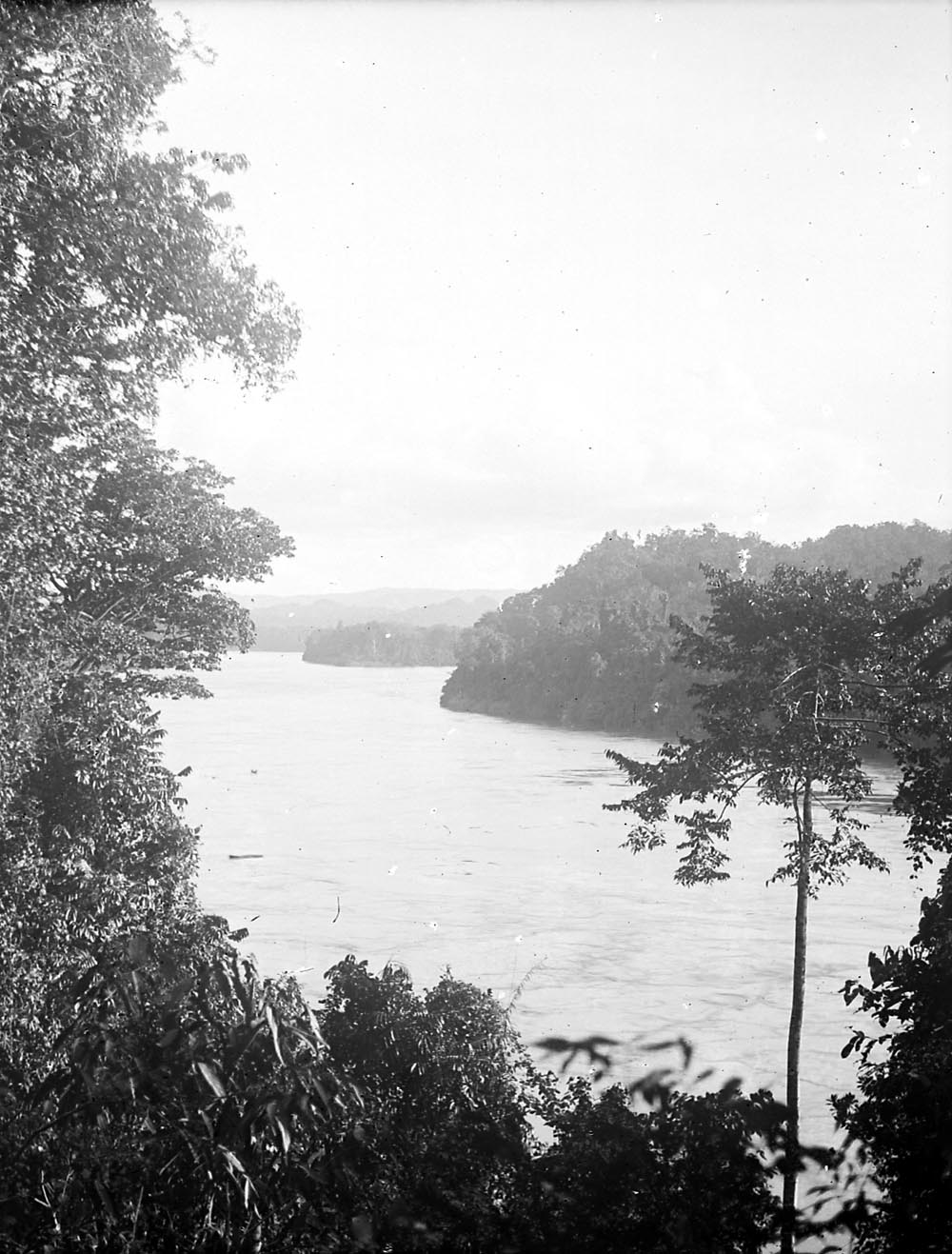
The bend in Mamberamo river near Pionierbivak

The main bivouac - called Pionierbivak (Pioneer Bivouac) - was situated along a strategic bend in the river. From the mouth of the Mamberamo it took several days to reach this place. From this "base camp" the Central New Guinea Expedition explored the dense flora and fauna of central  New Guinea. Besides, they encountered very friendly peoples near the central ridge. Not to be compared with the relentless headhunters around Merauke on the south coast!

1920
Pionierbivak in 1920 

The journey of this postcard also starts in Pionierbivak. Although philatelic in nature, I am not aware of any other postal (value) item sent from Pionierbivak, let alone an item sent from another bivouac. The expedition maintained a regular freight link across the river and sea with Manokwari. The card was sent by the expedition's zoologist, Dr. W.C. van Heurn. W.C. van Heurn (1887-1972) was of noble descent and carried the title of Jonkheer (comparable with squire in English). His younger brother had studied zoology as well and was active in the Sultanate of Deli on Sumatra. W.C. van Heurn has been described by the famous biologist and author Stephen Gould as a "taxonomist's taxonomist". Van Heurn was a keen collector (and hoarder) of 'ordinary' (i.e. not rare) species such as the European Mole and Grove Snail. The Dutch Museum of Natural Science - Naturalis - still houses Van Heurn's collection in a wide variety of jars. Specialists often discovered new species in Van Heurn's diverse collection and no less than 38 species has been named after our author. 

Some members of the Central New Guinea Expedition in front of a shelter (possibly in Pionierbivak): Standing from left to right: zoologist W.C. van Heurn, Lieutenant J. Kooy, Lieutenant Drost, Botanist H.J. Lam; Sitting: Medical Officer H.J.T. Bijlmer and Controleur J. Jongejans.

The addressee was a Frenchman who often asked Van Heurn to send him cards. The postcard was probably written in early December 1920 but was not postmarked in Manokwari until  (1) 4 (?) January 1921. Upon arrival in France in March (?) 1921, the postcard was forwarded to Rome. 
Nieuw-Guinea
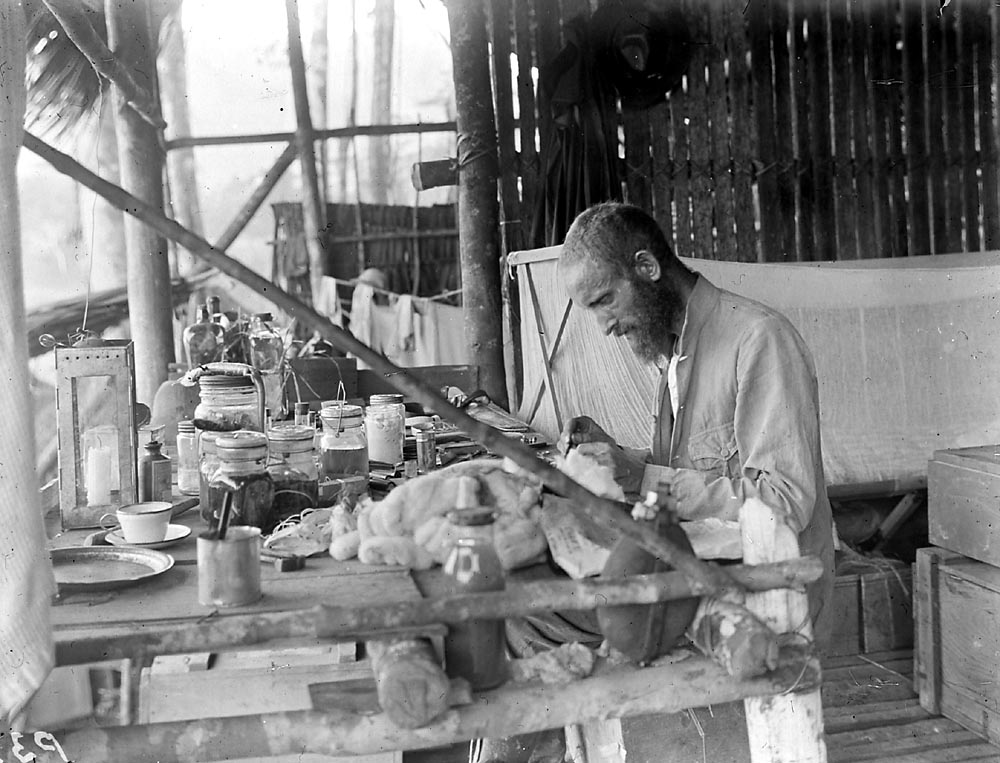
The zoologist and writer of the postcard - W.C. van Heurn. This photograph was taken inside his hut in Pionierbivak. He probably wrote this very postcard at this desk.


Postcard
The reverse side of the postcard with written 'Pionier-bivak' and Dec. 1920. The rather formal message was written in French. 

1st update: 7th of April 2021 - new photo, text additions Van Heurn

Saturday, 30 May 2020

Catching the 19:58 train from Hoogkarspel


Hoogkarspel
1940 express delivery cover which was sent from Hoogkarspel to The Hague by semi-private
 train mail. Rate: 10c (letter over 20 g) + 10c express delivery fee + 10c railway fee.  

In 1924 the Dutch postal service (P.T.T.) came to an agreement with the railways which allowed any railway company who signed up to this agreement to run their own station to station express delivery service. This new semi-private postal service had speed and its regular time-table as a big advantage over the ordinary mail system. Especially small railway towns and villages which used to see a once-a-day collection profited from this service. Initially the agreement between the P.T.T. and the railways was limited to express delivery only. From 15 May 1927 onwards however ordinary postcards and letters were allowed as well.

Hoogkarspel stempel
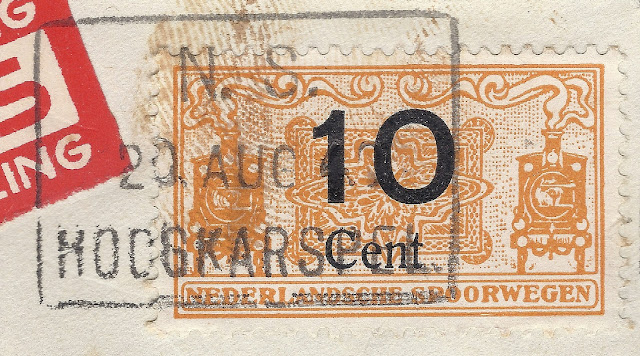
10c railway stamp cancelled by a boxed N.S. Hoogkarspel railway postmark. To this day (May 2020) there doesn't exist a compendium or even a list of these boxed railway hand stamps (bagagebureaustempel).   

Of course the railways charged a fee to finance their new service. Customers had to buy a 10c railway stamp at the station on top of the ordinary (express) letter rate. The cover would be handed over to a railway clerk at the luggage office who would take care of the right train and who would give instructions to the conductor: where the piece should change trains etc. At the station closest to the destination the item would be handed over to the P.T.T. for the final leg. 

Hoogkarspel postzegel
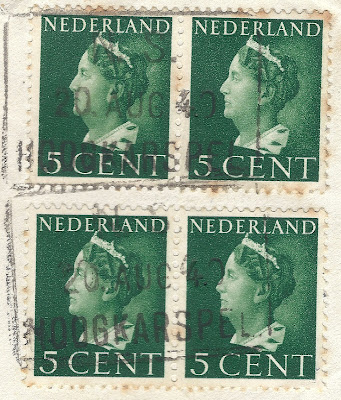
4x 5c green Wilhelmina Van Konijnenburg 

The cover which serves as illustration to this blog was picked up by the N.S. at Hoogkarspel and travelled with train 374 (blue pencil mark) which departed at 19:58 that evening (20-8-1940). Although the Dutch queen and cabinet sought refuge in the U.K. after the Germans invaded the Netherlands in May of that year, people still used stamps with her portrait. Reichskommisar Seyss-Inquart declared them invalid however on 10-10-1940. The P.T.T. stamps and the additional 10c railway stamp were cancelled by a boxed N.S. Hoogkarspel railway hand stamp. The express delivery was highlighted by the red Exprès label (type 37 L). Unfortunately the cover didn't make it to The Hague the same day. The arrival date stamp on the reverse makes clear that the item reached the capital on Wednesday 21-8-1940 between 9 and 10 AM.

Hoogkarspel station
The old railway station of Hoogkarspel. Sadly this station was replaced in 1965.

Sunday, 24 May 2020

12 Flying Doves from Opperdoes

Envelope from Opperdoes to Höör in Sweden sent on the 16th of March 1937 and franked with 12 Leabeau Flying Doves!  

I found this little gem in a philatelic webshop of which I thought that I had picked out the West Frisia items long ago. Apparently my previous searches didn't involve the the small village of 'Opperdoes'. 

Opperdoes is located just west of the city of Medemblik and is famous for its tasty potato- the so-called 'Opperdoezer Ronde'. In the 11th century the village was called 'Those' or 'Thosa' and later as 'Dosa' which refer to the mossy and moorlike ground. The prefix of 'Opper' (upper) was added later to mark the possible distinction between a 'upper' and 'lower' Does.

1935 map with Opperdoes in its centre and to its northeast the city of Medemblik.

Between 1887 and 1941 the village was served by a train. To this date the railway line has survived intact since it functions as a tourist steam railway nowadays.

The very Dutch sounding family names in the address (Leyden and Molenaar) made me wonder who moved to Höör (Sweden) in the 1920s or 1930s. The sender - a certain Mrs Blokker - didn't rang a bell. Besides, the names of Molenaar and Blokker sounds very catholic whilst Opperdoes was (and still is) a village with a very big majority of protestant inhabitants. So I did a small search online...

Announcement of engagement of  Cath. M. Molenaar of Twisk
 and Hjalmar Leyden of Höör Sweden. Schager Courant 29-7-1935   

Apparently Mrs Molenaar-Leyden was married to a Swedish man called Leyden! This man - Hjalmar Leyden - must have had Dutch ancestors since I don't think the name of Leyden originated in Sweden itself... They married in 1935 or 1936. I found another mention of Mrs Molenaar-Leyden in the same newspaper. She left for Sweden in September 1936:

People left: "... Molenaar, Catharina M., to Sweden, Höör"
Schager Courant 10-9-1936

What intrigues me the most about this envelope on a philatelic level is the excessive use of the 1c carmine/red (NVPH 170). The rate for a 20g envelope to Sweden in 1937 was fl. 0,12½ - so the cover was franked correctly. It might have something to do with another rate change in early 1937 - making the 1c red almost redundant. The simplest and most likely option though would be that Mrs Bakker couldn't find a 12½c stamp and used all her Flying Doves. A smart thing she did because this large unit of 1c stamps makes the cover very attractive - even when taking the annoying filing crease into consideration.

8x the 1927 1c carmine/red Lebeau 'Flying Dove' type tied by Opperdoes CDS


Location of Opperdoes (red arrow) in West Frisia and Holland

Sunday, 3 May 2020

Services rendered - Waterloo again

Letter sent to the Chancellor of the Military Order of William located in the Hague on the 12th of May 1832. A circular Amsterdam postmark in red has been used to date stamp the piece 


Pandemic or War?


When you're keeping up with the news on TV or read the papers the last couple of weeks I’m often left wondering if we are about to enter a new dawn of humanity or if we will rather see the end of it. The new corona virus COVID-19 has paralyzed the globalized world of which we’ve grown so fond in the last decades. The virus makes us feel vulnerable and small again. At least, that’s what I deduce from all the live coverage of the onslaught and the prospects of a global economic crisis which will dwarf the 1930s Depression. Yet, at the same time this absolute shelling of fearsome facts feels a bit obsolete. Out of all threats, a virus which attacks the homo sapiens is probably our most predictable enemy in our digital age. Although invisible and absolutely terrifying in the weeks after its first appearance, research and plain facts are already perfectly able to model and compute the growth rate, fatality rate, contamination rate etc.  An enemy which behaves itself as your most humble servant. An enemy which nevertheless increases exponentially when we take not enough heed. A difficult situation for sure but one which we could easily overcome by following simple rules and staying focused. If you think this COVID-19 pandemic is awful (fatality rate = < 1%) you should not even contemplate comparing it with the devastation destruction and randomness of war. The letter which I will discuss today reminds us of one. 

Contents of the letter (page I)

Begging letter


I stumbled upon a rather elegantly written letter which dates from 1832. I was intrigued by the almost calligraphic writing a couple of months ago but found it difficult to fold it open because of its unusual folding. Of course, the last thing I wanted was to ruin the paper. A week ago though the letter caught my attention again and this time I just had to open it. Its contents were rather cheerless. 

~

[in zwarte inkt] ? den 13 mei 1832 N28144

[in potlood] aan dit verzoek zal op de voorgestelde wijze niet kunnen worden voldaan


Amsterdam den 6e Mei 1832

Zijn Exellentie !


In afwachting dat UED mijn verzoek niet van de hand zal wijze zoo neeme ik de vrijheid mij langs dezen weg tot UED te begeven om de volgende reden namelijk! Ik ben door een zware ziekte in de behoefte van geld geraakt Alzoo heeft iemand mij zoo gunstig geweest om mij te helpen met ƒ34 waarvoor ik hem dan mij acte van Ridders Pensioen in pand moest geven ervoor [?] 5 centen van de gelden maar toen ik nu met dit laatste kwartaal kwam om te tekenen heeft diezelfde persoon de onheusheid gehad mijne acte aan een ander te verpanden en kan dus geen geld ontvangen dit is dan ook de reden als dat mijn acte de vita niet behoorlijkertijd daar is. In de hoop als dat UED mij na zoo goedgunstig belieft te zijn om mij een klein bewijs over te zenden opdat ik dan zelf persoonlijk zulks aan den weledele Bicker kan vertoonen om mij zelven te betalen dan blijf ik UED ten hoogsten verpligt en zal met die persoon een overeenkomst zien te treffen op een zegeltje om hem dan alle vierendeels jaars een zeker gedeelte van mijn pensioen aftestaan om niet mijn schuld te geraken en dan zoodan mijne acte terug te krijgen. 

In afwachting dat UED mij hierin als het u belieft wel zal te gemackd kom [?]

Zoo blijf ik met alle onderdanigheid

UED DW Dienaar

P. Lasance

~

[in black ink] ? 13 May 1832 N28144

[in pencil] 
this request cannot be complied with in the proposed manner

His Excellency !

Pending my request which I hope Your Right Honourable won’t deny, I take the opportunity to address Your Right Honourable because of the following matter. Due to a severe illness I’m in the need of money. Somebody was so kind to help me with a sum of ƒ34 for which I had to put my Soldiers Pension as collateral. However, in this last quarter, when I returned to this person to sign, it came to light he unfairly put my pension as collateral for another person which makes it impossible to receive any money. This is the reason why my certificate of life cannot duly arrive on time. Pending my hope that Your Right Honourable will send me some evidence after you have proven to be so auspicious, so that I can personally prove Mr Bicker to pay me, I will remain indebted to Your Right Honourable. I will try to reach an agreement with this person to cede him a certain part of my pension every quarter in order not to be in debt and to return my act. 

Pending that your honorable if you please will accommodate in this matter

I remain forever in your service, 


Your Right Honourable devoted servant

P. Lasance
~


Source of philatelic material


I've warned you: the contents picture a rather sobering message. Especially the apparent denial of the request (in pencil) made me feel sorry. Before we return to P. Lasance, I've to speak about prephilately first. How could historical documents end up in private collections? 

The academic approach to philately can only exist by plenty of material available for research. When looking for items which were sent pre-1900, you’ll come to realize that the material often originates from old archives (ranging from personal family documents to big firm archives). Sometimes these archives have been plundered for the sake of the philatelists – with hindsight a rather disgusting ‘side-effect' of the increasing popularity of the hobby –, but in most cases the material was acquired by dealers or auctions houses because the firm filed for bankruptcy or an archive would have to get rid of it anyway. In the latter case the archive deemed certain papers of insufficient interest to preserve for future generations. When interest in philately developed probably 100.000s of folded letters (or address sheets only) were saved and ended up in private hands. 

I think that this particular letter originates from a cleared archive. Somebody went through the files of the Kanselarij der Militaire Willemsorde (Military Order of William) because I could find dozens of other similar items online for sale: all addressed to general Janssens who functioned as chancellor of the order between its establishment in 1815 and his death in 1838. 

Contents of the letter (page II)

The life of P. Las(s)ance 


The poor bloke who wrote this letter had fallen gravely ill and is begging for a document which was denied by the chancellor of this Military Order of William. I took me some moments to realize that the man really hoped, begged almost, that his request which he had so carefully wrote, folded and sealed the letter would be honoured. It might have been his last resort. 

I already imagined how an old man, probably crippled at the time of writing, would spend his last days on this earth hoping for a miracle to happen since some rude person had taken advantage of his soldiers pension. Soldiers pension? Slowly some pieces of the jigsaw came together. P. Lasance was apparently entitled to be paid a soldiers pension and he asked the chancellor of some prestigious Dutch order for a certificate of life. He most certainly must have been a knight then. 

So I started my search. The Military Order of William was established by king Willem I in 1815 after the battles of Quatre-Bras and Waterloo. The sole recipients of the decoration (4 ranks) fought in these battles. When P. Lasance begged for proof of his identity the year was 1832. Until that time the order had only been rewarded to generals, corporals, soldiers and so forth who fought in the Waterloo campaign and in a now almost completely forgotten colonial war on Java (Java war 1825-1830). This letter was therefore likely to have been written by a Waterloo veteran! What a find! 

Register entry of P. Lassance
Next stop was the website of the Dutch Ministry of Defence. I knew that they maintained a databank in which you could browse through all decorated soldiers of the Netherlands. I typed Lasance – no results. I typed La sance – no results. I typed La Saints – no results. You can imagine that I started to panic now – what if this bloke just tried to fool the chancellor? – based on the denied request this possibility looked more likely by the second. 

I tried several more combinations of letters – Lassance did it. What a relief. But what a sobering message – again. 


P. Lassance Military Order of William 4th Class Awarded on the 17th of August 1815 on grounds of services rendered in the Battle of Waterloo the 18th of June 1815 in his function as fusilier of the Infantry Battalion of the 13th line.

Birth: 1797
Death: April 10 1833


Less than a year after P. Lassance had his request denied he died. Even in 1833 it was quite uncommon that men died in their 30s after having survived childhood and in Lassance’s case even a terrible battle. I haven’t found details whether he died of the disease he wrote about in his letter or something else. No single file in the Amsterdam archives seems to refer to this particular P. Lassance (or Lasance), but I would like to be proven wrong someday. 


Back of the cover with an incomplete strike of the  circular 's-Gravenhage arrival mark. 

Waterloo


Apart from his last troublesome months and his year of birth we know nothing about P. Lassance other than his apparently remarkable services in the Battle of Waterloo. 30.000 Dutchmen fought there but only 1004 knighthoods were awarded. Alas the register doesn’t mention which remarkable feat led him to be decorated. His fought as a foot soldier in the 13th line (637 men) of the 2nd Brigade of the Netherlands 3rd division under command of general baron Chassé. His interventions at Waterloo came at a pivotal moment when Napoleon sent his imperial guard to attack British troops stationed in front of Chassé. Because Chassé acted quickly with a strong counterattack in response (1st brigade under command of colonel Detmers) Napoleons actions were rendered futile at this particular point in the battle. The coalition held their line. Unfortunately I haven’t found any details on the activities of the 2nd Brigade in which Lassance fought. The 13th line most likely supported the 1st Brigade which stood in the line of fire.

General D.H. Chassé portrayed by Jan Willem Pieneman in
1832 wearing his decorations of the Military Order of William

Click here to read more about the Battle of Waterloo.   

Sunday, 1 March 2020

Parcel label to Montenegro retrouvé

Pakketkaart naar Montenegro
Dutch parcel card attached to a can of butter sent to the Grand Hotel in Cetinje in May 1913.The parcel card is franked with 1x 1g and 1x 25c Wilhelmina Fur collar stamps. This was the correct rate for 1 parcel weighing up to 5 kg. For a single parcel/package weighing 2-5 kg to Montenegro you would have to pay ƒ1.25g between 1904 and 1914.  

In a previous post I described a Dutch parcel label which was sent to Montenegro in late 1913. Since Dutch parcel labels to odd destinations during this period remain scarce, I surely didn't expect that the piece above would turn up. I couldn't believe my eyes at first! Obviously, I had to buy the item to add to my growing collection of Dutch parcel labels sorted on destination.

It's highly likely more parcel labels to Montengro survived, since I guess the archives of the Montenegrin Post were sold/stolen at some moment in time. Parcel labels were (meant to be) stored by postal service after they had delivered the actual package(s).

The other parcel label in my collection is a bit more spectacular, as three packages were involved instead of one. Nevertheless, the one above is in a better shape as it is still complete (the coupon strip wasn't cut from the piece) and it looks 'cleaner' than the one below. Please compare the two items yourself.

Pakketkaart Montenegro
Dutch parcel card attached to three packages sent to Cetinje in November 1913, then the capital of Montenegro. The parcel card is franked with 3 x 1g, 50c and 25c Wilhelmina Fur collar. This was the correct rate for 3 parcels weighing up to 5 kg. For a single parcel/package weighing  2-5 kg to Montenegro you would have to pay ƒ1.25g between 1904 and 1914. So 3x 1.25 makes the correctly applied postage of 3.75g.          

Vouko Vouletich alias Vuko Vuletic

Vouko Vouletitch
Photograph of Vuko Vuletic

The parcel is addressed to Vouko Vouletitch. I did some initial Google searches on his name, but unfortunately found nothing. I changed his name to Vouko Vouletic but still my search was in vain. Apparently this man had been lost in the maze of history: probably his name ha donly survived in some old and dusty Montenegrin census record. 

O boy, I was wrong. 

Although my attempts to trace him were useless, one Greek paper mentioned him. The article concerns the diplomatic relations between Greece and Montenegro before its disputed annexation by Serbia in 1918. Vouletitch was mentioned in this paper as a Montenegrin businessman of considerable status, since he could claim 1000K from his government. Not your ordinary salesman type, but rather a wealthy entrepreneur.     

I contacted the Montenegrin library to ask for help. Who was this mysterious man? Within a day they replied by sending my a link to a report (in Serbian nonetheless), but they spelled his name as Vuko Vuletic. This spelling changed my search totally.

When googling on Vuko Vuletic you'll find that this man was in charge of the restaurant in the Lokanda Hotel. This was the first hotel to be established in Cetinje and therefore the sender probably referred to it as the 'Grand Hotel'. Mr Vuletic was head of the kitchen there since 1892. The hotel itself could accommodate 100 guests and services were provided in 6 languages (including English!). A severe earthquake ruined the historical building in 1979 upon which it was demolished. The hotel featured on a recent Montenegrin stamp (see below).

Montenegro stamp
''150 years hotel Lokanda in Cetinje" - Montenegrin stamp issued in 2014
To be continued...

Monday, 10 February 2020

Dutch field post from the Waterloo campaign


Quatre-bras, Napoleon
15-6-1815 Brain-le-Comte Field post entire with the very scarce postmark Genaal = Postkantoor te Velde written by Otto van Limburg Stirum, who served as aide-de-camp to Prince Willem of Orange during the Waterloo Campaign 

Throughout the Waterloo campaign of 1815 the allied forces maintained a semi-regular field post system in order to communicate efficiently with each other and the anxious home front. The prospect of Napoleon invading his lost territories (including The Low Countries), defeating Wellington and subsequently consolidating his rule in France sent shivers down the spines of many allied generals and the populace. A certain defeat of Napoleon couldn't be taken for granted.

Napoleon's return
Napoleon's return from Elba by Charles Auguste Guillaume Steuben 1818

Before we scrutinize the letter, we should embed its contents into the situation at the time. Napoleon returned from his exile on the small Italian isle of Elba on the 26th of February 1815 with a small personal guard of 600 men. On the 1st of March he reached France and he immediately marched on Paris. By that time the king of France, the unpopular Louis XVIII, still deemed it possible to stop him in his tracks. On the 14th of March however one of Louis’ generals, Michel Ney, joined his former emperor with 6000 men. Several days later Napoleon entered Paris and Louis had fled to Ghent.

PEP M360
The extremely rare Genaal = Postkantoor te Velde postmark which was used between May and June 1815 during the Waterloo Campaign. Only 4 examples are known to exist (PEPII p. 456).  

In the months before June the 15th both Napoleon and the allied forces mobilised for war. Eventually Napoleon succeeded in raising over 200,000 soldiers which formed his l’Armée du Nord. During the congress of Vienna the allied forced declared Napoleon an outlaw and subsequently the Seventh Coalition was formed to defeat him. Initially they thought they could invade France before Napoleon would even dare to start with any hostilities. They were wrong. In the early hours of June 15th Napoleon’s l’Armée du Nord crossed the river Sambre at Charleroi – the very day our letter was written.

Otto van Limburg Stirum (1789-1851) wrote this letter in 2 parts on the day the French commenced their hostilities. As one of the personal aide-de-camps to Prince Willem of the Netherlands, he reports his personal thoughts about the situation to his father Leopold. Leopold resided in Amsterdam at the time and had close contacts to King Willem I. He was part of the famous triumvirate which returned the banished Stadtholder-heir to the Netherlands after the withdrawal of French troops from the Low Countries in the 2nd part of 1813. Prince Willem the VI was proclaimed King Willem I of the Netherlands in November of 1813.

To reinforce the close bond between Leopold and King Willem, the king made Leopold’s son Otto aide-de-camp to his son Willem (who later became king Willem II) during the Waterloo campaign.

Because of his close ties to the Prince of Orange, Otto gives us first-hand insights into the very day Napoleon rushed into Belgium. He states that Napoleon, Jérôme and Murat have camped at Fontaine-l’Évêque near Charleroi, but that Le Prince (Prince of Orange) and the Duke of Wellington are still at a ball in Brussels. If the situation would worsen though he estimates that his Prince would return as soon as possible. He also ponders about military tactics which could be used, e.g. general Hill should replace the Dutch detachment in order to combat the French. A rather strange passage appears near the end of the actual letter: Otto seems to warn his father not to enrage the prince (Mais surtout gardez vous je vous prie de dire que vous tenez quelque chose de moi le Prince serait furieux). To be explained by an earlier letter between the two?

Napoleon, battle of Waterloo,
Detail of the letter 

In a postscript written that evening, Otto shares the latest information with his father. He appears to be a bit pessimistic about their chances. The Prince hasn't returned from Brussels yet and a French paper confirms the report that Napoleon and his army are making progress. According to the paper the last sighting of his l’Armée du Nord was done at Valenciennes, but the Allied Force knew that the French were at Charleroi already. Otto ends the letter by saying that it would probably take a while before they would see each other again.

The day after Otto wrote this historical document, he was severely injured during the battle of Quatre-Bras. The French troops misidentified him for the Prince of Orange due to his young age. They allegedly said: “tuons-le, c'est le Prince!”. He was left for dead on the battlefield but eventually recovered from his wounds.

Otto van Limburg Stirum (1789-1851)

On the 18th of June the Allied Force defeated Napoleon at Waterloo.

In summary: this field post entire with a clear strike of the very rare Genaal = Postkantoor te Velde mark gives us a concise, but detailed and unique insight into the very upper levels of the Waterloo military campaign.

This letter will figure in Corinphila's April 2020 (Auction 244)


Transcript of the letter - by G. Vink


Braine le Comte le 15 juin 1815

Je m’emporte mon cher Père a vous communiquer en hate qu’en le moment le Prince vient de recevoir la nouvelle que les français ont commencés les hostilités du cote de CharleRoi. A Fontaine l’Eveque  Napoléon,  Jérome & Murat sont à l’armée.

Les Prussiens qui occupant la ligne celon l’ordre qu’ils en avoient prennent position dessus la Sambre. Sur le fameux champ de bataille de Fleurus bientôt prépare on va s’engage sérieusement, je ne doute pas on nous allons faire un mouvement, parfois nous illustrons ce fameux champ par une 3eme bataille a y [...]  de manière a le pousse jusqu’a Laon.

Le P[rince] qui a fait 18 heures ce matin est encore allé a Bruxelles, parler au Duc de Wellington. S’il y a quelque chose de sérieux, il reviendre encore ce soir, nous languissons tous de le voir rentrer d’après mon idée nous devrons être remplacés ici par le 2ond Corps du General Hill, pour pouvoir faire un mouvement vers la gauche a tomber les français dans le flanc s’ils osent s’aventurer s’il y a quelque chose de nouveau demain a que je puisse vous écrire je le serai.

Mais surtout gardez vous je vous prie de dire que vous tenez quelque chose de moi le Prince serait furieux. Adieu mon cher Père parfois vous apprendre quelque chose de moi par les Papiers ayez …. de rassurer ma femme s’il engage quelque chose de sérieux. Adieu je vous embrace tous tendrement a m dis votre fils affectionné

Othon

Le Soir P.S. Nos espérances sont plus ou moins réduit en fermé, le Prince ne revient p. Bruxelles, mais il a envoyé l’ordre de faire rentrer les trouppes dans leur cantonnements d’ou ils étaient sortés pour ressembler les brigades croyant que demain il y aurent quelque chose a faire. –
Les Papiers français que nous venons et voir affirment le départ de Nap: de Paris, et la marche de ses Corps d’Armée sur Charleville, Maubeuge et Valenciennes; Il me semble cependant que nous ne pouvons pas tandis de nous voir bientôt de près

Sunday, 2 February 2020

Moll and Levius - Dutch-Indies to Bratislava 1938

Toelangan 1938
Partially opened registered cover which was sent from Toelangan (Dutch Indies) to Bratislava on the 15th of November 1938. The Registered Fee to other countries apart from the Netherlands and colonies was 20c at that time. Add up the 15c rate to European countries and you're at 35c. Than you're still left with an extra 12c, so I guess that this is the additional Airmail Fee, although I'm not entirely sure about it. According to my resources the Airmail fee was 30c in 1938...  Nevertheless, it seems to me that all the 4 values of the Queen Wilhelmina Ruby Jubilee series of 1938 were correctly used to make up the rate to Bratislava. So this implies a non-philatelic franking!

In 1938 postal services between the Dutch Indies and other countries worldwide were already firmly established. Due to the increased volume of airmail and the introduction of telephone and radio the Indies seemed not longer 'out of reach' or on another planet in the latter half of the 1930s. Still, Queen Wilhelmina never visited her colony and governance remained very bureaucratic and rigid.

Prague cds
Reverse of the cover with 2 cds Prague transit machine cancellations  

The sender of the cover - Cornelis Lodewijk Moll - worked at SF. Kremboong. I discovered he was known as '1e Geëmpl." A chic name for an employee high up in the ranks of a factory. SF. Kremboong made sugar (SF stands for Suikerfabriek, Sugar Factory) and continues to exist as PG Krembung nowadays. When browsing through Google Streetview it seems to me nothing really has changed since the Dutch left in the 1940s. Many of the older architecture, infrastructure etc. still appear to be in use as of today!

SF Kremboong which is now known as PG Krembung. 

I couldn't find anything on Mr Moll by using Google of even the Dutch digital newspaper archives (Delpher.nl). The only time a 'C.L. Moll' pops up was in the obituary below.

Obituary of A.M. van Hamel 17-10-1925. She was the mother in law of C.L. Moll. 

Update 22-2-2020: "Mr Cornelis Lodewijk Moll was born on 28 March 1893 in Utrecht. He married Suzanna Antoinette van Hamel on 24 November 1921 in Haarlem. Suzanna was born on 22 August 1888 in Haarlem. Cornelis was a widower when he married Suzanna, and his profession is listed on his wedding certificate as ‘administrator’ (Suzanna had no profession)." All credits to Ben Jansen!

Still, Cornelis Moll remains a bit of a mystery person. But when compared to the addressee, we could state we almost knew him personally. I found nothing on the addressee. This Arpad Levius lived at the Fochgasse in Bratislava but I'm afraid he didn't survive WOII because of his Jewish sounding surname. Every combination of Arpad (not your ordinary first name) and Levius makes no sense when I put them in Google. This makes the relation between him and C.L. Moll difficult to interpret. Mr Levius might have been a customer of some sort - though Google gives me no clue if Levius or the Arpad family were merchants. Moreover, Moll addressed the letter to him personally, not using any company name etc.

Tulangan registration label
Toelangan registration label and 'Long Beam' cds reading 15.11.38.8-9 V meaning the cover was sent between 8 and 9 a.m.
Prague transit postmark

Whatever their relation has been like, the cover itself is quite a gem - albeit an incomplete entire. The destination is odd (Bratislava only had approx. 140.000 inhabitants in 1939) as is the franking. The registration label might be quite scarce as well, although Toelangan was located on the important east-west Java railway and the big city of Soerabaja lied in close proximity of SF. Kremboong. I hope that the relation between Moll and Levius will become clear one day though - even if Levius only turns out to have been an avid Dutch Indies stamp collector!

Wednesday, 8 January 2020

Porcelain Warehouse in Medemblik

Postcard sent from Medemblik to Amsterdam on the 27th of July 1900. The 2½c Vürtheim stamp has been tied by an unclear 'Large Round' cds. The card left Medemblik in early morning (12-6V) and arrived in Amsterdam between 20:00 and 21:00.  


Porcelain Store
'Warehouse of Porcelain, glass and pottery A. Langereis in Medemblik'.

Sunday, 22 December 2019

Dairy plant 'De Volharding' in Hem

zuivelfabriek
Company envelope sent from Hem on the 6th of November 1949 

The small village of Hem in the southern part of West Frisia established its own dairy plant in the early 1900s to streamline the condition of making cheese and other dairy products in the Zuiderkogge Polder. Farmers who supplied the plant with milk had each their share in the products and profit. The 'Coöp'. abbreviation stands for 'cooperation'. 

Hem fabriek
Dairy plant 'De Volharding' in Hem after it operations  in the 1960s. 

Volharding can be translated as 'perseverance'. The postwar building and especially its chimney still dominate the skyline of Hem in 2019. 

Hem Venhuizen
Juliana 'En Face' tied by a Hem (Noord-Holl.) 'Long Beam' postmark reading 6.XI.49.6.


Hem Venhuizen 1950
Hem and surrounding villages and countryside in the 1950s. The red arrow points to the location of the dairy plant.  

Sunday, 15 December 2019

1952 Child Welfare Fund

Kinderpostzegels
Order Postcard (bestelkaart) franked with a 1952 Child Welfare Fund 2c + 3c tied by a so-called 'Short Beam' Hoogkarspel cds 13-IV-5n 1953. Posted at 5pm on the 13th of April that year.

Verso of the order card

The 1952 Child Welfare Fund stamps were designed by Ms Janzen-Dalenoord. She produced 5 different designs for 5 different values. 

Wednesday, 20 November 2019

1864 issue tied by Hoog-carspel straight-line mark on cover - a stunning discovery!

Hoogkarspel Hoorn France postmark
Folded letter from Hoogkarspel to Tourcoing (France) 28-12-1866 franked by two Willem III 5c stamps (1864 issue) both tied by a HOOG-CARSPEL straight-line mark. The letter was sent to France but the sender/postal clerk put insufficient stamps on the item for a letter of this weight (up to 7½ grams). I suspect a sample of seed was included but not charged... If the sample would have been charged a letter up to 7½ grams to France in 1866 meant that 30c should have been put on the letter. The French Post taxed 12 decimes (120 centimes) which the recipient had to pay (60 Dutch cents (2x the original 30c rate)). The exchange rate Franc-Guilder was about 1:½ in 1866. The French post had already been warned by two Dutch ONTOEREIKEND (insufficient) marks in both black and red. Another mistake was certainly made by the postal clerk at Hoogkarspel, since the stamps shouldn't been cancelled by the HOOG-CARSPEL straight-line mark at all as the letter was sent to a destination located outside the rayon of Hoorn (franked letters sent within the Hoorn district were allowed to be cancelled by local straight-line marks). In Hoorn they corrected the mistake by placing two Boxed Franco cancellations over the stamps. Bureaucracy at its finest. A proper gem. 

Yesterday I came across this item by chance. By the kind permission of its owner I'm allowed to use several scans of it to demonstrate a rare - maybe even unique - item in West-Frisian philately.

Years of searching finally came to an end yesterday, when this letter surfaced. Since I live in Hoogkarspel, finding an item cancelled by one of Hoogkarspel's straight-line markers (either Hoog-carspel or Hoogcarspel) topped my search lists on Ebay and Delcampe for years. But due to the small and largely illiterate population of Hoogkarspel in the 3rd quarter of the 19th century (a dozen persons?) I had already given up hope of ever finding such an item. And now this letter crossed my path by pure chance! And what a gem it is.


Hoogkarspel
Reverse with transit postmark Lille 29 DEC 66 and faint arrival mark Tourcoing 30 DEC 66  

Hoogkarspel was upgraded to a sub-post office in 1866 and the Hoog-carspel postmark had been delivered on the 28th of June that year - just 6 months prior to the date on which the cover was sent. Maybe this novelty in the village caused the postal clerk to accidentally cancel the stamps... How many franked letters would have been sent with a destination outside the rayon of Hoorn since the introduction of the Hoog-carspel postmark only a couple of months earlier. A dozen again? We don't know, but it's properly rare.

Hoog-carspel postmark
1864 issue (Utrecht printing) with HOOG-CARSPEL straight-line cancel. 

Apart from very early use of this straight-line postmark, the stamps on the cover also gave me a little shock. The 1864 issue were to be replaced by a totally new design the next year. The stock of the blue 1864 5c stamps would have dried up soon - even in a small village like Hoogkarspel - after they stopped printing them. So the combination of the Hoog-carspel mark on this issue and this stamp in particular could have only been possible for a few months to one year at most... Extraordinary that this entire survived! I just cannot imagine there would have been sent over a 100 franked letters from Hoogkarspel in 1866-1867 cancelled by the Hoog-carspel mark. Moreover, they all should have been addressed to people/businesses within the Hoorn district, if not the mark should have been placed on the letter instead. So this mistake or happy accident was probably already unique in 1866. I repeat: extraordinary that this item survived all these 153 years largely unscratched. Extraordinary it turned up.

From mayor of Hoogkarspel to representative in The Hague


Letter written by Klaas Harshoorn de Jong. Transcription:

                                                                                                                    Hoog carspel, ce 28 Dec. 1866
                               Monsieur J Toulemonde
                                        à Tourcoing


                               Après un absence de quelques semaines, j'ai trouvé votre honoré [?] des 19 de l'écoulé.
                               Selon votre desire je vous envoie un Prix courant des graines de notre pays. Moi je fais le commerce de                                                                             Carvis et Moutarde brun tandisque c'est un des mes cousins qui cultive  tous les autres graines. 
                               Je serai bien heureux si vous pouviez me donner des ordres.
                                     En attendant le plaisir de vous lire Agnecy [?] Monsieur mes salutations sincères.

                                                                                                                   K. H. de Jong

Klaas Harshoorn de Jong (1815-1866) was born in the so-called Medemblikker Tolhuis on the 14th of December 1815. This toll house had been constructed in 1729 on the new junction of the old paved road between Hoorn and Enkhuizen (Streekweg) and the newly built Tolweg to Medemblik. Napoleon travelled to Medemblik over this road 4 years prior to De Jong's birth. His father Melchert farmed several pastures in Hoogkarspel and was innkeeper of the toll house. After having finished school Klaas de Jong became wholesaler and merchant in cheese, wine and liquor in Hoorn which he combined with his occupation as farmer and agriculturalist in Hoogkarspel. Besides this already busy lifestyle for a person in the early 1800s he trained himself to become a teacher. A remarkable person!

Map Hoogkarspel
Contemporary map of Hoogkarspel and surroundings which dates from ca. 1864. In the red balloon you could just read Medemblikker Tol. The red arrow points to the location of the Medemblik Toll House and the blue arrow to the Church and Ons Huis of Hoogkarspel.


Map West-Frisia
Location of Hoogkarspel in West Frisia in 1866 

Klaas also aspired a political career in later life which culminated in his function as representative of the Hoorn District between 1871 and 1884 and again between 1884 until his death in 1886. Before this he had been local council member of the Hoogkarspel municipality and he even served as mayor of Hoogkarspel between 1859 until his death. Apparently he had established himself as a popular political figure in the 3rd quarter of the 19th century and in the light of his various additional functions (Poldermeester, i.e. chair of a the Grootslag polder water board; church warden of the Dutch reformed church of Hoogkarspel; agricultural consultant to the Dutch Lower House etc. etc.) on may conclude Klaas Harshoorn de Jong certainly thrived as public man.

Painting Dutch 1855 Vorderman
Klaas Harshoorn de Jong and (I suppose) his second wife Ietske Rodenburg with his children (f.l.t.r. Aaltje, Grietje and Melchert de Jong). Klaas' first wife Elisabeth Pool died after Grietje was born in 1848. I assume the little girl holding Ietske's hand is a child of a previous marriage of her... The painting dates from 1855 and was allegedly painted by H. Vorderman. All rights reserved Het Westfries Museum Hoorn.      
  
On the painting above you can see the old reformed church of Hoogkarspel through the window. Klaas convinced the church board of replacing this medieval church by a new one in 1860. Above his sons head you could see a fictional (?) painting of 'Ons Huis' (Our House). Klaas thrived as business man as well and his earning allowed him to construct this large and modern mayor's residence/wine storage right beside the old church. After Klaas died in 1886 (he survived all his 3 wives) his house was subsequently owned by Klaas Koster, his son-in-law who was a merchant in wine too. He sold the building in 1903 to 't Nut (Society for Public Welfare) for fl. 5000,- The specific purpose of t' Nut in Hoogkarspel was to educate the villagers in things culturally and several rooms were used to exhibit photo's, moving images etc. Alas, Ons Huis was demolished in 1970, along with several other buildings in the center of the village to make room for a modern shopping mall, church and town hall. 

Sadly Klaas de Jong would not have been able to recognize his Hoogkarspel if he would be alive today. Not only his own house is no more: his newly constructed church was demolished in 1966 - it's said the foundations were in such a bad shape the building was beyond repair. His birthplace managed to survive until 1973 when fire ruined this historical building. Although in 1881 Medemblik had stopped levying the tolls over the Tolweg, the Toll House remained a place of community and an inn to its last days when it accommodated as snack bar. Only a few buildings which were built prior to De Jong's death in 1886 survive - most remarkable is the so-called Zonnehuis which he had commissioned in 1860 - but most of them have been replaced by modern structures, all inferior to their predecessors... Below I've attached a few photo's of the Toll House, De Jong's church and his house when they were still intact and palatable to observe. 


Hoogkarspel
Medemblikker Tolhuis (Toll House and inn) looking eastwards  around 1900-1910 - birthplace of mayor and representative Klaas Harshoorn de Jong

Hoogkarspel
Another image of the Medemblikker Tolhuis now looking westwards again between 1900-1910. The chariot right seems to have come from Medemblik over the Tolweg and is about to turn on the paved road between Hoorn and Enkhuizen. Also notice the way how the Toll House inn is described on the card: as an Hotel and Café Restaurant - brilliant. 

Dutch reformed church Hoogkarspel
Reformed Church of Hoogkarspel which replaced the older medieval church on Klaas de Jong's initiative of 1860. This Gothic Revival place of worship barely survived its centenary - it was demolished in 1966. The tree in the front - a variegated Norway maple - still exists and is probably the oldest tree of Hoogkarspel by now.   


Ons Huis (lit. Our House) where Klaas de Jong lived and had his office as merchant in wine and cheese. The name Ons Huis is coined after 1903 when the building was purchased by 't Nut (Society for Public Welfare). It was demolished in 1970.

Hoogkarspel
Another photograph of Ons Huis looking to the east which almost resembles the 'painting in the painting' of Klaas de Jong's family from 1855.  

Both the very interesting philatelic and historical value of this letter from 1866 make it a true document of note for Hoogkarspel. 

With special credits to a friendly collector and the Westfries Museum for making this blog understandable and attractive. 

Oily forwarding mystery - Delft to Port Swettenham via Babo

Newspaper wrapper sent from Delft 17-1-1938 via Pladjoe and Babo to Port Swettenham via Singapore (4-6-1938) The newspaper wrapper shown abo...